
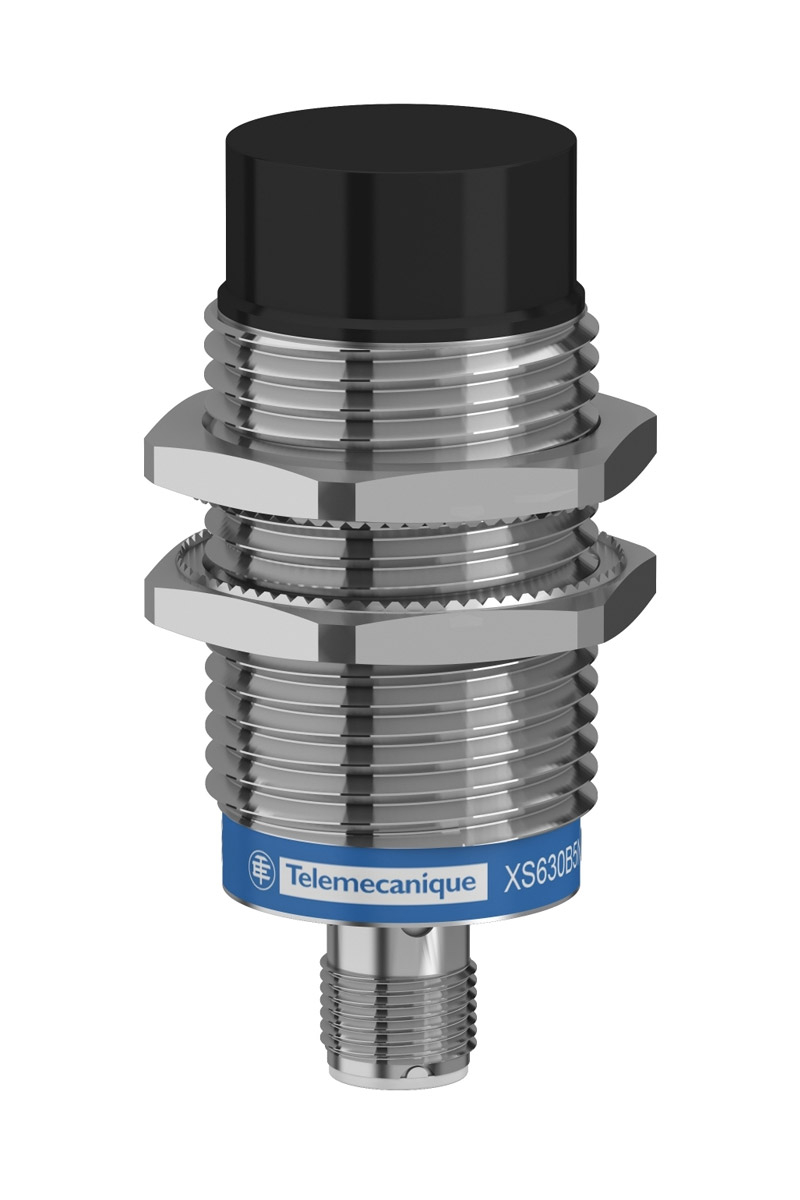
Telemecanique XS630B5PAM12 Inductive Proximity Sensor Guide
The Telemecanique XS630B5PAM12 inductive proximity sensor is a robust industrial sensor designed for accurate metallic target detection without physical contact. It belongs to the XS6 range and is commonly used in automation systems where dependable switching, mechanical strength, and fast installation are important.
This model uses a cylindrical M30 brass body with a 74 mm housing length and a nominal sensing distance of 30 mm. Its M12 connector makes it especially convenient for modular machine wiring, fast replacement, and maintenance-friendly installations.
Technical Overview
The Telemecanique XS630B5PAM12 is a 3-wire DC inductive sensor with PNP normally open output. It operates from 12 to 48 VDC and provides discrete output signaling to PLCs, control relays, I/O modules, and automation controllers. The sensor is non-flush mountable, which supports its extended 30 mm detection range.
Because it detects metal through an electromagnetic field, the sensor does not need direct contact with the object. This helps reduce wear, contamination-related failure, and mechanical misalignment problems often seen with limit switches in harsh production areas.
Why the M12 Connection Matters
The M12 connector is one of the main practical advantages of this version. Compared with a permanently attached cable, an M12 connection allows faster sensor replacement and cleaner machine wiring. Maintenance teams can disconnect the sensor without rewiring the full control cabinet or replacing long cable runs.
This is useful in packaging lines, automated handling systems, mobile machines, and production cells where downtime must be minimized. A connector-based sensor can also simplify spare parts strategy because the same sensor can be paired with different cable lengths or connector styles.
Typical Industrial Applications
The Telemecanique XS630B5PAM12 inductive proximity sensor is suitable for detecting metal pallets, machine parts, steel brackets, rotating cams, tooling positions, lift equipment locations, and conveyor stops. Its 30 mm nominal range gives designers more flexibility when the sensor cannot be mounted extremely close to the target.
In automation architecture, this sensor can support cycle confirmation, part presence detection, end-of-travel feedback, safety-related machine logic inputs, and process sequencing. Although it is not a safety sensor by itself, reliable detection data can improve the overall quality of a control process.
Mounting and Performance Considerations
As a non-flush inductive sensor, the XS630B5PAM12 should not be embedded directly into metal without the correct free zone. Nearby metal can influence the electromagnetic field and reduce sensing reliability. Proper target size and approach direction should also be considered during installation.
Standard steel usually gives the strongest response. Non-ferrous metals may be detected at shorter distances. For this reason, applications involving aluminum, brass, copper, or stainless steel should be validated during commissioning.
For additional information about Telemecanique products, visit Telemecanique sensor solutions.
Telemecanique XS630B5PAM12 FAQ
What is the Telemecanique XS630B5PAM12 used for?
It is used to detect metallic objects in industrial automation systems. Common uses include part presence detection, position feedback, conveyor control, and machine movement confirmation.
What is the sensing distance of XS630B5PAM12?
The nominal sensing distance is 30 mm. The actual operating distance depends on target material, target size, mounting conditions, and environmental factors.
Does XS630B5PAM12 have a cable or connector?
This version uses a male M12 connector. That makes replacement and machine wiring easier than hardwired versions in many industrial installations.
Can XS630B5PAM12 be mounted flush?
No. It is a non-flush mountable inductive sensor. Correct clearance from surrounding metal is required to maintain stable detection performance.
What output type does this sensor use?
It uses a PNP normally open discrete output. This configuration is widely used with DC PLC input modules and industrial control systems.