
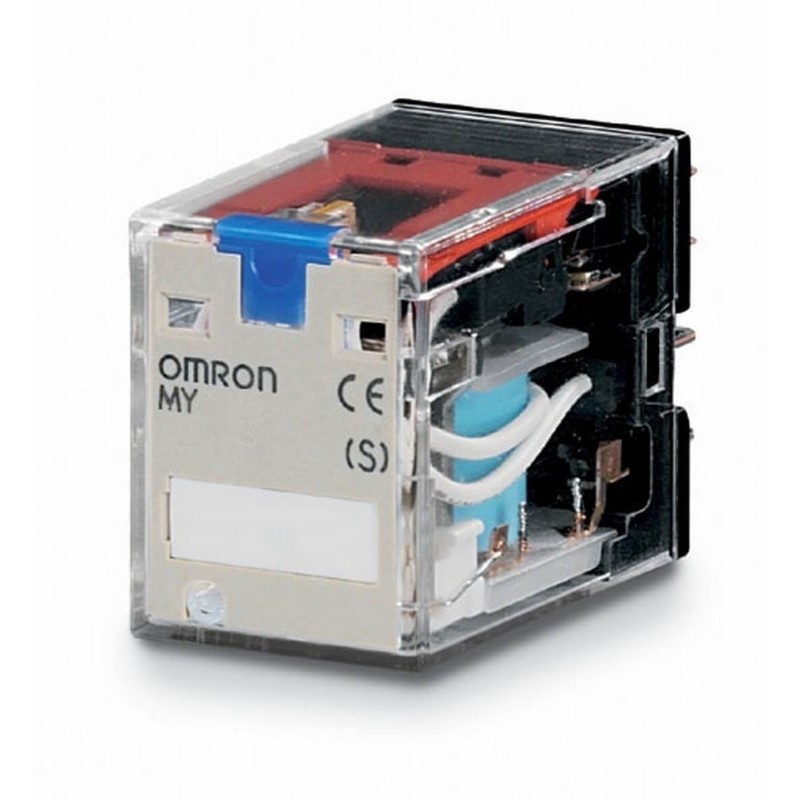
Omron MY2IN1 24VDC (S) Miniature Power Relay
The Omron MY2IN1 24VDC (S) Miniature Power Relay is a plug-in industrial relay designed for 24 VDC control systems. It is part of the Omron MY relay family and is commonly selected for control panels, automation equipment, machine interfaces, auxiliary switching, and relay logic circuits where compact size and dependable switching are important.
This relay uses a DPDT contact form, meaning it provides two changeover contacts controlled by one coil. That configuration is valuable in industrial design because it allows one control signal to manage two separate circuits. For more details about Omron components, visit Omron relay information.
Technical Overview
The Omron MY2IN1 24VDC (S) relay is generally associated with a 24 VDC coil, plug-in terminals, operation indication, and a latching lever structure depending on the exact configuration. In typical MY series ratings, the relay provides DPDT switching with silver contacts and is used for both AC and DC control loads within the specified rating limits.
24 VDC is one of the most common control voltages in modern automation. It is widely used with PLC systems, sensors, relays, safety modules, control switches, and interface devices. This makes the Omron MY2IN1 24VDC (S) Miniature Power Relay a practical option for control cabinet builders and maintenance teams working with standardized industrial DC control circuits.
Where This Relay Fits
The relay is suitable for panel-level control tasks such as signal multiplication, auxiliary contact switching, lamp control, alarm output, interlock circuits, low-power actuator control, and separation between field devices and controllers. Its plug-in design supports fast replacement, which is useful in production environments where downtime must be minimized.
Because it has two changeover contacts, the relay can support flexible circuit functions. One contact may be used for the main control output, while the second contact may be used for feedback, indication, or a secondary control path. This makes it useful in conveyor systems, packaging machines, process panels, pump control cabinets, and HVAC control units.
Installation and Engineering Notes
The coil voltage must match the system supply. A 24 VDC relay should not be used on AC circuits or higher DC voltages unless the circuit has been specifically designed for that relay. Contact ratings should also be checked against the load type. Resistive loads are easier to switch than inductive loads, which may create voltage spikes when the circuit opens.
Socket compatibility is another important factor. Omron MY relays are normally used with compatible PY series sockets, depending on wiring style and panel design. Correct socket selection supports stable electrical contact, safe installation, and easier maintenance.
Omron MY2IN1 24VDC (S) FAQ
What is the Omron MY2IN1 24VDC (S) Miniature Power Relay used for?
It is used for 24 VDC industrial control circuits, automation panels, PLC interface circuits, auxiliary switching, and machine control applications.
Why is 24 VDC common in automation?
24 VDC is widely used because it supports safer control voltage design, compatibility with PLC systems, and reliable operation across sensors, relays, and control modules.
What does MY2IN1 indicate?
It identifies a specific Omron MY relay variation. The exact configuration should always be confirmed from the product marking and datasheet before installation.
Is this relay plug-in type?
Yes, this relay is designed for plug-in socket mounting, which helps simplify replacement and panel maintenance.
Can it be used with PLC outputs?
Yes, when the PLC output rating and relay coil requirement are compatible. The circuit design must confirm current capability and protection needs.
What is the advantage of DPDT contacts?
DPDT contacts allow two separate circuits to be switched at the same time, making the relay useful for interlocking, feedback, and signal separation.
What should be verified before use?
Verify coil voltage, socket compatibility, contact rating, wiring diagram, operating environment, load type, and whether the relay includes internal indication or other special features.