
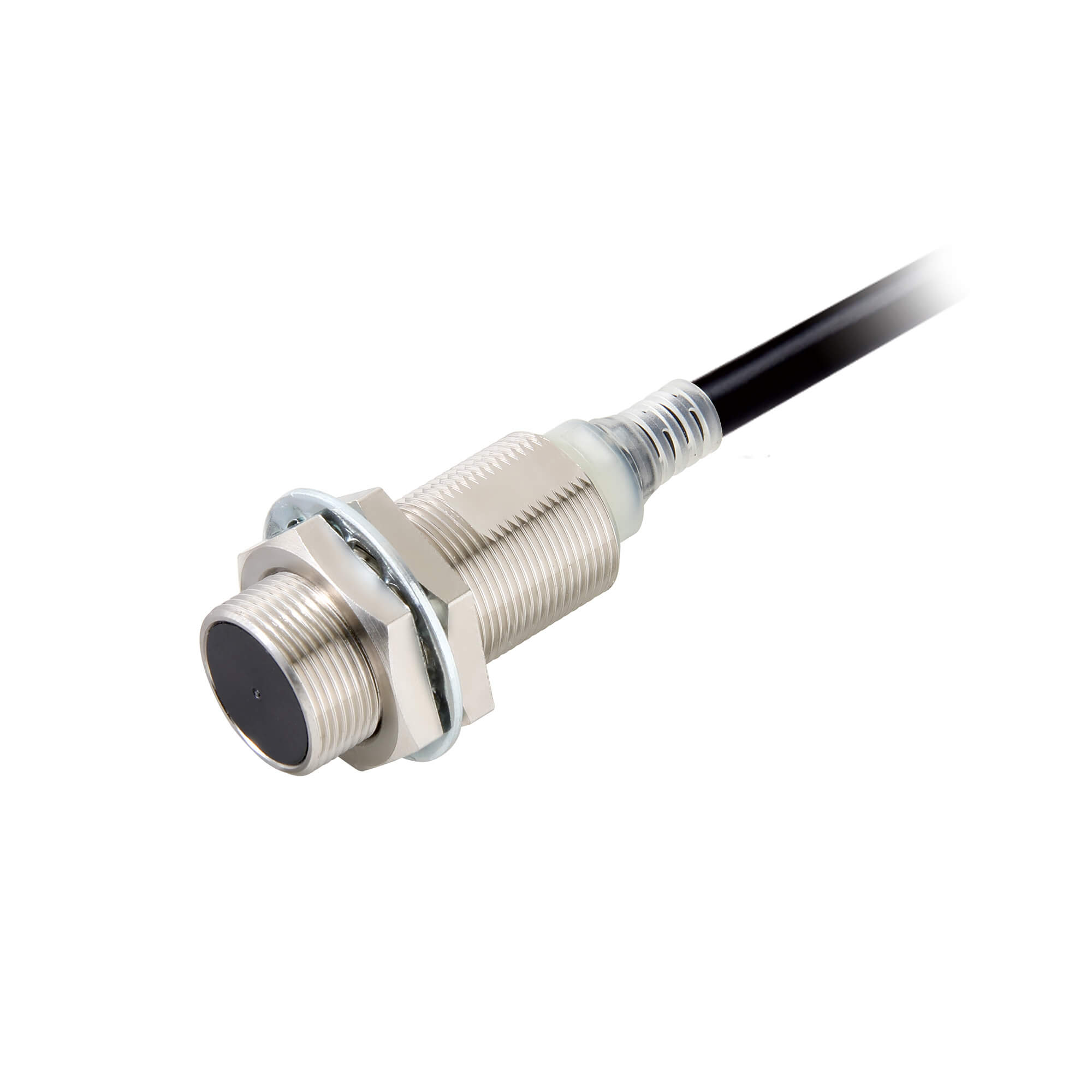
Omron E2E-X5D1-TR-N 2M Inductive Proximity Sensor
| Feature | Value |
|---|---|
| Sensor Type | Inductive Proximity Sensor |
| Series | E2E NEXT |
| Sensing Distance | 5 mm |
| Housing Size | M18 |
| Mounting Type | Flush Mount |
| Output Type | DC 2-Wire |
| Output Configuration | NC (Normally Closed) |
| Supply Voltage | 10 to 30 VDC |
| Response Frequency | 250 Hz |
| Cable Length | 2 m |
| Housing Material | Nickel-Plated Brass |
| Sensing Surface Material | PBT |
| Protection Rating | IP67, IP67G, IP69K |
| Operating Temperature | -25°C to +70°C |
| Overall Length | 54.3 mm |
Reliable position monitoring is a fundamental requirement in modern automation systems. The Omron E2E-X5D1-TR-N 2M Inductive Proximity Sensor is developed to provide stable detection of metallic objects while supporting fail-safe control strategies through its normally closed output configuration. This design approach is frequently selected in applications where detection integrity and wiring diagnostics are important considerations.
The Omron E2E-X5D1-TR-N 2M Inductive Proximity Sensor belongs to the E2E NEXT family and combines non-contact sensing technology with a rugged industrial housing. Its compact M18 cylindrical body enables installation in machinery, conveyors, assembly equipment, and automated production cells where space efficiency and durability are required.
Technical Description
This inductive proximity sensor is designed for detecting metallic objects within a rated sensing distance of 5 mm. The shielded sensing structure allows flush installation within metal mounting surfaces, making it suitable for compact machine designs and enclosed equipment layouts.
The sensor incorporates a DC two-wire electrical interface and a normally closed output configuration. In this arrangement, the output state changes when a metallic target enters the sensing area, enabling control systems to monitor equipment conditions and detect wiring interruptions more effectively.
The nickel-plated brass housing provides resistance against mechanical stress and industrial contaminants, while the PBT sensing face supports reliable long-term operation.
Working Principle
The sensing mechanism is based on electromagnetic induction. An oscillator inside the sensor generates a high-frequency magnetic field around the sensing face. When a conductive metal object enters this field, eddy currents are induced within the target material.
These currents absorb energy from the oscillator circuit, causing a measurable change in amplitude. Once the internal threshold is reached, the sensor switches its output state and communicates the detection event to connected control equipment.
The non-contact operating method eliminates mechanical wear, allowing the sensor to perform consistently in applications involving frequent machine cycles and repetitive positioning tasks.
Typical Areas of Use
- Machine position verification
- Metal component presence detection
- Automated assembly systems
- Conveyor transport equipment
- Packaging machinery
- Material transfer stations
- Industrial indexing systems
- Production line monitoring
The Omron E2E-X5D1-TR-N 2M Inductive Proximity Sensor is often selected for systems where normally closed logic contributes to machine safety or diagnostic monitoring requirements.
Industrial Applications
Automated Manufacturing Cells
Manufacturing systems use proximity sensors to verify workpiece locations, machine movements, and fixture positions. Consistent metal detection helps maintain process accuracy throughout production cycles.
Conveyor and Transport Systems
Industrial transport equipment requires reliable sensing of carriers, pallets, and transfer mechanisms. The sensor can monitor movement positions and trigger control actions within automated material flow systems.
Packaging Operations
Packaging machinery relies on position feedback from various moving assemblies. Inductive sensing provides accurate detection without introducing contact-related wear.
Machine Building
Machine manufacturers integrate proximity sensors into control architectures for position confirmation, sequence monitoring, and actuator feedback applications.
Advantages
- Normally closed output configuration
- Non-contact metal detection technology
- Flush mounting capability
- Compact M18 housing design
- High environmental protection ratings
- Oil-resistant cable construction
- Reliable operation in industrial environments
- Reduced maintenance requirements compared with mechanical switches
Engineers seeking additional sensing solutions can review Omron sensor products for alternative sensing distances, housing dimensions, and output configurations.
Sector-Specific Usage Examples
- Monitoring fixture positions in automotive assembly lines
- Detecting transfer carriage locations in logistics systems
- Verifying metal component placement in robotic workstations
- Tracking indexing mechanisms in packaging equipment
- Monitoring actuator positions in industrial machinery
- Detecting moving steel parts in fabrication processes
Factors to Consider During Selection
Sensor selection should consider target material characteristics, required sensing distance, available installation space, electrical interface requirements, and environmental exposure levels.
The Omron E2E-X5D1-TR-N 2M Inductive Proximity Sensor is particularly suitable where normally closed switching logic is preferred for system monitoring. Engineers should also verify compatibility with PLC input modules and machine control systems before implementation.
Omron E2E-X5D1-TR-N 2M Frequently Asked Questions
What is the sensing distance of this sensor?
The rated sensing distance is 5 mm.
What output configuration does the sensor use?
It features a normally closed (NC) DC 2-wire output.
Can the sensor be installed flush with metal surfaces?
Yes. The shielded design supports flush mounting applications.
What type of targets can it detect?
The sensor is designed to detect metallic objects through electromagnetic induction.
Omron E2E-X5D1-TR-N 2M What is the cable length?
This version includes a permanently attached 2-meter cable.
Which industries commonly use this model?
Automotive manufacturing, machine building, logistics, packaging, and industrial automation sectors frequently use it.
How does the sensor operate?
It generates an electromagnetic field and detects changes caused by nearby metal objects.
What environmental protection ratings are provided?
The sensor is rated IP67, IP67G, and IP69K.
What temperature range is supported?
The operating temperature range is -25°C to +70°C.
Why is a normally closed output selected?
Normally closed configurations are often used in applications requiring diagnostic monitoring of wiring integrity and sensor status.