
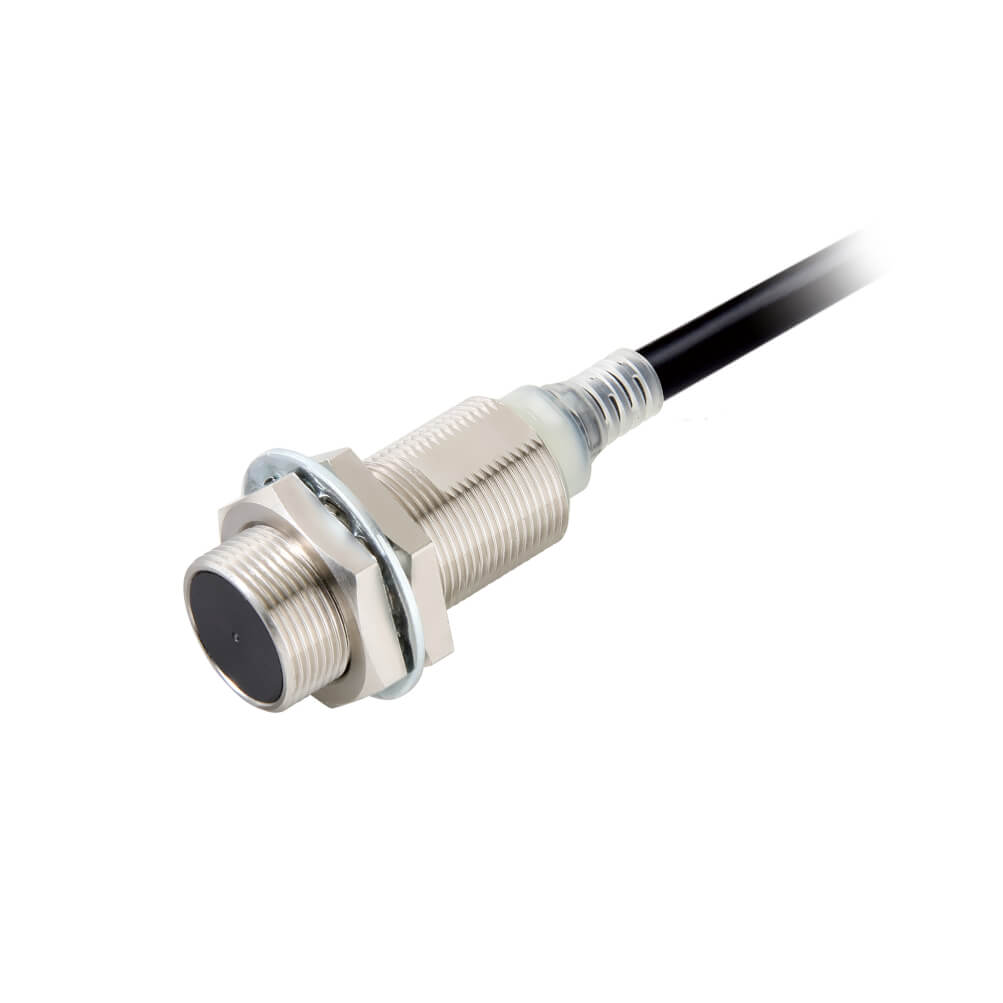
Omron E2E-X5D1-N 2M Inductive Proximity Sensor
| Feature | Value |
|---|---|
| Sensor Type | Inductive Proximity Sensor |
| Series | E2E NEXT |
| Housing Diameter | M18 |
| Mounting Style | Flush Shielded |
| Sensing Distance | 5 mm |
| Output Type | DC 2-Wire Normally Open |
| Cable Length | 2 m |
| Housing Material | Nickel-Plated Brass |
| Thread Length | 37 mm |
| Total Length | 54 mm |
| Protection Rating | IP67 / IP67G / IP69K |
| Connection Type | Pre-wired Cable |
Industrial automation systems frequently require reliable object detection solutions capable of operating in harsh environments while maintaining stable performance. The Omron E2E-X5D1-N 2M Inductive Proximity Sensor is designed for these conditions, offering non-contact metal detection with a compact M18 threaded housing and a durable cable connection suitable for fixed installations.
As part of the E2E NEXT sensor family, this model is engineered to provide dependable switching performance in manufacturing equipment, automated production lines, machine tools, and material transport systems where precise position monitoring is essential.
Technical Description
The Omron E2E-X5D1-N 2M Inductive Proximity Sensor is a flush-mounted inductive sensor featuring a 5 mm sensing distance. Its shielded design enables installation directly into metal mounting brackets and machine frames while minimizing interference from surrounding conductive materials.
The sensor incorporates a DC 2-wire normally open output configuration and a permanently attached 2-meter cable for direct integration into industrial control circuits. The nickel-plated brass housing contributes to mechanical durability in environments exposed to vibration, oils, and routine maintenance procedures.
Environmental protection ratings of IP67, IP67G, and IP69K support installation in applications where exposure to water, dust, coolant, or cleaning processes may occur.
Working Principle
Inductive sensing technology operates through the generation of a high-frequency electromagnetic field at the sensor face. When a metallic object enters the detection zone, the induced eddy currents alter the oscillation characteristics of the sensing circuit.
The sensor electronics continuously evaluate these changes and activate the output when the target reaches the defined sensing range. Because the process relies entirely on electromagnetic interaction, physical contact between the sensor and the target is unnecessary.
This contactless detection method helps reduce mechanical wear and supports long operational life in repetitive industrial processes.
Common Application Areas
- Conveyor position monitoring
- Assembly line automation
- Packaging machinery
- Automated sorting systems
- Machine tool positioning
- Transfer equipment monitoring
- Metal component verification
- Production line sequencing systems
Industrial Applications
In conveyor-based manufacturing systems, the Omron E2E-X5D1-N 2M Inductive Proximity Sensor can be used to confirm the arrival of metallic carriers before automated processing begins.
Machine builders frequently integrate inductive sensors into moving assemblies to verify slide positions, actuator travel limits, and fixture status information.
Within packaging equipment, the sensor may monitor mechanical drive components, rotating assemblies, and transfer mechanisms that coordinate production sequences.
Material handling installations often use inductive sensors to verify pallet locations and support automated routing decisions throughout logistics operations.
Advantages
- Reliable 5 mm metal detection capability
- Flush mounting design for compact installation
- Long 2-meter cable for flexible wiring layouts
- Robust nickel-plated brass housing
- Suitable for harsh industrial environments
- High resistance to dust and moisture exposure
- Contactless detection minimizes mechanical wear
- Compatible with a wide range of industrial control systems
Sector-Specific Examples
Automotive Production
Used for detecting body components, tooling fixtures, and assembly station positioning elements.
Metal Fabrication
Supports machine monitoring functions including part positioning and process verification.
Logistics Facilities
Provides detection of metallic transport structures used throughout conveyor and transfer systems.
Packaging Industry
Assists in synchronization of machine movements and verification of mechanical component positions.
Important Selection Criteria
Engineers should evaluate sensing distance requirements, target material characteristics, mounting constraints, and environmental conditions before selecting an inductive sensor.
The flush-mounted design of the Omron E2E-X5D1-N 2M Inductive Proximity Sensor is particularly suitable when installation space is limited and surrounding metal structures are present.
Applications exposed to washdown procedures or contamination may benefit from the sensor’s IP69K protection rating. The Omron E2E-X5D1-N 2M Inductive Proximity Sensor also offers simplified integration through its pre-wired cable connection.
Additional sensor technologies and related product families can be explored through Omron sensor series.
Frequently Asked Questions
What objects can this sensor detect?
The sensor is designed to detect metallic targets through inductive sensing technology.
What is the nominal sensing distance?
The nominal sensing distance is 5 mm.
Can the sensor be installed in metal brackets?
Yes. Its shielded flush design allows installation directly into metal structures.
What type of output does it provide?
It uses a DC 2-wire normally open output configuration.
How long is the connection cable?
The sensor is supplied with a 2-meter pre-wired cable.
Is it suitable for washdown environments?
Yes. The IP69K rating supports use in applications exposed to intensive cleaning procedures.
Which industries commonly use this sensor?
Automotive, packaging, logistics, machine building, and metal processing industries commonly deploy inductive proximity sensors.
Does the sensor require routine mechanical maintenance?
Because detection occurs without physical contact, maintenance requirements are generally limited to inspection and cleaning of the sensing area.