
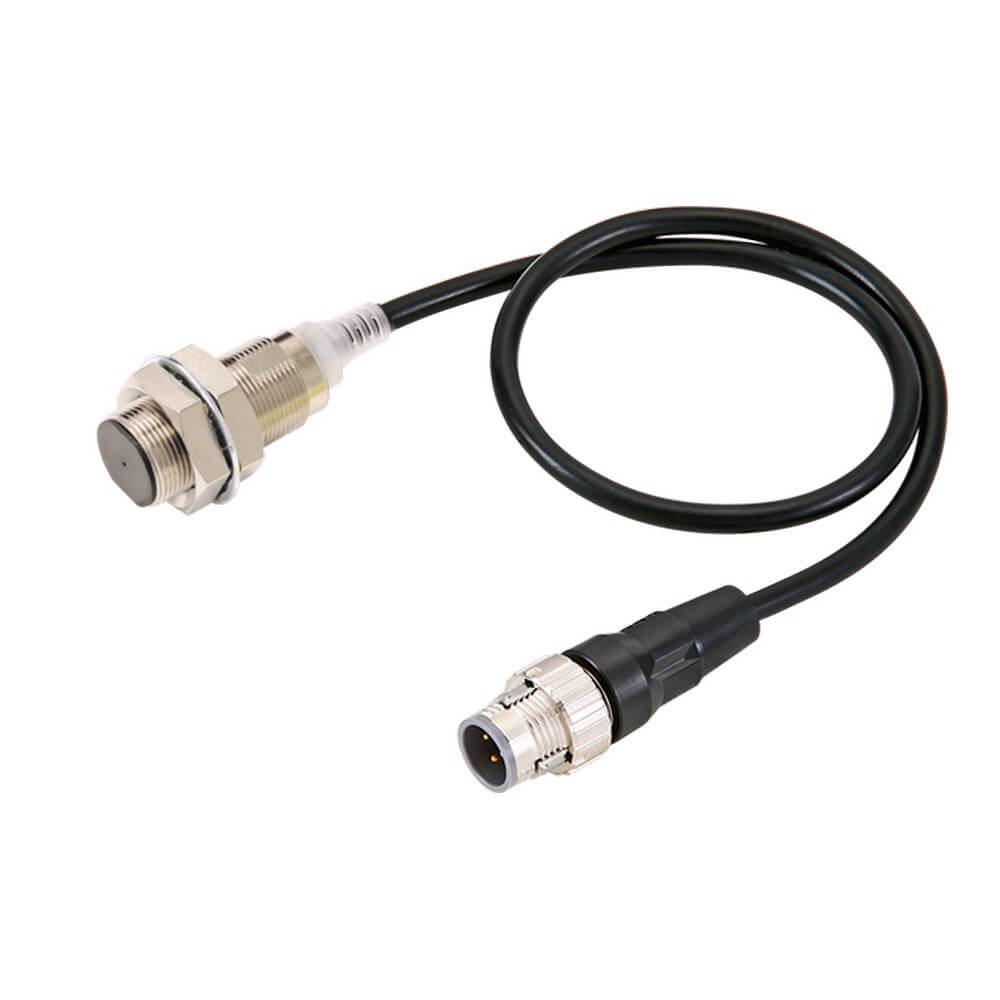
Omron E2E-X5B218-M1TJ 0.3M Inductive Proximity Sensor
| Feature | Value |
|---|---|
| Sensor Type | Inductive Proximity Sensor |
| Series | Omron E2E NEXT |
| Sensing Distance | 5 mm |
| Housing Size | M18 Threaded Cylindrical |
| Mounting Type | Flush Shielded |
| Output Type | PNP, Normally Closed (NC) |
| Wiring | 3-Wire DC |
| Supply Voltage | 10 to 30 VDC |
| Response Frequency | 600 Hz |
| Connection Method | M12 Smartclick Pigtail Connector |
| Cable Length | 0.3 m |
| Housing Material | Nickel-Plated Brass |
| Protection Rating | IP67 / IP67G / IP69K |
| Operating Temperature | -25°C to +70°C |
| Overall Length | 55.3 mm |
Omron E2E-X5B218-M1TJ Technical Overview
The Omron E2E-X5B218-M1TJ Inductive Proximity Sensor is a cylindrical M18 sensing device designed for non-contact detection of metallic objects in industrial automation environments. As part of the E2E NEXT family, it incorporates enhanced sensing stability and environmental resistance suitable for manufacturing systems, material handling equipment, and machine automation.
This sensor uses an inductive sensing principle and is intended for flush mounting installations. Its shielded construction helps maintain predictable sensing performance when mounted in metallic structures. The sensor provides a 5 mm sensing distance and features a PNP normally closed output configuration operating from a 10 to 30 VDC power supply.
The Omron E2E-X5B218-M1TJ Inductive Proximity Sensor is equipped with a pre-wired M12 Smartclick connector and a 0.3 m oil-resistant PVC cable, simplifying integration into industrial control systems and reducing installation time.
How the Sensor Works
Inductive proximity sensors detect metallic targets without requiring physical contact. The sensing face generates a high-frequency electromagnetic field. When a conductive metal object enters this field, eddy currents are induced within the target material.
These eddy currents alter the oscillation characteristics of the sensor circuit. The internal electronics monitor these changes and switch the output state once the target reaches the defined sensing range.
Because the sensing mechanism relies on electromagnetic interaction rather than mechanical movement, the sensor operates without wear-related components. This contributes to reliable performance in continuous industrial processes.
Omron E2E-X5B218-M1TJ Key Features and Engineering Advantages
- 5 mm sensing distance for metal object detection
- Flush-mounted shielded M18 design
- PNP normally closed output configuration
- 3-wire DC operation
- Nickel-plated brass housing for mechanical durability
- IP67, IP67G, and IP69K environmental protection
- 600 Hz response frequency for dynamic applications
- M12 Smartclick connector for efficient installation
- Wide operating voltage range of 10 to 30 VDC
- Suitable for harsh industrial environments
Typical Areas of Use
The Omron E2E-X5B218-M1TJ Inductive Proximity Sensor is commonly installed wherever reliable detection of metallic machine components is required. Its compact M18 body allows installation in confined machinery spaces while maintaining consistent sensing performance.
- Automated assembly systems
- Conveyor position monitoring
- Packaging machinery
- Metal processing equipment
- Industrial robotics
- Machine tool automation
- Pallet transfer systems
- Material handling equipment
Engineers frequently select the Omron E2E-X5B218-M1TJ Inductive Proximity Sensor for applications requiring dependable target detection under vibration, washdown exposure, and temperature fluctuations.
Industrial Applications
Automotive Manufacturing
Production lines use inductive sensors to verify the presence and positioning of metallic components before welding, fastening, or assembly operations begin.
Packaging Facilities
Sensors can monitor machine positions, actuator movement, and metal guide components to maintain process synchronization throughout packaging operations.
Material Handling Systems
Conveyor transfer points often rely on proximity sensors to detect pallet carriers, fixtures, and moving mechanical elements.
Machine Building
OEM machine builders integrate proximity sensors into safety interlocks, motion control systems, and machine status monitoring architectures.
Selection Considerations
When selecting an inductive proximity sensor, engineers should evaluate installation constraints, electrical requirements, environmental conditions, and target material characteristics.
- Confirm the required sensing distance
- Verify PNP output compatibility with the PLC input module
- Evaluate available mounting space for an M18 housing
- Consider exposure to water, oil, and cleaning processes
- Review cable routing and connector requirements
- Check operating temperature conditions
- Assess response frequency requirements for moving targets
Applications involving frequent washdowns or exposure to coolant systems can benefit from the sensor’s IP67, IP67G, and IP69K protection ratings.
Related Omron Sensor Solutions
Engineers evaluating sensing technologies for factory automation can explore additional Omron sensor products covering inductive, photoelectric, fiber optic, and displacement sensing applications.
Frequently Asked Questions
1. What type of sensor is the Omron E2E-X5B218-M1TJ 0.3M?
It is an inductive proximity sensor designed to detect metallic objects without physical contact.
2. What is the sensing distance?
The rated sensing distance is 5 mm.
3. What output configuration does the sensor use?
The sensor provides a PNP normally closed (NC) output.
4. What supply voltage is required?
The device operates from 10 to 30 VDC.
5. Is the sensor suitable for washdown environments?
Yes. The sensor carries IP67, IP67G, and IP69K protection ratings for demanding industrial environments.
6. What connection method is used?
It uses an M12 Smartclick pigtail connector with a 0.3-meter cable.
7. Can it be mounted flush in metal?
Yes. The sensor is a shielded flush-mount model intended for installation in metallic structures.
8. Which industries commonly use this sensor?
Automotive manufacturing, packaging, machine building, logistics automation, and material handling industries commonly use this sensor for metal target detection.