
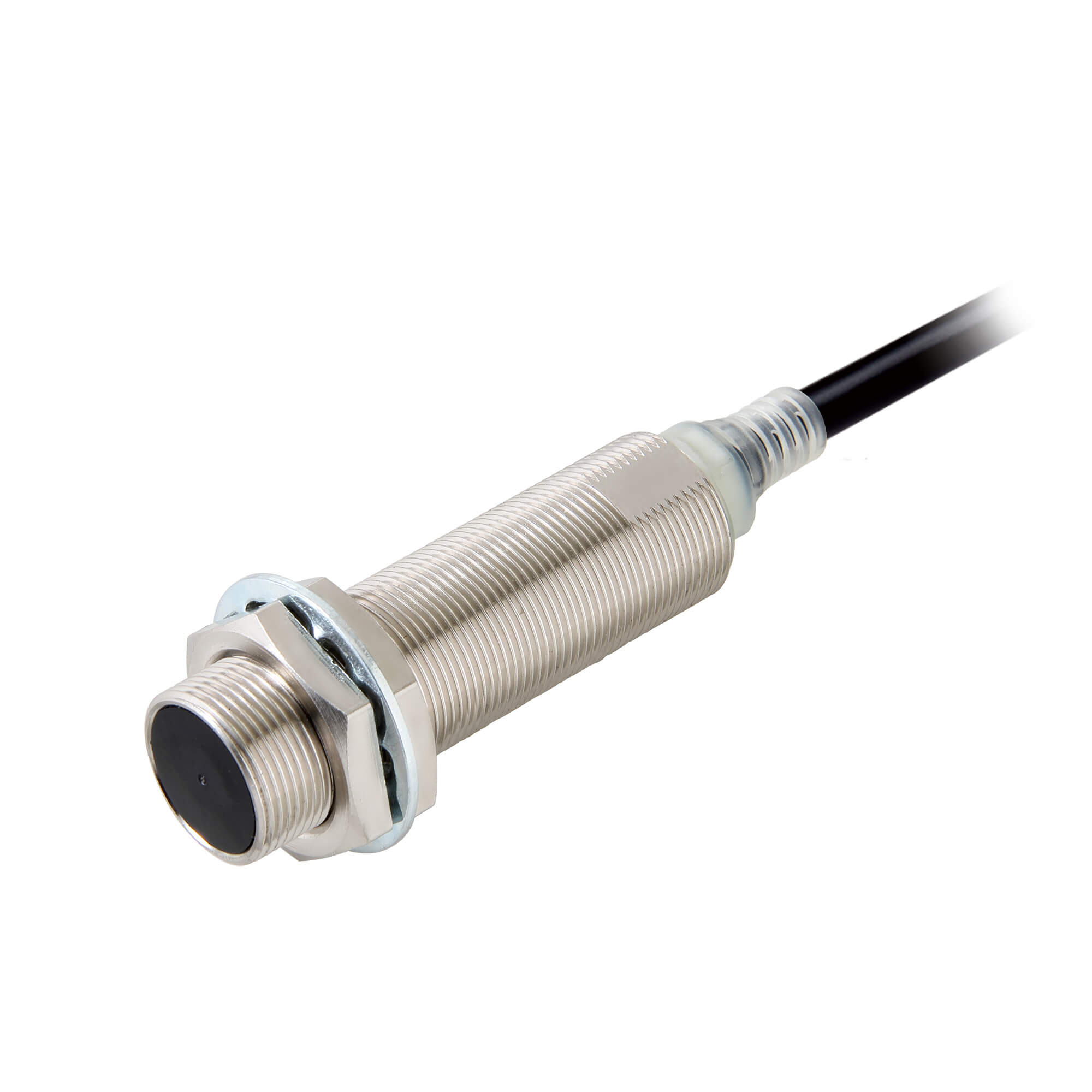
Omron E2E-X5B2L18 2M Inductive Proximity Sensor
| Feature | Value |
|---|---|
| Sensor Type | Inductive Proximity Sensor |
| Series | Omron E2E NEXT |
| Sensing Distance | 5 mm |
| Housing Diameter | M18 |
| Mounting Type | Flush Shielded |
| Output Type | PNP Normally Open (NO) |
| Wiring Method | 3-Wire DC |
| Supply Voltage | 10 to 30 VDC |
| Response Frequency | 600 Hz |
| Cable Length | 2 m |
| Housing Material | Nickel-Plated Brass |
| Protection Rating | IP67 / IP67G / IP69K |
| Operating Temperature | -25°C to +70°C |
| Overall Length | 55 mm Class |
Technical Description
Modern industrial automation systems rely on precise object detection to coordinate machine movements, monitor production flow, and provide position feedback to control equipment. The Omron E2E-X5B2L18 Inductive Proximity Sensor is designed to perform these tasks through reliable non-contact sensing of metallic targets.
As a member of the Omron E2E NEXT family, this sensor combines a shielded M18 cylindrical housing with a 5 mm sensing range and a PNP normally open output. The design allows stable operation in installations where sensors are mounted directly into metal machine frames and equipment structures.
The Omron E2E-X5B2L18 Inductive Proximity Sensor incorporates a permanently attached 2-meter cable, making it suitable for installations where direct wiring to control panels or junction boxes is preferred. Its rugged housing and environmental protection ratings support operation in demanding industrial environments.
Operating Principle
Inductive sensing technology is based on electromagnetic field generation. The sensing face continuously produces a high-frequency magnetic field extending from the front of the sensor.
When a metallic object enters the sensing zone, eddy currents develop within the target material. These currents absorb energy from the oscillating magnetic field, causing measurable changes inside the sensor electronics.
The internal detection circuit monitors these changes and activates the output once the switching threshold is reached. Because the process occurs without mechanical contact, sensor wear is minimized and long-term operational consistency is maintained.
Omron E2E-X5B2L18 Main Characteristics
- 5 mm sensing distance
- Shielded flush-mount design
- PNP normally open output
- 3-wire DC wiring configuration
- 600 Hz response frequency
- M18 threaded cylindrical housing
- 2-meter integrated cable
- Nickel-plated brass construction
- IP67, IP67G, and IP69K protection ratings
- Wide operating voltage range
Common Installation Areas
The Omron E2E-X5B2L18 Inductive Proximity Sensor is frequently installed in automated equipment where direct contact switches would be exposed to excessive wear or contamination.
- Production machinery
- Transfer conveyors
- Automated assembly stations
- Industrial robots
- Material transport systems
- Packaging equipment
- Pallet handling mechanisms
- Machine tool systems
The sensor’s cable connection simplifies integration in equipment layouts where connector-based sensors may not be preferred due to space limitations or wiring practices.
Omron E2E-X5B2L18 Industrial Application Examples
Automated Conveyor Monitoring
Conveyor systems often require detection of metal carriers, positioning brackets, and moving mechanical assemblies. Inductive sensors provide dependable switching signals for process control and synchronization.
Assembly Equipment
Production cells use proximity sensors to verify component positioning before initiating fastening, welding, pressing, or inspection operations.
Machine Tool Automation
Metalworking machinery employs sensors to monitor spindle positions, fixture presence, and movement limits within automated production cycles.
Warehouse Automation
Automated storage and retrieval systems use inductive sensing technology to identify metallic transport components and positioning mechanisms.
Advantages in Industrial Environments
The Omron E2E-X5B2L18 Inductive Proximity Sensor offers several practical benefits in industrial applications where mechanical switches may be susceptible to contamination, vibration, or repetitive operation.
- Non-contact detection reduces mechanical wear
- Stable sensing performance in metal installations
- Resistance to water and cleaning processes
- Suitable for continuous-duty automation systems
- Reliable operation in environments exposed to oils and coolants
- Consistent switching performance during repetitive cycles
Selection Considerations
Selecting an inductive sensor requires evaluation of the installation environment and control system requirements.
- Confirm that a 5 mm sensing range is appropriate
- Verify compatibility with PNP input modules
- Ensure adequate mounting space for M18 dimensions
- Review environmental exposure conditions
- Determine required cable length and routing path
- Assess target material characteristics
- Consider switching frequency requirements
Applications involving washdown procedures or outdoor exposure may particularly benefit from the sensor’s high protection ratings.
Additional Omron Sensor Technologies
For projects requiring alternative sensing methods, engineers can review Omron sensor serileri including photoelectric sensors, fiber optic systems, displacement sensors, and advanced industrial detection solutions.
Frequently Asked Questions
1. What does the Omron E2E-X5B2L18 2M detect?
It detects metallic objects using inductive sensing technology.
2. What is the rated sensing distance?
The sensor provides a nominal sensing distance of 5 mm.
3. Which output type is included?
The sensor features a PNP normally open output configuration.
4. Can the sensor be installed flush in metal?
Yes. It is a shielded sensor specifically designed for flush mounting applications.
5. What cable length is supplied?
This version includes a permanently attached 2-meter cable.
6. Is the sensor suitable for washdown environments?
Yes. The device supports IP67, IP67G, and IP69K environmental protection ratings.
7. What voltage range is required?
The sensor operates from 10 to 30 VDC.
8. Which industries commonly use this sensor?
Manufacturing, packaging, automotive production, logistics automation, machine building, and material handling industries commonly use this sensor.