
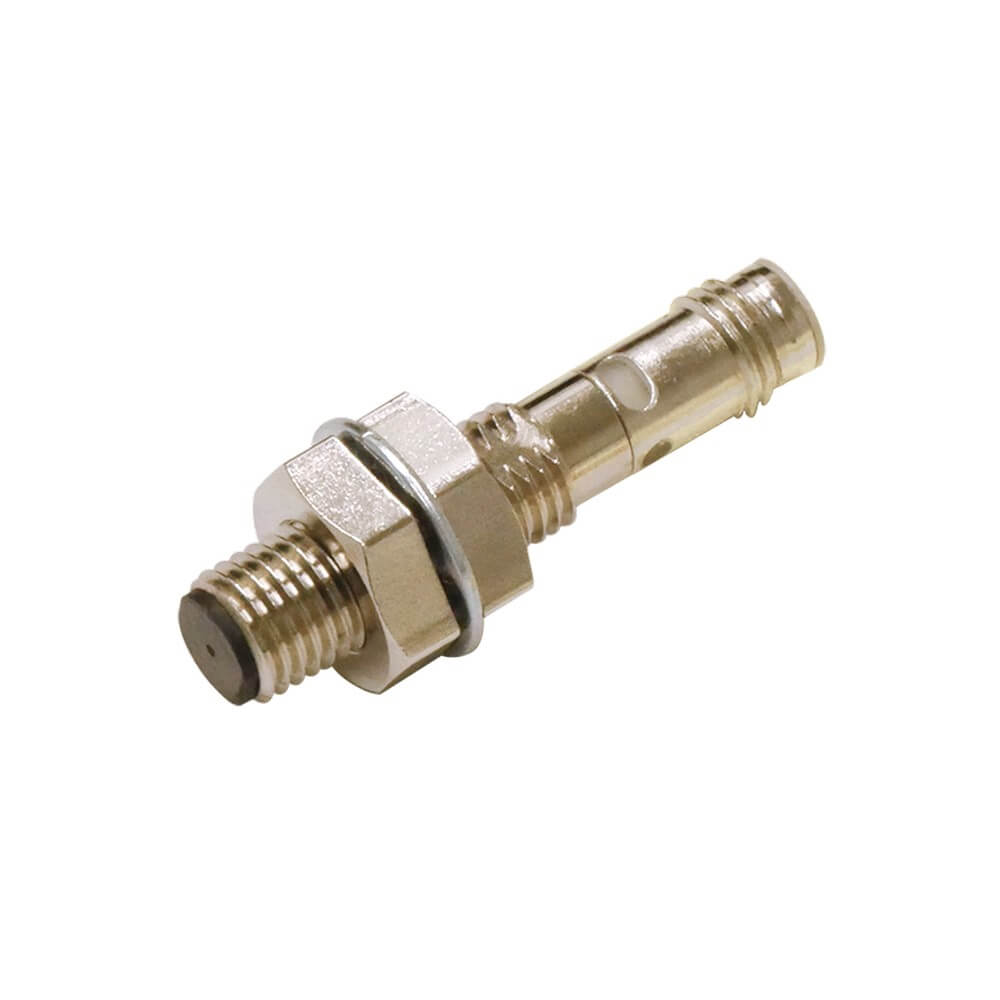
Omron E2E-X4C18-M3 Inductive Proximity Sensor
| Feature | Value |
|---|---|
| Sensor Type | Inductive Proximity Sensor |
| Series | E2E NEXT |
| Sensing Distance | 4 mm |
| Mounting Type | Quasi-Flush (Shielded) |
| Output Type | NPN Normally Open (NO) |
| Supply Voltage | 10 to 30 VDC |
| Connection Method | 3 m PVC Cable |
| Housing Material | Nickel-Plated Brass |
| Thread Size | M8 |
| Protection Rating | IP67 / IP67G / IP69K |
| Operating Temperature | -25°C to +70°C |
| Response Frequency | 1 kHz |
Modern industrial systems rely on accurate object detection to maintain process consistency and equipment coordination. The Omron E2E-X4C18-M3 Inductive Proximity Sensor is engineered to identify metallic targets without mechanical contact, providing dependable feedback for automation systems operating in demanding production environments.
Technical Description
The Omron E2E-X4C18-M3 Inductive Proximity Sensor belongs to the E2E NEXT series of cylindrical inductive sensors. Designed with a compact M8 threaded housing, it offers a sensing distance of 4 mm while maintaining stable switching characteristics. The sensor utilizes an NPN normally open output and operates from a 10 to 30 VDC power supply.
A permanently attached 3-meter cable simplifies installation in machinery where remote control cabinets or junction points are located away from the sensing position.
How the Sensor Works
Inductive sensing technology is based on electromagnetic field generation. The sensing face creates a high-frequency oscillating field. When a conductive metal object enters this field, eddy currents develop within the target material.
These currents alter the oscillator’s amplitude. Internal electronic circuits detect the change and activate the output transistor once the detection threshold is reached. Because the process occurs without physical contact, sensor wear is minimized while maintaining repeatable performance.
The Omron E2E-X4C18-M3 Inductive Proximity Sensor is designed to provide stable detection under vibration, temperature variation, and continuous operating conditions commonly found in industrial facilities.
Common Applications
- Metal component detection
- Machine position monitoring
- Automated assembly equipment
- Conveyor control systems
- Transfer station verification
- Packaging machinery
- Automated sorting equipment
- Robotic cell monitoring
Industrial Applications
In electronics manufacturing facilities, the sensor may be used to verify fixture positions and metallic carrier placement before automated processes begin.
In logistics automation systems, it can monitor shuttle mechanisms and detect the arrival of metallic transport carriers at designated locations.
Packaging machines frequently integrate inductive sensors to verify actuator movement and confirm mechanical component positions during production cycles.
In metal fabrication facilities, the sensor can detect workpiece presence prior to machining, welding, or transfer operations.
Advantages
- Non-contact metal detection
- Compact M8 cylindrical housing
- Long 3-meter cable connection
- High environmental protection ratings
- Stable operation in industrial conditions
- Suitable for continuous operation
- Reduced maintenance requirements
- Simple integration with PLC systems
Sector-Specific Examples
Electronics Assembly
Used for detecting metallic pallets and fixture locations within automated production cells.
Logistics Equipment
Provides position confirmation for transport carts and transfer mechanisms.
Metal Processing
Detects incoming steel components before forming or machining operations.
Packaging Industry
Monitors mechanical assemblies and transfer systems throughout production sequences.
Omron E2E-X4C18-M3 Selection Considerations
Engineers should evaluate sensing distance requirements, installation constraints, cable routing, output compatibility, and environmental exposure before selecting an inductive sensor.
The Omron E2E-X4C18-M3 Inductive Proximity Sensor is particularly useful when a compact sensor body and extended cable connection are required in automation equipment.
Additional sensing technologies and configurations can be explored through Omron sensor series when designing advanced automation systems.
Frequently Asked Questions
1. What type of object can this sensor detect?
The sensor is designed to detect metallic targets using inductive sensing technology.
2. What is the rated sensing distance?
The rated sensing distance is 4 mm.
3. What output configuration is available?
The sensor provides an NPN normally open output.
4. What supply voltage is required?
The operating voltage range is 10 to 30 VDC.
5. Is the sensor suitable for outdoor industrial use?
Its IP67, IP67G, and IP69K ratings provide protection against water and dust ingress in demanding environments.
6. What is the cable length?
The sensor is supplied with a fixed 3-meter cable.
7. Where is the Omron E2E-X4C18-M3 Inductive Proximity Sensor commonly used?
It is commonly used in packaging systems, conveyors, machine tools, and assembly automation equipment.
8. Does the sensor require physical contact with the target?
No. Detection occurs through an electromagnetic field and requires no physical contact.
9. What housing material is used?
The housing is manufactured from nickel-plated brass.
10. Why choose the Omron E2E-X4C18-M3 Inductive Proximity Sensor for automation projects?
Its compact dimensions, industrial protection ratings, and stable detection performance support reliable integration into industrial control systems.