
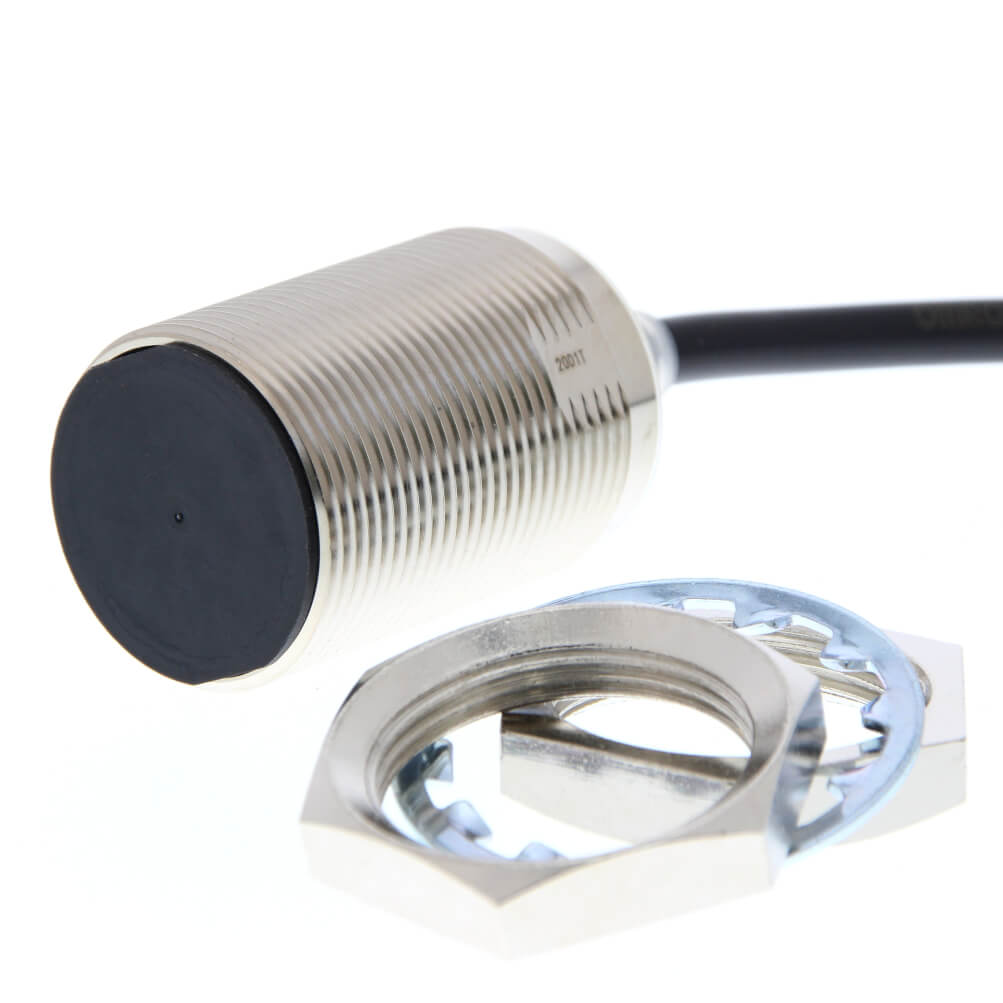
Omron E2E-X22B1T30 5M Inductive Proximity Sensor
| Feature | Value |
|---|---|
| Manufacturer | Omron |
| Series | E2E NEXT |
| Sensor Type | Inductive Proximity Sensor |
| Housing Size | M30 |
| Mounting Type | Quasi-Flush |
| Sensing Distance | 22 mm |
| Output Type | IO-Link, PNP |
| Operation Mode | Normally Open (NO) |
| Connection Method | Cable |
| Cable Length | 5 m |
| Cable Material | Oil-Resistant PVC |
| Housing Material | Nickel-Plated Brass |
| Thread Length | 38 mm |
| Overall Length | 60.3 mm |
| IO-Link Baud Rate | COM3 (230.4 kbps) |
| Protection Rating | IP67 / IP67G / IP69K |
Technical Description
The Omron E2E-X22B1T30 5M Inductive Proximity Sensor is designed for accurate detection of metallic objects in industrial automation systems. As part of the E2E NEXT product family, this sensor combines a compact short-body M30 housing with a sensing distance of 22 mm and integrated IO-Link communication functionality. The design is intended for applications where reliable detection, machine diagnostics, and long-term operational stability are required.
The Omron E2E-X22B1T30 5M Inductive Proximity Sensor incorporates a 5-meter oil-resistant cable that supports installation across large machines, conveyor systems, and distributed automation architectures. Its nickel-plated brass housing provides mechanical durability while maintaining resistance to industrial contaminants and challenging operating conditions. :contentReference[oaicite:0]{index=0}
Working Principle
The sensor operates using inductive sensing technology. An electromagnetic field is generated at the sensing surface. When a metallic object enters this field, eddy currents are created within the target material. These currents affect the sensor’s internal oscillator and cause the output state to change.
Since the sensing process is performed without physical contact, the sensor is suitable for repetitive industrial processes where mechanical wear must be minimized. This operating principle supports stable performance in positioning, counting, and presence detection applications.
Key Features
22 mm Detection Distance
The 22 mm sensing range provides additional installation flexibility and allows metallic targets to be detected from greater distances than many standard inductive sensor configurations. :contentReference[oaicite:1]{index=1}
Integrated IO-Link Communication
IO-Link COM3 communication enables advanced diagnostic functions, parameter management, device identification, and enhanced visibility within automation systems. This capability can simplify maintenance planning and device monitoring. :contentReference[oaicite:2]{index=2}
Industrial Protection
The IP67, IP67G, and IP69K ratings support operation in environments exposed to moisture, dust, cleaning processes, lubricants, and industrial fluids. :contentReference[oaicite:3]{index=3}
Application Areas
- Automated assembly systems
- Conveyor monitoring equipment
- Machine tool automation
- Material handling systems
- Warehouse automation
- Packaging machinery
- Robotic manufacturing cells
- Metal processing equipment
Industrial Applications
In automotive manufacturing facilities, the sensor can verify the presence of metal fixtures before robotic assembly operations begin. In material handling systems, it can monitor transfer mechanisms, pallet positioning equipment, and conveyor transport assemblies.
The Omron E2E-X22B1T30 5M Inductive Proximity Sensor is also suitable for packaging machinery where machine positions and metallic carriers must be monitored throughout production cycles. Its IO-Link communication capability can support predictive maintenance initiatives by providing access to device-level information within modern automation infrastructures.
Advantages
- Reliable non-contact metal detection
- 22 mm sensing distance
- Integrated IO-Link COM3 communication
- M30 industrial housing
- 5-meter oil-resistant cable
- High ingress protection ratings
- Reduced mechanical wear
- Suitable for advanced automation systems
Selection Considerations
When selecting an inductive sensor, engineers should evaluate sensing distance requirements, target material properties, available mounting space, communication requirements, and environmental conditions. The PNP Normally Open output configuration should be verified against PLC input specifications and machine control requirements.
For additional sensing technologies and alternative housing formats, engineers can review Omron sensor series to identify the most appropriate solution for their automation projects.
Frequently Asked Questions
1. What is the sensing distance of this sensor?
The nominal sensing distance is 22 mm. :contentReference[oaicite:4]{index=4}
2. What type of objects can be detected?
The sensor is designed for detecting metallic objects using inductive sensing technology.
3. What communication protocol does the sensor support?
The device supports IO-Link COM3 communication at 230.4 kbps. :contentReference[oaicite:5]{index=5}
4. What is the cable length?
The sensor is supplied with a 5-meter oil-resistant PVC cable. :contentReference[oaicite:6]{index=6}
5. Where is the Omron E2E-X22B1T30 5M Inductive Proximity Sensor commonly used?
It is commonly installed in conveyors, machine tools, robotic systems, packaging equipment, and material handling machinery.
6. Is the sensor suitable for harsh industrial environments?
Yes. The IP67, IP67G, and IP69K ratings support operation in demanding industrial environments. :contentReference[oaicite:7]{index=7}
7. What housing material is used?
The housing is manufactured from nickel-plated brass. :contentReference[oaicite:8]{index=8}
8. Does the sensor require physical contact with the target?
No. Detection occurs without direct contact through an electromagnetic sensing field.
9. What output configuration is provided?
The sensor features a PNP Normally Open output configuration with IO-Link capability. :contentReference[oaicite:9]{index=9}
10. How does the Omron E2E-X22B1T30 5M Inductive Proximity Sensor support modern automation systems?
The sensor combines inductive metal detection with IO-Link communication, allowing integration into diagnostic, monitoring, and predictive maintenance strategies.