
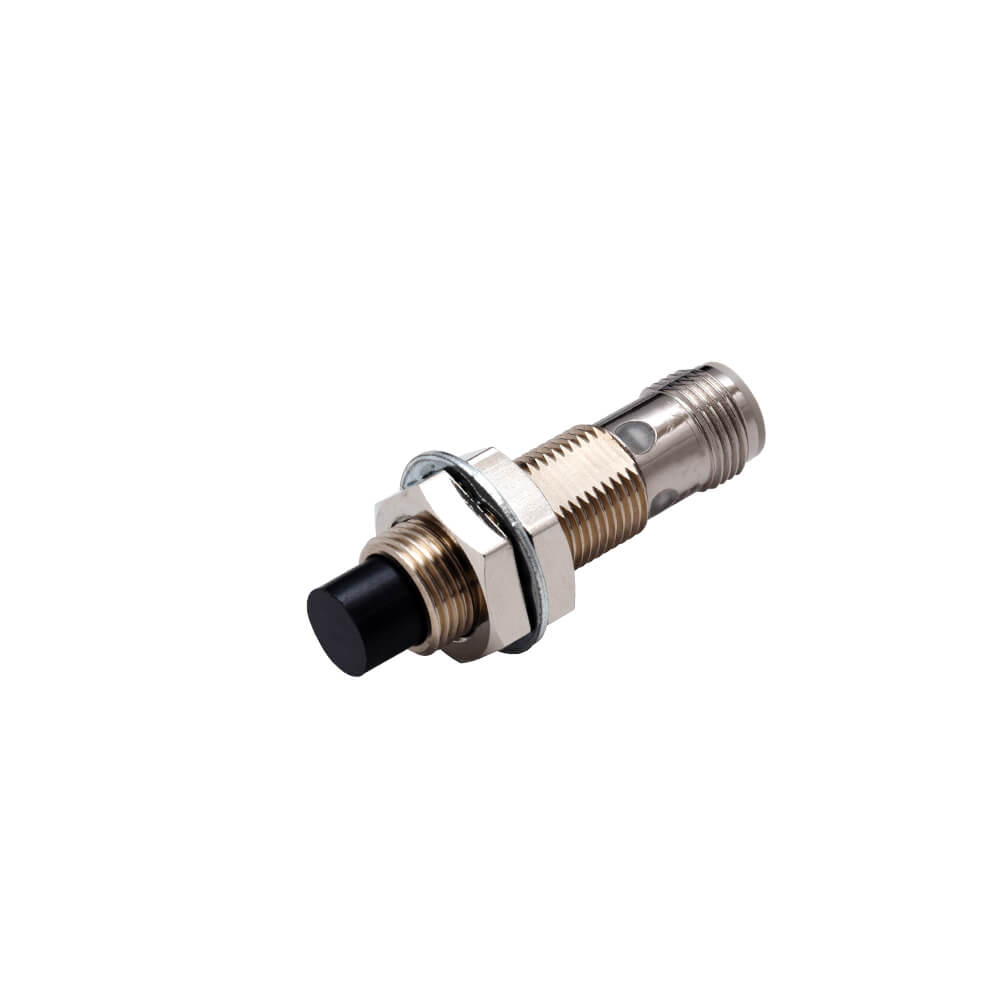
Omron E2E-X10MB1T12-M1 Inductive Proximity Sensor
| Feature | Value |
|---|---|
| Sensor Type | Inductive proximity sensor |
| Series | E2E NEXT |
| Size | M12 |
| Mounting Type | Non-flush |
| Sensing Distance | 10 mm |
| Output Type | IO-Link, PNP |
| Operation Mode | NO |
| Connection Method | M12 connector |
| IO-Link Baud Rate | COM3, 230.4 kbps |
| Housing Material | Nickel-plated brass |
| Overall Length | 48 mm |
| Thread Length | 26 mm |
| Protection Rating | IP67, IP69K |
Omron E2E-X10MB1T12-M1 Technical Description
The Omron E2E-X10MB1T12-M1 Inductive Proximity Sensor is a cylindrical M12 sensor designed for non-contact detection of metallic targets in automated machinery. Its non-flush structure provides a 10 mm sensing distance, making it suitable for applications where the target cannot always pass very close to the sensing face.
The sensor uses a nickel-plated brass body, an M12 connector, PNP output, normally open operation, and IO-Link communication. The Omron E2E-X10MB1T12-M1 Inductive Proximity Sensor is commonly used where compact installation, diagnostic communication, and repeatable metal detection are required in the same device.
Omron E2E-X10MB1T12-M1 Working Principle
Inductive sensing is based on an electromagnetic field generated at the front of the sensor. When a metallic object enters this field, eddy currents are created in the target surface. The sensor detects the resulting change in oscillation and switches its output.
Because the process is contactless, there is no mechanical wear between the target and sensor. The IO-Link interface can also provide device status and parameter information to compatible control systems.
Usage Areas and Industrial Applications
This model is suitable for metal part detection, position confirmation, indexing table monitoring, conveyor stopper feedback, and actuator end-position checking. In machine tools, it can confirm the position of fixtures or metallic slides. In packaging machinery, it may be used to verify metal carrier movement. In automotive assembly, it can support process control by confirming the presence of brackets, clamps, or stamped metal components.
Advantages
- 10 mm sensing distance in an M12 housing
- IO-Link support for modern control architectures
- M12 connector for quick replacement and structured wiring
- Nickel-plated brass body for industrial mechanical strength
- IP67 and IP69K ratings for demanding environments
Sector-Based Use Examples
In conveyor automation, the sensor may detect metal pallets before transfer. In robotic cells, it can confirm gripper parking positions. In food packaging machinery, the IP69K rating can be useful where cleaning procedures are part of routine operation. In metalworking equipment, it can monitor fixture closure before machining begins.
Selection Considerations
Before selecting this sensor, engineers should confirm target material, available installation space, controller input type, IO-Link master availability, connector orientation, and environmental exposure. Non-flush sensors also require attention to surrounding metal clearance to prevent unwanted influence on sensing performance.
Related Omron Sensor Series
For additional device families and comparable sensing options, review Omron sensor series.
Omron E2E-X10MB1T12-M1 Frequently Asked Questions
What does this sensor detect?
It detects metallic objects without physical contact.
What is the sensing distance?
The rated sensing distance is 10 mm.
Is it flush mountable?
No. This model is designed for non-flush mounting.
What output type does it use?
It uses IO-Link and PNP output with normally open operation.
What connector is used?
The model uses an M12 connector.
Can it be used in washdown areas?
The IP69K rating supports use in environments where high-pressure cleaning may occur.
Why is IO-Link useful?
IO-Link enables communication of device data, diagnostics, and parameter information through a compatible control system.
What should be checked before installation?
Target size, metal clearance, mounting position, controller compatibility, and connector access should be reviewed.