
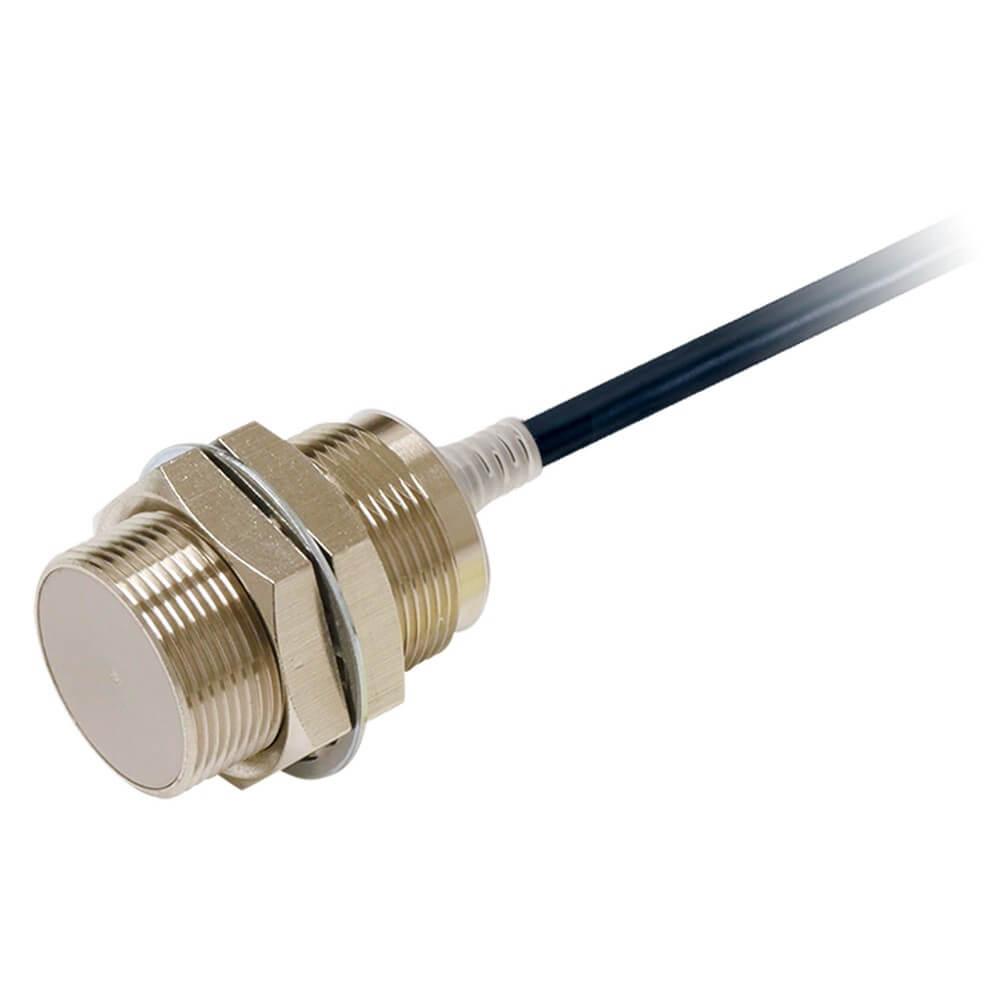
Omron E2E-X10C230 5M Inductive Proximity Sensor
| Feature | Value |
|---|---|
| Manufacturer | Omron |
| Model | E2E-X10C230 5M |
| Sensor Type | Inductive Proximity Sensor |
| Housing Size | M30 |
| Mounting Type | Shielded (Flush) |
| Sensing Distance | 10 mm |
| Output Type | NPN Normally Closed (NC) |
| Supply Voltage | 10 to 30 VDC |
| Connection Method | 5 m PVC Cable |
| Housing Material | Nickel-Plated Brass |
| Response Frequency | 400 Hz |
| Protection Rating | IP67, IP67G, IP69K |
| Operating Temperature | -40°C to +85°C |
| Overall Length | 82.3 mm |
The Omron E2E-X10C230 5M Inductive Proximity Sensor is designed for industrial automation systems that require reliable metallic object detection together with normally closed switching logic. Its integrated 5-meter cable provides installation flexibility in machinery where control panels and sensing points are separated by longer distances.
Built within a robust M30 cylindrical housing, the sensor is engineered for use in production environments exposed to vibration, moisture, dust, and industrial contaminants. The shielded sensing structure allows flush installation in metal surfaces while maintaining consistent sensing characteristics.
Technical Description
The Omron E2E-X10C230 5M Inductive Proximity Sensor operates using electromagnetic induction technology to detect conductive metallic targets without physical contact. The sensor generates a magnetic field at the sensing surface and monitors changes caused by nearby metal objects.
This model features an NPN normally closed output configuration and supports operating voltages from 10 to 30 VDC. The integrated 5-meter PVC cable enables direct connection to industrial controllers, I/O modules, and machine control systems while reducing the need for additional extension wiring.
The Omron E2E-X10C230 5M Inductive Proximity Sensor is commonly integrated into automated machinery where continuous monitoring of metallic machine components is required.
Working Principle
The sensing circuit continuously generates a high-frequency electromagnetic field. When a conductive metal object enters the sensing range, eddy currents are induced within the target material.
These currents absorb energy from the oscillator circuit, causing a measurable change within the sensor electronics. The detection circuit processes this change and switches the output according to the normally closed operating logic.
Because no physical contact occurs between the sensor and the target, mechanical wear is minimized, making inductive sensing suitable for repetitive industrial operations.
Usage Areas
- Industrial conveyor systems
- Machine positioning applications
- Transfer equipment monitoring
- Automated assembly lines
- Material handling systems
- Packaging machinery
- Metal processing equipment
- Production automation systems
The sensor is particularly useful where metallic objects, machine components, or actuator positions must be detected repeatedly during automated production processes.
Industrial Applications
Automotive Production Facilities
Manufacturing systems use proximity sensors to monitor fixture positions, actuator movement, and component presence throughout assembly operations.
Packaging Equipment
Metallic indexing mechanisms and transfer assemblies can be monitored to ensure proper machine sequencing and operational control.
Material Handling Installations
Automated transport systems rely on sensors to detect moving carriers, positioning devices, and mechanical stops within conveyor networks.
Metal Fabrication Processes
Machine tools, presses, and automated forming equipment frequently use inductive sensors to verify machine states and monitor motion sequences.
Advantages
- Non-contact detection reduces mechanical wear
- Normally closed output supports monitoring applications
- Extended 5-meter cable simplifies installation
- Flush mounting capability supports compact machine designs
- Nickel-plated brass housing improves mechanical durability
- IP67, IP67G, and IP69K protection ratings support demanding environments
- Wide operating temperature range allows use in various industrial conditions
- Fast response frequency supports automated machinery
Sector-Specific Examples
In logistics facilities, the sensor can detect metal carrier positions across long conveyor sections where extended cable routing is required.
In automated packaging operations, it can monitor mechanical indexing systems and provide feedback signals to programmable controllers.
In metal processing plants, the sensor can verify actuator positions before machining or forming operations begin.
In warehouse automation systems, it can monitor shuttle mechanisms and transfer devices moving between storage locations.
Considerations When Selecting the Sensor
- Required output logic configuration
- Available installation space
- Target material properties
- Environmental protection requirements
- Distance between sensor and control cabinet
- Required sensing range
- System voltage compatibility
- Machine maintenance strategy
Engineers should confirm that the normally closed output logic aligns with the control architecture and safety philosophy of the application.
For additional information regarding Omron sensor products, related inductive sensing technologies and installation options can be evaluated according to project requirements.
Omron E2E-X10C230 5M Frequently Asked Questions
What type of sensor is the E2E-X10C230 5M?
It is a shielded inductive proximity sensor designed to detect metallic objects without physical contact.
What is the rated sensing distance?
The sensor provides a rated sensing distance of 10 mm.
Which output configuration does this model use?
The sensor features an NPN normally closed output.
What supply voltage is required?
The operating voltage range is 10 to 30 VDC.
What is the cable length?
The sensor is equipped with an integrated 5-meter PVC cable.
Can it be mounted flush in metal?
Yes. The shielded construction allows flush mounting installations.
What environmental protection ratings are available?
The sensor is specified with IP67, IP67G, and IP69K protection ratings.
What industries commonly use this sensor?
Automotive manufacturing, logistics, packaging, machine building, warehouse automation, and metal processing industries frequently use this sensor type.
Can the sensor detect non-metallic materials?
No. Inductive sensing technology is intended for conductive metallic targets.
Why would a 5-meter cable version be selected?
The longer cable can simplify installation in large machines and conveyor systems where control equipment is located farther from the sensing point.