
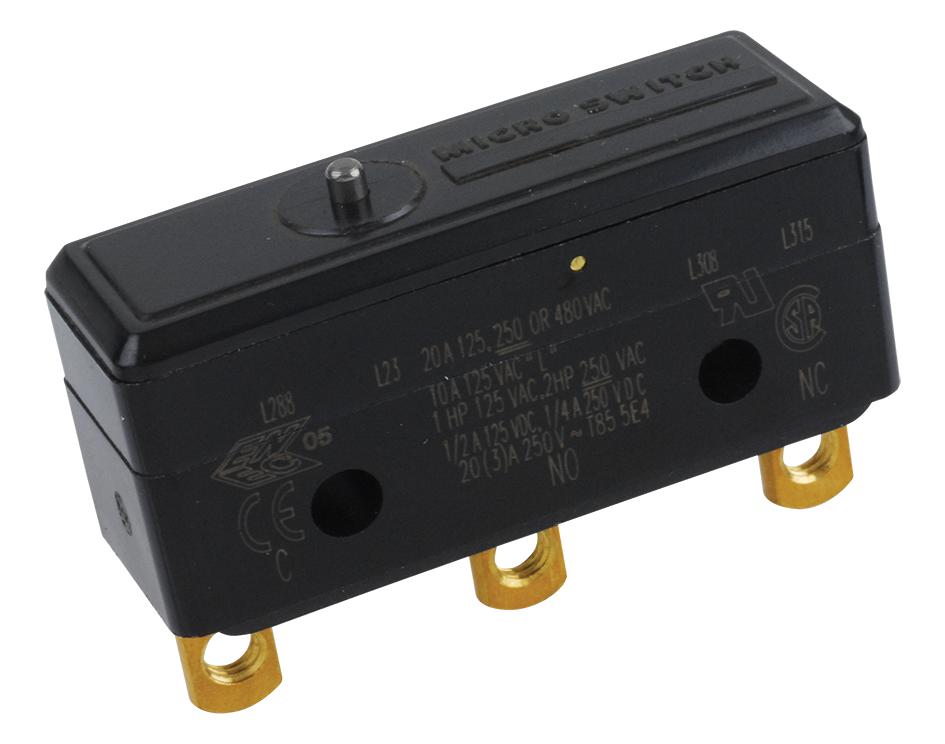
Honeywell BA-2R708-P7 Basic Switch: Industrial Ratings, Design, and Application Guide
The Honeywell BA-2R708-P7 basic switch belongs to Honeywell’s MICRO SWITCH premium large basic switch platform. It is widely referenced as an SPDT switch with a pin plunger actuator and threaded screw terminal blades, built for applications that need dependable snap-action performance under repeated mechanical actuation. In practical engineering terms, the Honeywell BA-2R708-P7 basic switch is a strong fit for OEM machinery, industrial controls, and heavy-duty electromechanical assemblies where switching consistency matters more than cosmetic compactness.
What makes the Honeywell BA-2R708-P7 notable?
The main value of the Honeywell BA-2R708-P7 Honeywell basic switch is its robust electrical rating. Product listings describe it as a single pole double throw switch rated at 20 A for 125/250/480 Vac, with ENEC 20 A at 250 Vac, using a pin plunger actuator. It also features threaded screw terminal blades and mounting holes around 4.3 mm, with approvals including UL, CE, CSA, and ENEC. This combination makes it attractive in industrial designs where electrical load capacity and mechanical repeatability both matter.
Understanding the product type
A Honeywell BA-2R708-P7 basic switch is not a complete enclosed limit switch. Instead, it is a large-format snap-action switch intended to be integrated into equipment. That means the system designer usually determines enclosure strategy, actuator interface, and wiring environment. This architecture is common in industrial machines, access mechanisms, process equipment, and electromechanical assemblies where the switch is protected inside the machine but still needs high electrical performance.
Electrical and mechanical profile
The Honeywell BA-2R708-P7 industrial basic switch uses an SPDT contact arrangement, which gives designers both normally open and normally closed switching options within one device. That flexibility is important in safety interlocks, status monitoring, sequencing logic, and shutoff conditions. The 20 A AC rating signals that the switch is positioned for more demanding load profiles than light-duty miniature switches. The pin plunger actuator supports direct linear engagement, which is often the cleanest solution when designers want a controlled contact point and short actuation path.
Where the BA-2R708-P7 fits best
In real installations, the Honeywell BA-2R708-P7 basic switch is typically relevant in equipment that cycles regularly and depends on stable snap-action response. Examples include industrial door systems, machine guards, transfer assemblies, vending or dispensing systems, and packaging or material-handling mechanisms. Because it is a large basic switch rather than a sealed field device, it is usually chosen where the machine itself offers adequate protection from direct contamination.
Designers also appreciate the Honeywell BA-2R708-P7 Honeywell switch when serviceability is important. Screw-terminal style connections are familiar in industrial maintenance environments and often simplify replacement compared with fully molded or permanently terminated alternatives. That can be helpful in facilities where technicians need to minimize downtime and use existing wiring conventions.
Installation and design considerations
When integrating the Honeywell BA-2R708-P7 basic switch, designers should look at actuation geometry, overtravel control, contact loading, and the full operating environment. The switch performs best when the plunger is actuated in a controlled, repeatable path without excessive impact or side loading. It is also important to consider the actual electrical load type. Resistive, inductive, and motor loads can affect contact wear differently, even when the nominal rating appears acceptable.
Another consideration is enclosure design. Because the Honeywell BA-2R708-P7 basic switch is often used as a built-in component, the machine builder must account for dust, fluids, and accidental mechanical interference at the system level. This is one reason Honeywell basic switches are often specified by experienced engineering teams that want flexibility without giving up performance.
Why it remains relevant in industrial equipment
Not every application needs a fully enclosed field-mounted switch. In many machines, a large basic switch offers the right balance of electrical capacity, integration freedom, and maintenance accessibility. The Honeywell BA-2R708-P7 basic switch fits that niche very well. It supports a straightforward design philosophy: strong mechanical actuation, proven snap-action behavior, and broad acceptance in industrial control architectures. For more information about Honeywell, it is worth reviewing related switch families when comparing sealed and non-sealed options.
FAQ
What type of product is Honeywell BA-2R708-P7?
The Honeywell BA-2R708-P7 is a premium large basic snap-action switch with an SPDT contact arrangement and a pin plunger actuator. It is intended for integration into machinery and industrial equipment.
What is the current rating of the Honeywell BA-2R708-P7 basic switch?
Published product information lists a 20 A rating at 125/250/480 Vac, with ENEC 20 A at 250 Vac. That positions it well for heavier-duty AC switching tasks than many miniature switch alternatives.
Why choose an SPDT basic switch?
An SPDT configuration gives designers one common terminal and both normally open and normally closed outputs. That makes one switch body useful for different logic schemes, feedback paths, and control strategies without redesigning the system.
Is Honeywell BA-2R708-P7 suitable for harsh outdoor mounting?
It is best understood as a built-in basic switch rather than a sealed external limit switch. In harsh environments, it should usually be installed inside a suitable enclosure or protected section of the machine.
What actuator does the Honeywell BA-2R708-P7 use?
This model is described with a pin plunger actuator. That means the switch is actuated through direct linear movement, which is common in controlled mechanical interfaces.
What approvals are associated with this model?
Listings identify UL, CE, CSA, and ENEC approvals. That can be useful for equipment builders working across multiple compliance frameworks and export markets.