
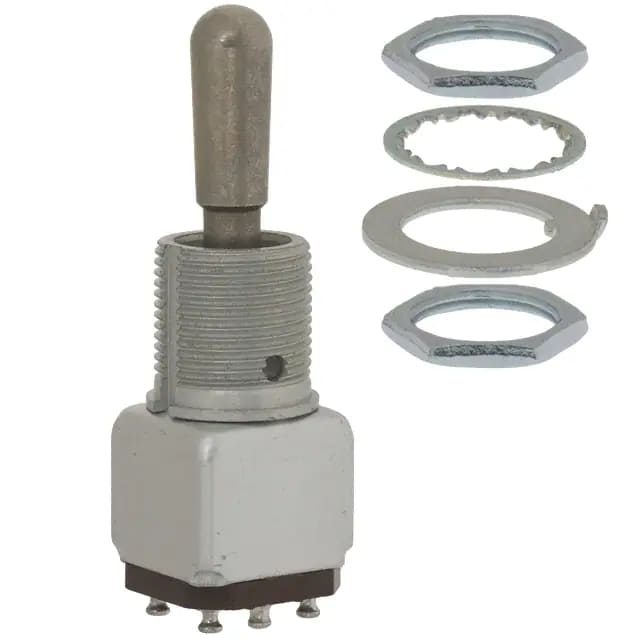
Honeywell 12TW1-5 Toggle Switch Explained
The Honeywell 12TW1-5 toggle switch is one of the most useful formats within the MICRO SWITCH TW Series because it combines a familiar three-position layout with a more nuanced operating action. As listed by Arrow, the Honeywell 12TW1-5 operator controls accessory is a DPDT switch with (ON)-OFF-ON behavior, a round lever, solder terminals, and threaded panel mounting. That means one active side is momentary, the center is off, and the opposite side is maintained, making it suitable for control schemes that need both temporary and fixed states.
Technical Profile of the Honeywell 12TW1-5 Toggle Switch
The TW Series specification gives helpful background for understanding this model. The family is described as a miniature military-grade toggle switch platform with operating temperatures from -65 °C to 71 °C, available 2- or 3-position action, momentary and maintained options, bushing mounting, and solder or other termination styles depending on variant. Electrical ratings in the product sheet include up to 5 A at 125 Vac and 30 Vdc on common resistive listings.
How the (ON)-OFF-ON Action Works
The Honeywell 12TW1-5 toggle switch matters because not every three-position toggle behaves the same way. In Honeywell’s order guide, the “5” function shows a two-pole arrangement where one active position is momentary, the center is off, and the opposite active position is maintained. This makes the Honeywell 12TW1-5 accessory relevant in applications where an operator may need a spring-return command in one direction but a stable command in the other, such as jog control, test initiation, temporary override, or directional actuation.
Why This Switch Is Popular in Engineered Panels
There is a practical reason engineers keep returning to this format. A switch like the Honeywell 12TW1-5 toggle switch gives straightforward visual feedback while also embedding logic into the human interface. The center-off position supports neutrality, the maintained side supports a stable state, and the momentary side supports temporary engagement. In operator panels, that can simplify workflows without introducing more complex control hardware.
Application Context
Honeywell associates the TW Series with industrial machinery, aviation, test instruments, agricultural machinery, process control, construction equipment, and medical instrumentation. In those sectors, durable manual switching is still essential. The Honeywell 12TW1-5 operator controls accessory fits especially well where a control must be intuitive for humans, compact behind the panel, and mechanically dependable over time.
For more information about Honeywell, visit Honeywell.
FAQ
What does (ON)-OFF-ON mean on the Honeywell 12TW1-5?
It means one side of the switch is momentary, the center position is off, and the opposite side is maintained. The lever returns automatically from the momentary side when released.
Is the Honeywell 12TW1-5 a DPDT switch?
Yes. Product listings describe the Honeywell 12TW1-5 toggle switch as a DPDT three-position model with solder terminals and threaded panel mounting.
What kind of applications benefit from this switch action?
This style is useful when one command should be temporary and another should remain engaged until the operator changes it. That can be helpful in jog functions, directional control logic, testing sequences, and other operator-driven equipment functions.
What operating environment does the TW Series support?
The TW Series documentation specifies an operating temperature range of -65 °C to 71 °C and positions the family for demanding sectors such as machinery, aviation, medical instrumentation, and process control.
Why is the Honeywell 12TW1-5 still relevant in modern panels?
Because it combines rugged construction with a very human-friendly control logic. Operators can immediately understand the lever state, and designers can implement both maintained and spring-return behavior in one compact component.