
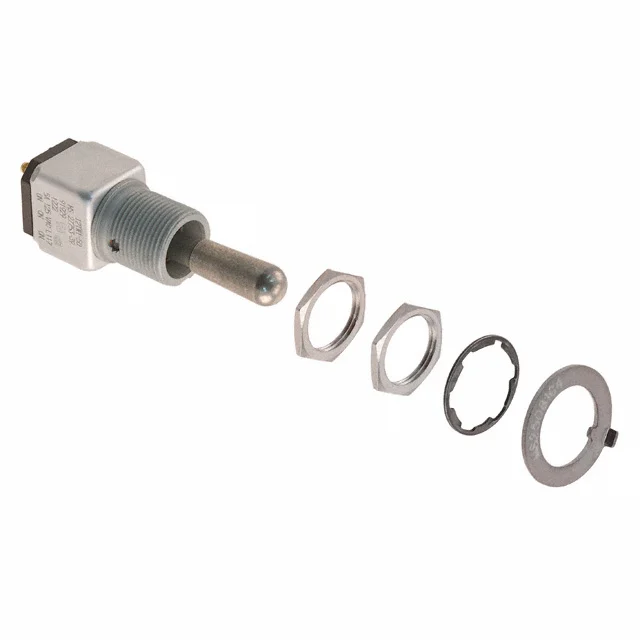
Honeywell 12TW1-50 Toggle Switch Guide
The Honeywell 12TW1-50 toggle switch stands out inside the TW Series because it uses Honeywell’s special -50 circuitry, which is intended for a three-position operating pattern different from the standard center-off arrangement. In Honeywell’s manual order guide, the Honeywell 12TW1-50 operator controls accessory is shown as a two-pole, three-position model with special circuitry, while broader distributor information also places it in the family of panel-mount solder-terminal toggle switches rated for demanding control applications.
Technical Characteristics of the Honeywell 12TW1-50 Toggle Switch
The TW Series specification sheet describes the platform as miniature and military-grade, with operating temperatures from -65 °C to 71 °C, multiple circuitry options, bushing mounting, and resistive ratings up to 5 A at 125 Vac and 30 Vdc in common TW configurations. For the Honeywell 12TW1-50 toggle switch specifically, the order guide identifies a three-position, two-pole format tied to the special -50 circuit arrangement rather than the more familiar ON-OFF-ON pattern.
What Is Special About the -50 Circuitry?
Honeywell’s TW Series product sheet explicitly calls out special circuitries with -10, -50, and -70 suffix numbers. The -50 circuitry is illustrated as a distinct switching arrangement in the product sheet, which signals that it is meant for applications where a standard off-centered logic does not fully match the control requirement. This is an important distinction because many engineers search for a “Honeywell 12TW1-50 toggle switch” expecting a simple three-position toggle, while the actual switching logic is more specialized than that.
Why This Matters in Control Design
A special-circuit toggle can be valuable when the operator interface must reflect a very specific process sequence, directional path, or contact relationship. The Honeywell 12TW1-50 accessory is therefore most useful in equipment where the contact arrangement is just as important as the lever movement itself. In complex panels, the wrong three-position switch may look correct mechanically but behave incorrectly electrically. That is exactly why part-specific circuit suffixes matter.
Where the Honeywell 12TW1-50 Fits
TW Series toggles are used in industrial machinery, commercial and military aviation, construction equipment, test instruments, agriculture, process control, and medical instrumentation. Within that context, the Honeywell 12TW1-50 toggle switch makes the most sense in engineered systems that need a compact, panel-mount, manually actuated switch with clearly defined three-position behavior and robust operating credentials.
For more information about Honeywell, visit Honeywell.
FAQ
What kind of switch is the Honeywell 12TW1-50?
The Honeywell 12TW1-50 is a TW Series three-position toggle switch associated with Honeywell’s special -50 circuitry. Honeywell’s manual guide presents it as a two-pole special-circuit model.
Is the Honeywell 12TW1-50 a standard ON-OFF-ON switch?
No. The documentation places it in the special -50 circuitry category, which is different from the standard center-off style shown elsewhere in the TW Series order guide.
Why is special circuitry important when choosing a toggle switch?
Because the visible lever positions do not tell the full electrical story. Two switches can look nearly identical on the panel but create different internal contact states, which can change how the equipment behaves.
What are the common TW Series ratings around this product family?
The TW Series specification sheet lists operating temperatures from -65 °C to 71 °C and common resistive ratings up to 5 A at 125 Vac and 30 Vdc, depending on configuration.
Who typically uses a Honeywell 12TW1-50 operator controls accessory?
It is most relevant to engineers, panel builders, and maintenance professionals working in industrial, instrumentation, aviation, agricultural, medical, and other demanding equipment environments.