
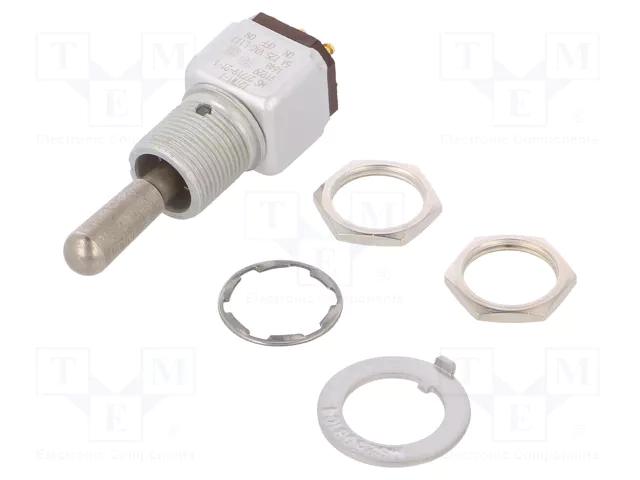
Honeywell 12TW1-3G Toggle Switch Guide
The Honeywell 12TW1-3G toggle switch is part of the MICRO SWITCH TW Series, a long-established line of compact, military-grade toggle switches designed for control panels that demand reliable manual actuation. As a Honeywell 12TW1-3G operator controls accessory, this model is defined by its 2-pole, 2-position configuration, solder termination, locking lever, and threaded panel-mount format. In practical terms, it is the kind of switch used when the operator should not move between states casually or by accident.
Technical Characteristics of the Honeywell 12TW1-3G Toggle Switch
Arrow identifies the Honeywell 12TW1-3G toggle switch as an ON-ON DPDT locking lever switch with solder terminals, a 5 A rating at 125 Vac, and 30 Vdc capability in a panel-mount threaded design. The wider TW Series documentation adds important context: the family is built around miniature military-grade construction, qualified sealing, operating temperatures from -65 °C to 71 °C, and contact options such as fine silver or gold-plated materials depending on configuration.
Understanding the G Suffix
What separates the Honeywell 12TW1-3G accessory from a closely related part like 12TW1-3F is the locking behavior. In Honeywell’s locking configuration chart, suffix G means the lever is locked in the extreme position on the keyway side. That distinction may look small on paper, but it can influence operator workflow, panel orientation choices, and service procedures. In tightly designed systems, even the side of the locking action can matter for ergonomic consistency and error reduction.
Why This Toggle Format Remains Relevant
Many engineers still specify Honeywell TW Series parts because they offer a balance of clarity and ruggedness. A locking toggle provides immediate visual state recognition, mechanical confirmation through lever movement, and a more deliberate human-machine interaction than a basic non-locking lever. The Honeywell 12TW1-3G toggle switch fits especially well in panels where accidental actuation could interrupt a process, alter a mode, or trigger an unwanted operational state.
Typical Applications
Honeywell lists TW Series use cases across industrial machinery, military and commercial aviation, construction equipment, test instruments, agricultural machinery, process control systems, and medical instrumentation. That broad placement tells an important story: the Honeywell 12TW1-3G toggle switch is less about consumer simplicity and more about dependable behavior under real operating pressure, including vibration, environmental exposure, and frequent operator interaction.
For more information about Honeywell, visit Honeywell.
FAQ
What is the Honeywell 12TW1-3G?
The Honeywell 12TW1-3G is a TW Series 2-pole, 2-position locking toggle switch with solder terminals and panel-mount threaded installation. It is commonly described as a DPDT ON-ON switch.
How is the Honeywell 12TW1-3G different from the 12TW1-3F?
The core platform is very similar, but the locking suffix changes the lever behavior. In Honeywell’s chart, G locks the extreme position on the keyway side, while F locks the extreme position on the opposite keyway side.
What electrical rating should users note first?
A commonly cited product listing for the Honeywell 12TW1-3G shows 5 A at 125 Vac and 30 Vdc capability. The TW Series family documentation also frames the platform around 0.1 A to 5.0 A usage ranges depending on load and configuration.
Is the Honeywell 12TW1-3G suited to harsh environments?
The TW Series was developed for demanding applications and includes environmental sealing capability within the family, along with a wide operating temperature range. That makes it a strong candidate for engineered equipment rather than light-duty decorative switching.
Honeywell Why would someone choose a locking lever toggle switch?
A locking lever helps reduce unintended switching. In equipment where a mode change or command should be intentional, a pull-to-unlock action provides an extra layer of operator control and can support safer, more disciplined panel use.