
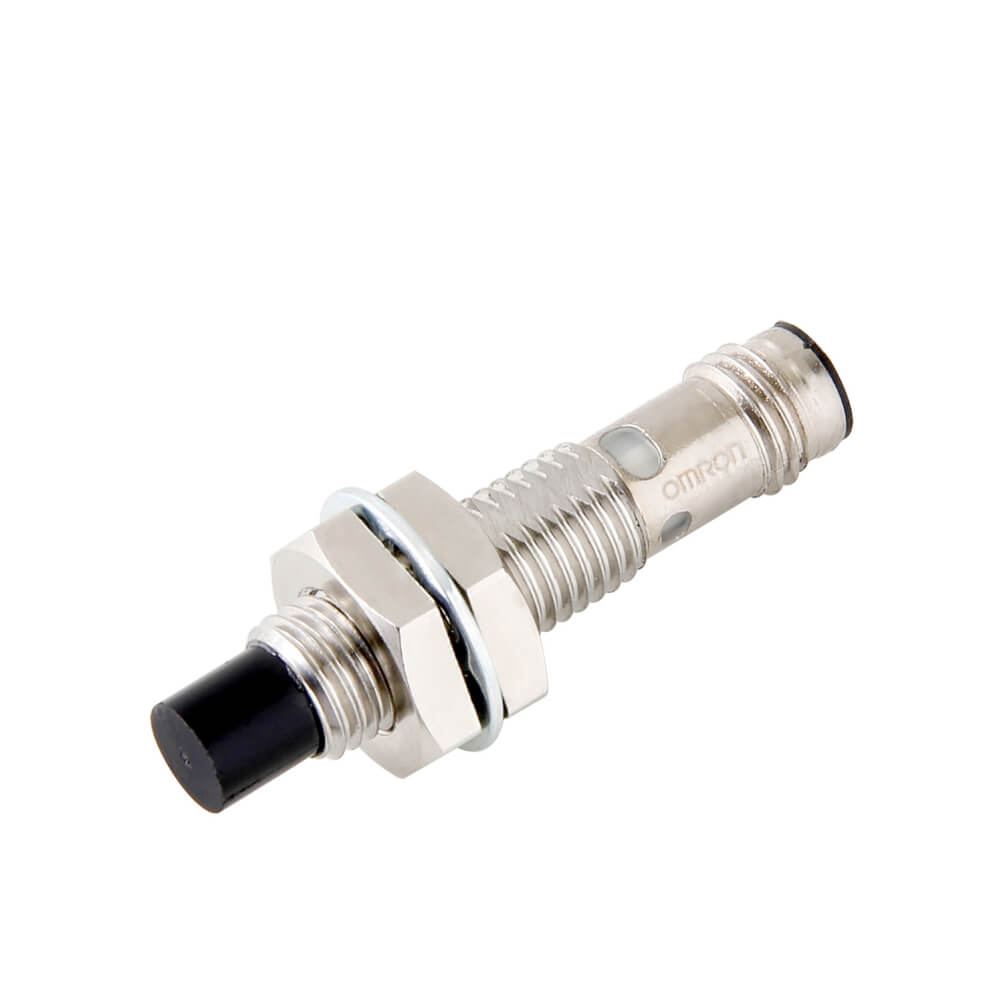
Omron E2E-X4MC28-M3 Inductive Proximity Sensor
| Specification | Value |
|---|---|
| Sensor Type | Inductive Proximity Sensor |
| Series | E2E NEXT |
| Sensing Distance | 4 mm |
| Housing Size | M8 |
| Mounting Style | Non-flush (Unshielded) |
| Output Type | PNP Normally Open (NO) |
| Supply Voltage | 10 to 30 VDC |
| Connection Type | M8 Connector |
| Response Frequency | 1 kHz |
| Housing Material | Stainless Steel (SUS303) |
| Protection Rating | IP67 / IP69K |
| Operating Temperature | -40°C to +85°C |
| Overall Length | 43 mm |
| Thread Diameter | M8 |
Industrial automation systems often require reliable object detection solutions that operate consistently under demanding environmental conditions. The Omron E2E-X4MC28-M3 Inductive Proximity Sensor is designed for this purpose, offering non-contact metal detection in machinery, manufacturing equipment, and automated handling systems. Its compact M8 housing allows installation in restricted spaces while maintaining dependable sensing performance.
Technical Description
The Omron E2E-X4MC28-M3 Inductive Proximity Sensor is part of Omron’s E2E NEXT series. This model features a 4 mm sensing distance and a PNP normally open output configuration. It is designed to detect metallic objects without physical contact, helping reduce wear associated with mechanical limit switches.
The sensor is housed in a stainless-steel body and supports operation in environments exposed to moisture, dust, vibration, and cleaning processes. The IP67 and IP69K protection ratings contribute to stable operation in industrial facilities where environmental protection is critical.
Working Principle
The sensor operates using electromagnetic induction. An oscillator circuit generates a magnetic field at the sensing face. When a conductive metallic target enters the sensing zone, eddy currents are induced within the object.
These currents absorb energy from the oscillator, causing a measurable change in the oscillation amplitude. Internal circuitry evaluates this change and activates the output when the detection threshold is reached. This sensing method eliminates direct mechanical contact and supports long operational life.
Applications in Automation Systems
The Omron E2E-X4MC28-M3 Inductive Proximity Sensor is commonly used in automated production equipment where accurate metal detection is required.
- Conveyor position monitoring
- Automated assembly stations
- Industrial robotics
- Packaging machinery
- Transfer systems
- Sorting equipment
- Machine tool automation
- Part presence verification systems
Its compact dimensions make it suitable for integration into machine frames, actuators, and moving assemblies.
Industrial Applications
In electronics manufacturing, the sensor can verify the presence of metallic fixtures used during assembly operations. Within automated storage systems, it can monitor the position of lifting mechanisms and shuttle devices.
Packaging facilities often employ inductive sensors to confirm the movement and positioning of metallic machine components. Material handling systems can use the sensor to detect carrier locations and control sequential machine operations.
Key Advantages
- Reliable non-contact sensing technology
- Compact M8 threaded housing
- 4 mm sensing distance for stable detection
- PNP normally open output compatibility
- Resistance to dust and water ingress
- High mechanical durability
- Wide operating temperature range
- Simple installation using connector-based wiring
Sector-Specific Use Cases
Logistics Automation
Warehouse automation systems can utilize the sensor to monitor shuttle positions and transfer mechanisms.
Electronics Production
Manufacturing equipment may use the sensor to verify tooling positions before automated assembly cycles begin.
Packaging Facilities
The sensor can monitor machine actuators and metal guide components within high-speed packaging lines.
Mechanical Engineering
Machine builders frequently integrate inductive sensors for end-position detection and motion monitoring.
Selection Considerations
Choosing the correct inductive sensor requires evaluating target material, sensing distance, mounting conditions, output requirements, and environmental factors. Engineers should also verify compatibility with PLC input modules and machine control architectures.
The Omron E2E-X4MC28-M3 Inductive Proximity Sensor is suitable for installations requiring a compact sensor with PNP normally open output functionality and enhanced environmental protection.
Additional information regarding Omron sensor series can help engineers compare sensing technologies for specific industrial applications.
Performance in Challenging Environments
Modern industrial facilities often expose automation components to temperature fluctuations, cleaning chemicals, and continuous machine vibration. The Omron E2E-X4MC28-M3 Inductive Proximity Sensor is engineered to maintain stable performance under these conditions.
The combination of stainless-steel construction, robust sealing, and proven inductive sensing technology enables the Omron E2E-X4MC28-M3 Inductive Proximity Sensor to support long-term operation across a variety of industrial environments.
Frequently Asked Questions
What is the sensing distance of this sensor?
The rated sensing distance is 4 mm.
What output type does the sensor provide?
It uses a PNP normally open output configuration.
Can it detect non-metallic objects?
No. The sensor is designed specifically for metallic target detection.
What supply voltage range is supported?
The operating voltage range is 10 to 30 VDC.
Is the sensor suitable for washdown applications?
Yes. Its IP67 and IP69K protection ratings support use in washdown environments.
What material is used for the housing?
The housing is manufactured from SUS303 stainless steel.
Can the sensor be used in cold environments?
Yes. It supports operating temperatures down to -40°C.
Which industries commonly use this sensor?
Automotive, packaging, logistics, machinery manufacturing, and electronics production industries commonly utilize inductive proximity sensors.
Does the sensor require physical contact with the target?
No. Detection occurs through electromagnetic induction without physical contact.
Why is non-contact sensing beneficial?
It minimizes mechanical wear, reduces maintenance requirements, and improves long-term reliability.