
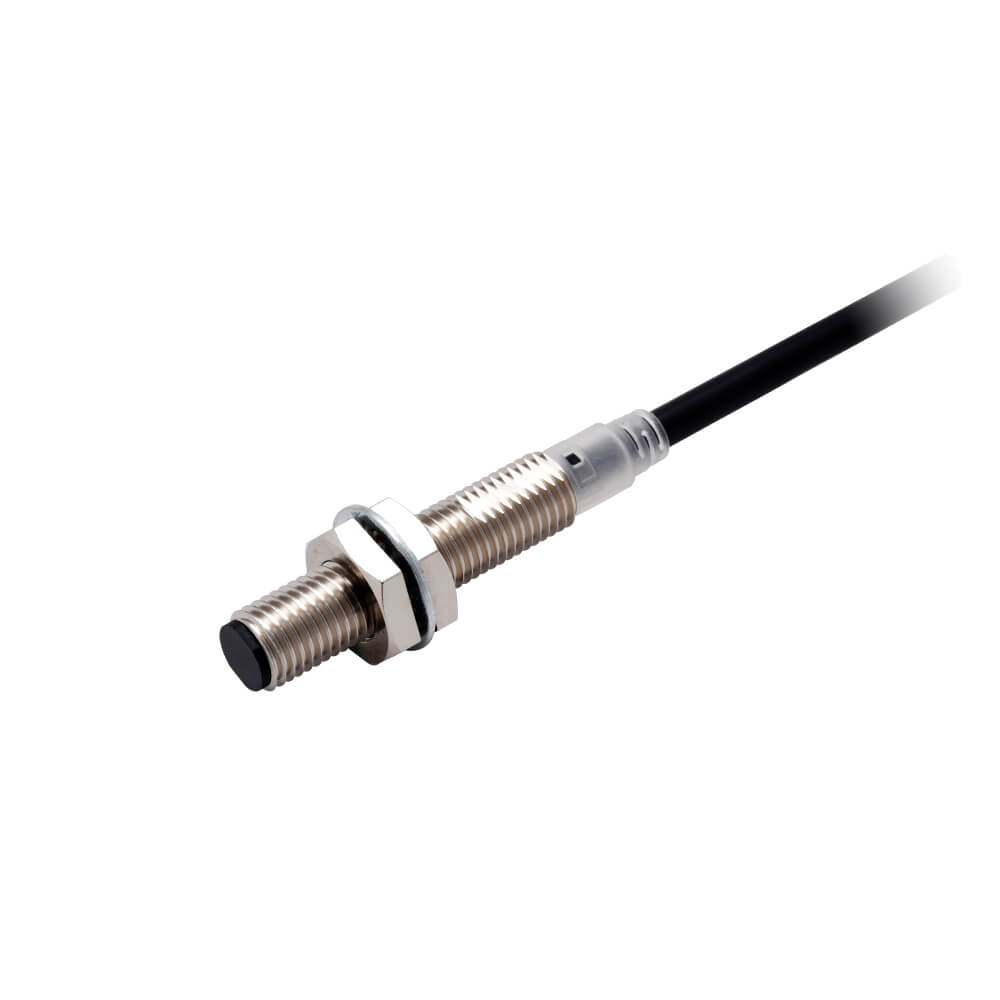
Omron E2E-X3B1TL8 2M Inductive Proximity Sensor
| Feature | Value |
|---|---|
| Sensor Type | Inductive Proximity Sensor |
| Series | E2E NEXT |
| Housing Diameter | M8 |
| Housing Style | Long Body Threaded Cylindrical |
| Sensing Distance | 3 mm |
| Mounting Type | Quasi-flush |
| Output Type | PNP Normally Open |
| Supply Voltage | 10 to 30 VDC |
| Connection Method | Pre-wired Cable |
| Cable Length | 2 m |
| Housing Material | Nickel-plated Brass |
| Protection Rating | IP67 / IP67G / IP69K |
| Operating Temperature | -25°C to +70°C |
The Omron E2E-X3B1TL8 2M Inductive Proximity Sensor is developed for precise metallic object detection in industrial automation systems where extended threaded housing length can simplify mounting arrangements. The sensor belongs to the E2E NEXT family and combines compact M8 dimensions with robust environmental protection and dependable sensing performance.
Its long-body construction provides additional flexibility during installation, particularly in machinery where mounting brackets, protective guards, or structural elements require greater threaded engagement. The sensor is designed for non-contact metal detection and supports stable operation in a wide variety of manufacturing environments.
Technical Description
The Omron E2E-X3B1TL8 2M Inductive Proximity Sensor utilizes electromagnetic induction technology to detect conductive metallic targets. The sensing element generates a high-frequency electromagnetic field at the active face of the sensor. When a metal object enters the sensing zone, eddy currents are induced within the target material.
These currents influence the oscillation circuit, creating measurable changes that are processed by the sensor electronics. Once the detection threshold is reached, the PNP normally open output switches and transmits a signal to the connected control system.
The Omron E2E-X3B1TL8 2M Inductive Proximity Sensor provides a nominal sensing distance of 3 mm and includes a factory-installed 2-meter cable for direct connection to industrial control equipment.
Working Principle
Inductive proximity sensors operate without mechanical contact. During normal operation, the sensor continuously emits an electromagnetic field. When a conductive metal object approaches the sensing surface, electromagnetic energy is absorbed through induced eddy currents.
The resulting variation in oscillation amplitude is detected by the internal circuitry. The sensor then activates its output signal, allowing controllers, PLCs, and automation systems to recognize the presence or position of the target.
This non-contact detection principle minimizes mechanical wear and supports long operational life in applications with frequent switching cycles.
Primary Areas of Use
- Industrial machinery
- Automated assembly systems
- Packaging equipment
- Material handling systems
- Conveyor automation
- Machine tool applications
- Automotive manufacturing equipment
- Robotic production cells
The extended threaded body makes this model particularly useful in installations where additional mounting depth is required.
Industrial Applications
Automotive Assembly Systems
Automotive manufacturing equipment frequently requires position verification of fixtures, carriers, and mechanical assemblies. The sensor can detect metallic components and provide switching signals for process control.
Packaging Machinery
Packaging equipment often depends on accurate monitoring of moving machine components. The sensor can detect guide rails, indexing mechanisms, and actuator positions during production cycles.
Conveyor Automation
Conveyor systems use proximity sensors to monitor transfer stations, pallet positioning, and stop mechanisms. Reliable metal detection supports synchronized material movement throughout the facility.
Machine Tool Equipment
Machining systems utilize inductive sensors to verify fixture engagement, tool positioning mechanisms, and workpiece presence before processing operations begin.
Advantages
- Extended threaded body for flexible mounting arrangements
- Compact M8 housing dimensions
- Reliable 3 mm sensing distance
- PNP normally open output configuration
- Integrated 2-meter cable connection
- Non-contact metal detection technology
- IP67, IP67G, and IP69K environmental protection
- Nickel-plated brass construction for mechanical durability
Sector-Specific Usage Examples
- Monitoring fixture positions in automotive assembly lines
- Detecting metal carriers in packaging equipment
- Verifying actuator positions in automated machinery
- Monitoring transfer units in logistics systems
- Detecting workpiece presence in machining centers
- Position sensing within robotic handling equipment
Considerations When Selecting This Sensor
Engineers should assess mounting requirements, sensing distance needs, environmental conditions, target material properties, and electrical interface compatibility before selecting a proximity sensor.
The long-body design of the Omron E2E-X3B1TL8 2M Inductive Proximity Sensor can simplify installation in applications where standard housing lengths may not provide sufficient mounting flexibility.
Omron E2E-X3B1TL8 2M For additional sensing technologies and automation components, engineers can explore Omron sensör serileri to compare available industrial sensor solutions.
Omron E2E-X3B1TL8 2M Frequently Asked Questions
What type of sensor is the Omron E2E-X3B1TL8 2M Inductive Proximity Sensor?
It is an inductive proximity sensor designed for non-contact detection of metallic objects.
What is the sensing distance?
The nominal sensing distance is 3 mm.
What output configuration does this model use?
The sensor features a PNP normally open output.
What is the benefit of the long-body housing?
The extended threaded section provides greater flexibility when mounting the sensor in deeper brackets or machine structures.
Omron E2E-X3B1TL8 2M How long is the cable?
The sensor includes a factory-installed 2-meter cable.
Which materials can be detected?
The sensor is intended for conductive metallic target detection using inductive sensing technology.
Can the sensor operate in harsh industrial environments?
Yes. The sensor supports IP67, IP67G, and IP69K protection ratings.
Which industries commonly use this sensor?
It is frequently used in manufacturing, packaging, automotive production, logistics, and machine automation systems.
How does the sensor detect metal objects?
It monitors changes in an electromagnetic field caused by eddy currents generated within conductive targets.
Why is non-contact sensing advantageous?
Non-contact operation minimizes mechanical wear and supports reliable performance in high-cycle industrial applications.