
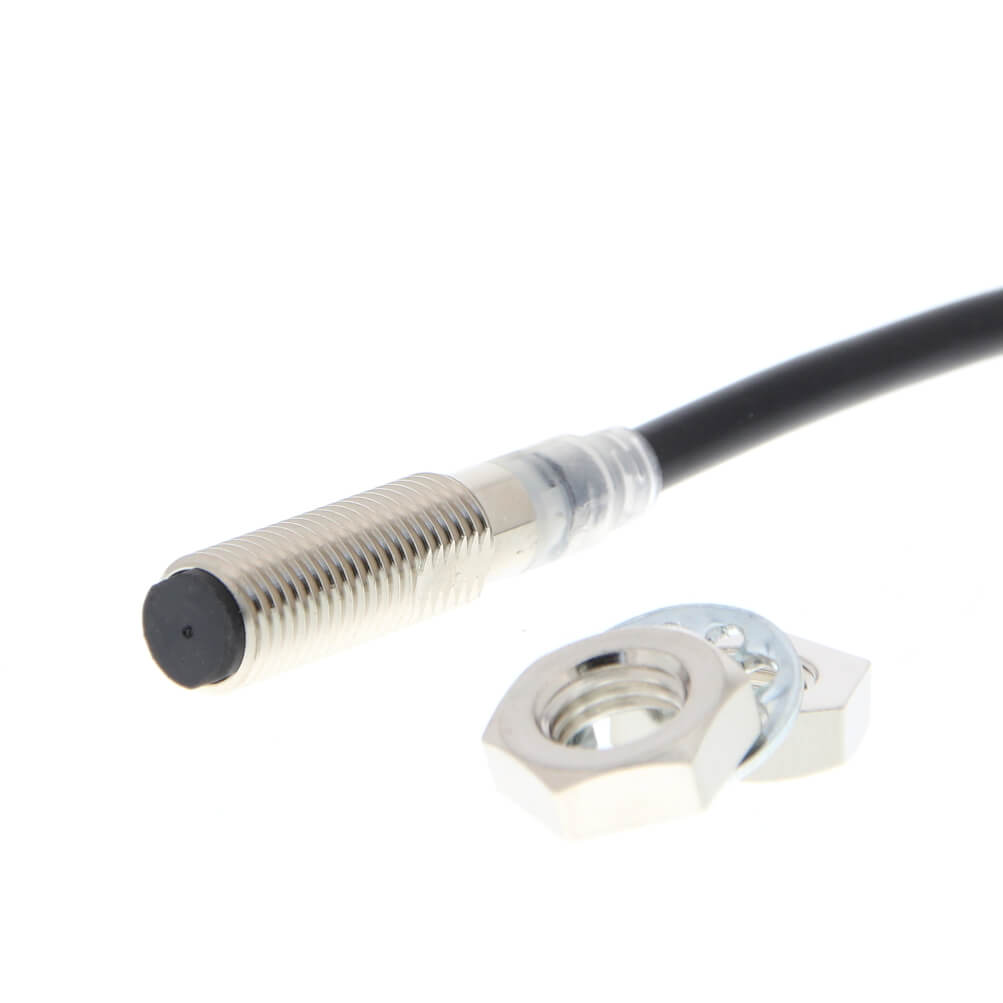
Omron E2E-X3B1T8-R 2M Inductive Proximity Sensor
| Feature | Value |
|---|---|
| Sensor Type | Inductive Proximity Sensor |
| Series | E2E NEXT |
| Housing Diameter | M8 |
| Sensing Distance | 3 mm |
| Mounting Type | Quasi-flush |
| Output Configuration | DC 2-Wire |
| Supply Voltage | 10 to 30 VDC |
| Connection Method | Pre-wired Cable |
| Cable Length | 2 m |
| Housing Material | Nickel-plated Brass |
| Protection Rating | IP67 / IP67G / IP69K |
| Operating Temperature | -25°C to +70°C |
| Overall Length | 37.8 mm |
The Omron E2E-X3B1T8-R 2M Inductive Proximity Sensor is engineered for reliable non-contact detection of metallic objects in industrial automation systems. Designed with a compact M8 cylindrical housing, this sensor provides dependable switching performance while minimizing installation space requirements. The DC 2-wire configuration makes it suitable for applications where simplified wiring and straightforward integration are preferred.
As a member of the E2E NEXT sensor family, the device incorporates durable construction and environmental protection characteristics intended for operation in manufacturing facilities, machine automation systems, and material handling equipment.
Technical Description
The Omron E2E-X3B1T8-R 2M Inductive Proximity Sensor operates using electromagnetic induction principles to detect conductive metallic targets. A high-frequency oscillation circuit creates an electromagnetic field at the sensing surface. When a metal object enters the sensing zone, eddy currents are generated within the target, causing measurable changes in the oscillation characteristics.
The sensor electronics continuously monitor these variations and activate the switching output when the target reaches the detection threshold. This contactless sensing method eliminates mechanical wear and supports long service life in repetitive industrial processes.
The Omron E2E-X3B1T8-R 2M Inductive Proximity Sensor offers a nominal sensing distance of 3 mm and includes a factory-installed 2-meter cable for direct integration into control systems.
Working Principle
Inductive sensors detect metal objects by monitoring disturbances in an electromagnetic field. During operation, the sensing face emits a stable electromagnetic field into the surrounding area. As a conductive target approaches, energy losses occur due to induced eddy currents.
The internal electronics interpret these energy changes and convert them into an output signal. Because no physical contact occurs between the sensor and the target, performance remains stable even during high-cycle industrial operations.
This detection principle is commonly applied in systems requiring reliable position monitoring, object verification, and machine sequence control.
Typical Areas of Use
- Assembly automation systems
- Industrial conveyor equipment
- Packaging machinery
- Material transport systems
- Machine tools
- Industrial processing equipment
- Automated production lines
- Mechanical positioning systems
Omron E2E-X3B1T8-R 2M The compact housing and 2-wire design make the sensor suitable for installations where wiring simplicity and limited mounting space are important considerations.
Industrial Applications
Production Machinery
Manufacturing equipment often requires confirmation of moving component positions before sequential operations can proceed. The sensor can detect metallic machine elements and provide switching signals to automation controllers.
Material Handling Systems
Conveyor and transfer systems rely on position feedback to coordinate product movement. The sensor can monitor stops, carriers, and metal transport mechanisms throughout production facilities.
Packaging Equipment
Packaging machines frequently use inductive sensors to monitor guide assemblies, actuator positions, and indexing mechanisms. Reliable metal detection contributes to consistent machine operation.
Machine Tool Installations
In machining environments, proximity sensors are used to verify workpiece presence, fixture engagement, and mechanical positioning before processing begins.
Advantages
- Compact M8 cylindrical housing
- Reliable 3 mm sensing range
- DC 2-wire wiring configuration
- Integrated 2-meter cable
- Non-contact metal detection
- High resistance to industrial contaminants
- IP67, IP67G, and IP69K environmental protection
- Nickel-plated brass housing construction
Sector-Specific Usage Examples
- Monitoring metal carriers in assembly systems
- Detecting fixture positions in manufacturing equipment
- Position sensing for automated transfer units
- Monitoring actuator movement in packaging machines
- Detecting metal workpieces in machining operations
- Position verification in warehouse automation equipment
Factors to Consider During Sensor Selection
When selecting an inductive proximity sensor, engineers should evaluate sensing distance requirements, target material characteristics, installation dimensions, electrical interface needs, and environmental operating conditions.
The Omron E2E-X3B1T8-R 2M Inductive Proximity Sensor is suitable for applications requiring compact dimensions, simple DC 2-wire connectivity, and dependable metal object detection.
Additional information regarding Daha fazla Omron sensör çözümü may assist engineers in selecting appropriate sensing technologies for automation projects.
Omron E2E-X3B1T8-R 2M Frequently Asked Questions
What type of sensor is this?
It is an inductive proximity sensor designed for non-contact detection of metallic objects.
What is the nominal sensing distance?
The sensor provides a nominal sensing distance of 3 mm.
What output configuration is used?
This model utilizes a DC 2-wire output configuration.
How long is the attached cable?
The sensor is supplied with a 2-meter pre-wired cable.
Which materials can be detected?
The sensor is designed for detecting conductive metallic targets.
Can it operate in harsh industrial environments?
Yes. The device offers IP67, IP67G, and IP69K protection ratings.
What industries commonly use this sensor?
It is frequently used in manufacturing, packaging, logistics, machine building, and automation systems.
How does non-contact sensing improve reliability?
Because no mechanical contact occurs during detection, wear is minimized and operational consistency can be maintained over extended periods.
What housing size is used?
The sensor features a compact M8 threaded housing.
Why choose a 2-wire sensor configuration?
2-wire designs can simplify wiring requirements in suitable industrial control systems.