
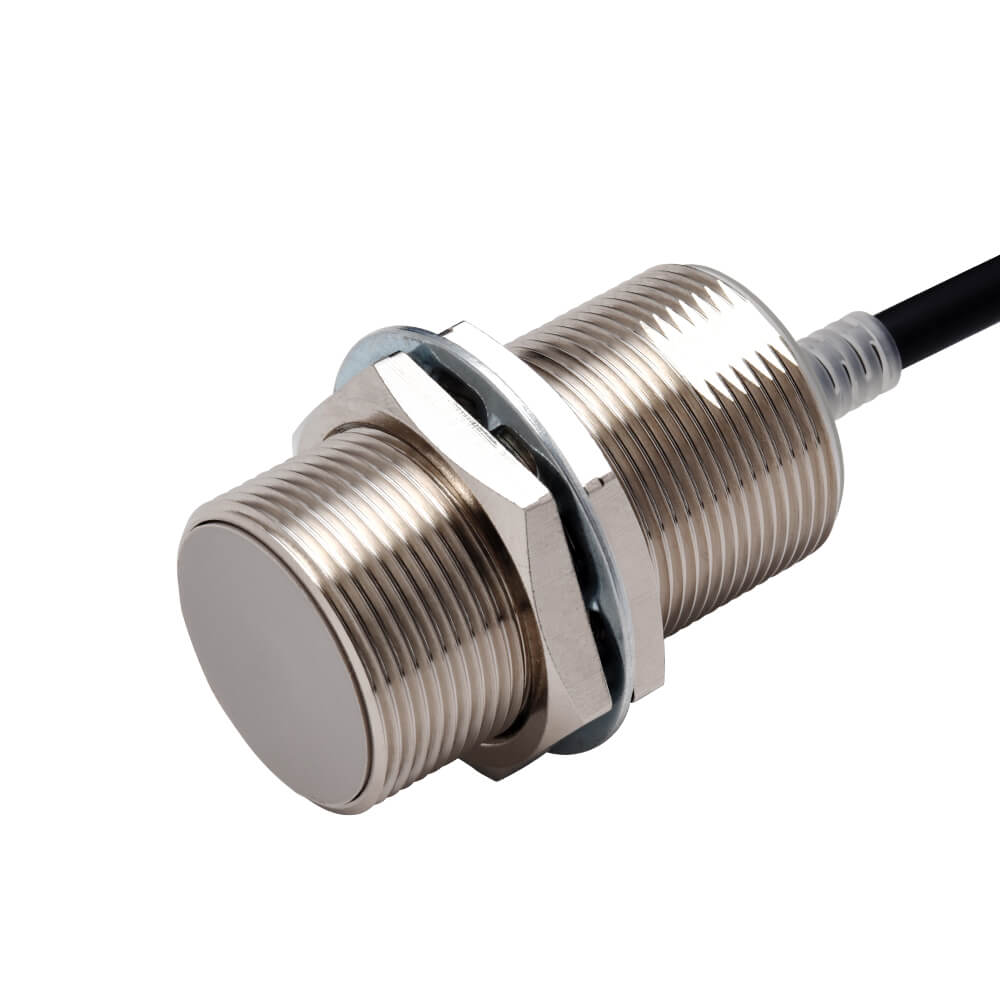
Omron E2E-X10C1L30 5M Inductive Proximity Sensor
| Feature | Value |
|---|---|
| Manufacturer | Omron |
| Model | E2E-X10C1L30 5M |
| Sensor Type | Inductive Proximity Sensor |
| Housing Size | M30 |
| Mounting Type | Shielded (Flush) |
| Sensing Distance | 10 mm |
| Output Type | NPN Normally Open (NO) |
| Supply Voltage | 10 to 30 VDC |
| Connection Method | 5 m PVC Cable |
| Housing Material | Nickel-Plated Brass |
| Response Frequency | 400 Hz |
| Protection Rating | IP67, IP67G, IP69K |
| Operating Temperature | -40°C to +85°C |
| Overall Length | 82.3 mm |
The Omron E2E-X10C1L30 5M Inductive Proximity Sensor is intended for industrial position sensing and object detection tasks where extended cable routing is required. Its integrated 5-meter cable simplifies installation in large machinery, conveyor networks, and distributed automation systems.
Built with a shielded M30 cylindrical housing, the sensor detects metallic targets without physical contact. This approach minimizes wear while providing repeatable switching performance in demanding industrial environments.
Technical Description
The Omron E2E-X10C1L30 5M Inductive Proximity Sensor employs inductive sensing technology to detect conductive materials entering its electromagnetic field. The sensor incorporates a three-wire DC circuit with an NPN normally open output and operates within a 10 to 30 VDC power range.
Its nickel-plated brass enclosure offers mechanical protection while supporting installation in production facilities where vibration, oil exposure, and contaminants may be present.
The Omron E2E-X10C1L30 5M Inductive Proximity Sensor is frequently integrated into PLC-controlled systems requiring reliable position feedback from metallic machine elements.
Working Principle
The sensing face generates an oscillating electromagnetic field. When a metallic object approaches, induced eddy currents alter the oscillation characteristics.
The sensor electronics continuously monitor these changes. Once the predefined threshold is reached, the output switches, allowing the control system to recognize the presence of the target.
This operating method enables high-speed detection without direct mechanical interaction.
Common Usage Areas
- Production line automation
- Conveyor monitoring systems
- Automated machinery
- Sorting equipment
- Industrial lifting systems
- Machine guarding functions
- Transfer station monitoring
- Automated assembly equipment
Industrial Applications
Logistics Centers
Conveyor structures spanning long distances often benefit from the integrated 5-meter cable, reducing additional wiring requirements.
Manufacturing Equipment
The sensor can monitor moving machine components and provide feedback to motion control systems.
Packaging Automation
Metallic indexing mechanisms and transfer assemblies can be tracked accurately during repetitive operating cycles.
Process Industry Installations
Production equipment can use proximity sensing to verify actuator positions and equipment status.
Advantages
- Extended cable length simplifies installation
- Reliable non-contact detection
- Flush mounting capability
- High environmental protection ratings
- Suitable for harsh industrial conditions
- Durable nickel-plated brass housing
- Fast switching performance
Sector-Specific Examples
Distribution centers may use the sensor to detect the position of metal carriers moving through automated sorting systems.
Heavy equipment manufacturers can integrate it into hydraulic machine assemblies for position verification.
Packaging operations often utilize inductive sensors to synchronize machine sequences involving metallic mechanisms.
Industrial assembly plants can employ the sensor to confirm fixture alignment before automated operations begin.
Selection Considerations
- Available mounting space
- Required output logic
- Distance to the control cabinet
- Environmental exposure conditions
- Target material composition
- Detection speed requirements
- Protection rating requirements
Where longer wiring runs are required, the integrated 5-meter cable can simplify installation planning and reduce connector requirements.
Engineers looking for additional Omron sensor series can compare various sensing distances, output configurations, and connection methods.
Frequently Asked Questions
What distinguishes this model from the 2M version?
The primary difference is the integrated cable length, which is 5 meters instead of 2 meters.
What sensing technology does it use?
It uses inductive sensing technology for metallic object detection.
What is the rated sensing distance?
The sensor provides a 10 mm sensing distance.
Is it suitable for industrial automation?
Yes. It is designed specifically for automation and machine control applications.
Can it detect non-metallic materials?
No. Inductive sensors are intended primarily for metallic targets.
What output type is available?
The sensor provides an NPN normally open output.
What protection ratings are supported?
IP67, IP67G, and IP69K protection levels are specified.
What operating temperature range is supported?
The sensor is designed to operate from -40°C to +85°C.