
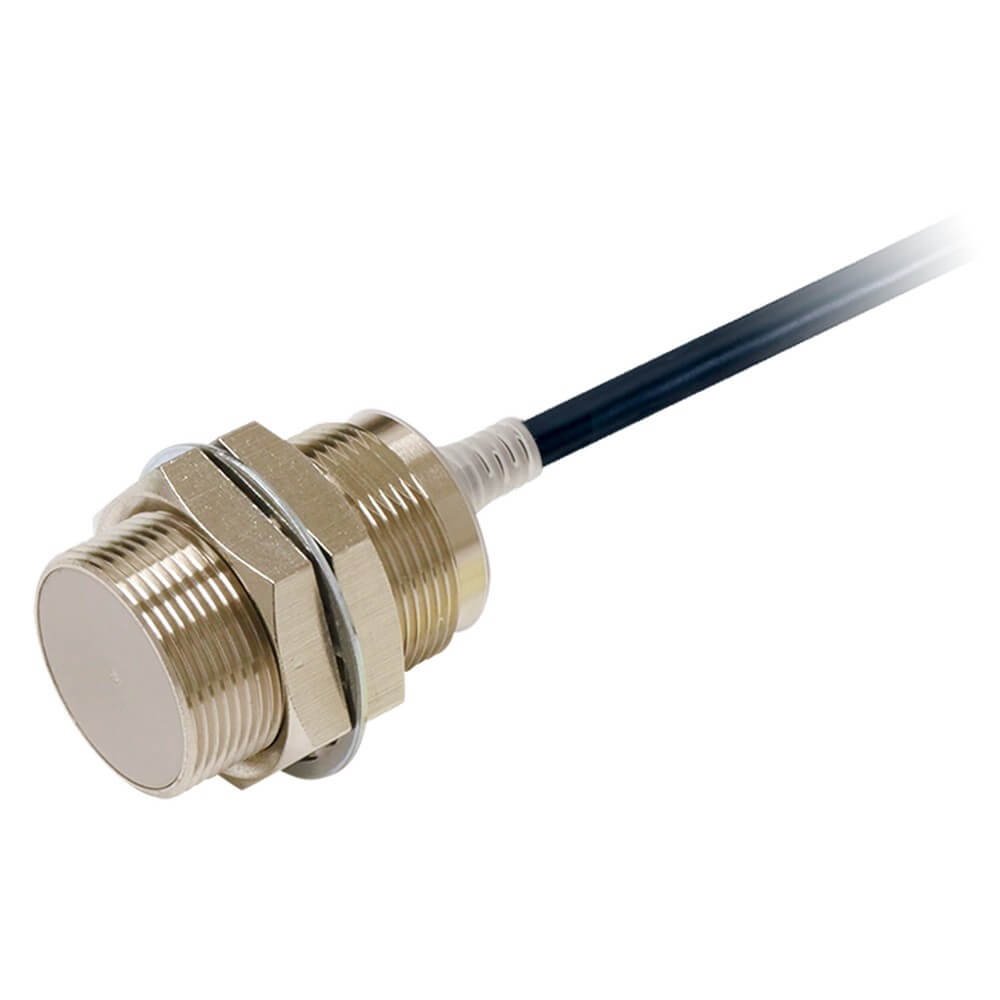
Omron E2E-X10C1L30 2M Inductive Proximity Sensor
| Feature | Value |
|---|---|
| Manufacturer | Omron |
| Model | E2E-X10C1L30 2M |
| Sensor Type | Inductive Proximity Sensor |
| Housing Size | M30 |
| Mounting Type | Shielded (Flush) |
| Sensing Distance | 10 mm |
| Output Type | NPN Normally Open (NO) |
| Supply Voltage | 10 to 30 VDC |
| Connection Method | 2 m PVC Cable |
| Housing Material | Nickel-Plated Brass |
| Response Frequency | 400 Hz |
| Protection Rating | IP67, IP67G, IP69K |
| Operating Temperature | -40°C to +85°C |
| Overall Length | 82.3 mm |
The Omron E2E-X10C1L30 2M Inductive Proximity Sensor is designed for non-contact detection of metallic objects in industrial automation environments. Its shielded M30 cylindrical construction enables stable installation in machinery, production equipment, material handling systems, and automated manufacturing cells where accurate object detection is required.
This sensor belongs to the E2E NEXT family and combines a 10 mm sensing distance with a rugged nickel-plated brass housing. The design supports operation in environments exposed to oil, vibration, moisture, and industrial contaminants while maintaining reliable detection performance.
Technical Description
The Omron E2E-X10C1L30 2M Inductive Proximity Sensor utilizes electromagnetic induction to detect conductive metallic targets. When a metal object enters the sensing field, the internal oscillator circuit changes state, causing the NPN normally open output to switch.
The sensor operates from a 10 to 30 VDC supply and provides a three-wire DC output configuration. The shielded sensing structure allows flush mounting within metal surfaces without significant impact on sensing performance.
For engineers designing compact machine systems, the Omron E2E-X10C1L30 2M Inductive Proximity Sensor offers a practical solution where mechanical switches would be exposed to wear or contamination.
Working Principle
An inductive proximity sensor generates a high-frequency electromagnetic field at the sensing face. When a metallic object approaches this field, eddy currents are induced within the target material.
These currents absorb energy from the oscillation circuit, causing the sensor electronics to detect the change. Once the target reaches the operating distance, the output switches from OFF to ON, allowing a PLC, controller, relay, or monitoring device to receive a position signal.
This sensing method eliminates mechanical contact, reducing maintenance requirements and increasing operational reliability.
Typical Areas of Use
- Automated conveyor systems
- Packaging equipment
- Assembly line positioning
- Metal component counting systems
- Machine tool monitoring
- Transfer and indexing mechanisms
- Industrial robotics
- Automated storage systems
The sensor is particularly suitable for applications where repeated contact with mechanical limit switches would result in excessive wear.
Industrial Applications
Automotive Manufacturing
Production lines use inductive sensors to verify the presence of metallic brackets, chassis components, and tooling fixtures during assembly processes.
Packaging Industry
Machines equipped with metallic carriers or indexing components can utilize the sensor for cycle monitoring and position confirmation.
Metal Processing Facilities
Presses, cutting machines, and fabrication equipment frequently employ inductive sensing for motion control and part detection.
Warehouse Automation
Automated storage and retrieval systems use proximity sensors to monitor carriage positions and actuator movements.
Advantages
- Non-contact sensing reduces mechanical wear
- Flush mounting capability simplifies installation
- IP67, IP67G, and IP69K protection ratings support harsh environments
- Nickel-plated brass housing provides mechanical durability
- Wide operating temperature range supports industrial applications
- 400 Hz response frequency enables fast detection cycles
- Oil-resistant cable construction supports manufacturing environments
Sector-Specific Examples
In automotive welding cells, the sensor can confirm fixture positioning before robotic operations begin.
In food packaging machinery, it can monitor metallic machine components while remaining protected from cleaning procedures and washdown conditions.
In material handling systems, the sensor can detect pallet transfer mechanisms and metal carriers moving between production stations.
In machine tool applications, it can verify actuator positions and support interlock functions during machining operations.
Factors to Consider When Selecting a Sensor
- Required sensing distance
- Target material characteristics
- Mounting configuration
- Electrical interface requirements
- Environmental protection level
- Cable routing requirements
- Response speed requirements
- Available installation space
When evaluating alternatives, engineers should verify that the sensing distance and output configuration match the requirements of the control system.
Omron E2E-X10C1L30 2M Additional information about Omron sensor products can help compare related sensing technologies and installation options.
Omron E2E-X10C1L30 2M Frequently Asked Questions
What type of sensor is the E2E-X10C1L30 2M?
It is a shielded inductive proximity sensor designed for metallic object detection.
What is the sensing distance?
The rated sensing distance is 10 mm.
What output configuration does it use?
The sensor provides an NPN normally open output.
Can it be mounted flush in metal?
Yes. Its shielded design supports flush mounting installations.
What supply voltage is required?
The operating voltage range is 10 to 30 VDC.
Is the sensor suitable for washdown environments?
Its IP67, IP67G, and IP69K protection ratings support demanding industrial cleaning conditions.
What cable length is included?
The sensor is supplied with a 2-meter integrated cable.
Which industries commonly use this sensor?
Automotive, packaging, machine building, material handling, logistics, and metal processing industries frequently use this sensor type.