
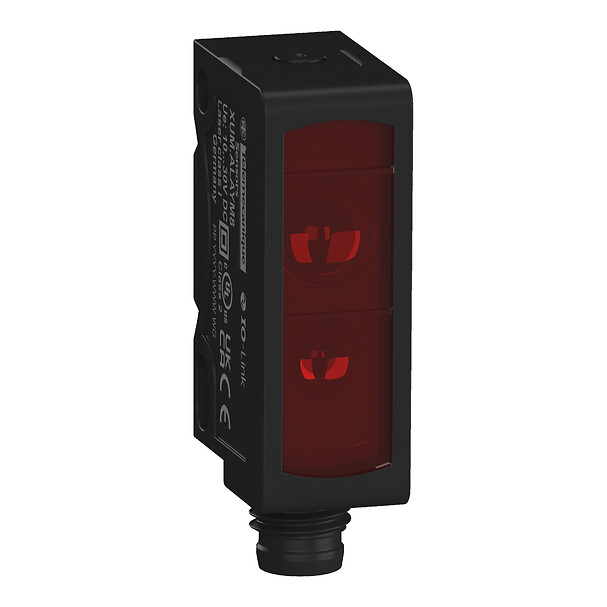
Telemecanique XUM5ALAYM8 Photoelectric Sensor Technical Information
The Telemecanique XUM5ALAYM8 photoelectric sensor is a compact industrial sensing device designed for precise object detection in automated production systems. Industrial automation increasingly depends on optical sensing technology because it enables fast and reliable detection without requiring physical contact between the sensor and the target object.
As part of the Telemecanique miniature sensor portfolio, the XUM5ALAYM8 combines compact dimensions with dependable industrial performance. This makes it suitable for equipment manufacturers, system integrators, and industrial maintenance teams seeking efficient sensing solutions for demanding applications.
Technical Features and Design
The sensor operates on a 1224 VDC power supply and is designed for integration into industrial control systems. The compact housing allows installation inside machinery where available mounting space is limited. Despite its small size, the sensor delivers stable optical detection performance suitable for continuous industrial operation.
The housing construction supports use in environments exposed to dust, vibration, and routine industrial cleaning procedures. These environmental characteristics are important in modern manufacturing facilities where automation equipment operates continuously under demanding conditions.
The integrated M8 connection system simplifies wiring and supports efficient replacement or maintenance procedures when required.
Photoelectric Sensor Advantages
One major advantage of photoelectric sensors is their ability to detect objects without physical contact. Mechanical switches may wear over time due to repeated contact cycles, but optical sensors avoid this limitation. As a result, photoelectric sensing solutions are widely used in high-speed production environments.
The XUM5ALAYM8 supports rapid object detection and can be integrated into automated handling systems, packaging lines, assembly equipment, and conveyor monitoring applications. Reliable sensing contributes to smoother production flow and improved operational efficiency.
Common Industrial Uses
The Telemecanique XUM5ALAYM8 photoelectric sensor is commonly applied in material handling systems, industrial conveyors, packaging equipment, automated logistics systems, and production machinery. Manufacturers often use optical sensors to detect object presence, verify positioning, and monitor product movement.
Its compact size makes the sensor useful in machinery where installation flexibility is important. OEM machine builders frequently select miniature sensors because they simplify mechanical integration while maintaining high sensing performance.
Telemecanique XUM5ALAYM8 For additional industrial automation references, visit Telemecanique automation technology.
Telemecanique XUM5ALAYM8 Installation and Operational Guidance
The sensor should be mounted securely to maintain consistent optical alignment during machine operation. Cable routing should avoid high-voltage interference sources and moving mechanical parts that may damage wiring over time.
Routine inspection and cleaning are recommended for environments with airborne dust or contamination. Maintaining a clean optical surface helps preserve accurate sensing performance and long-term operational reliability.
Telemecanique XUM5ALAYM8 FAQ
What is the Telemecanique XUM5ALAYM8 used for?
It is used for optical object detection in industrial automation systems and production machinery.
What voltage does the sensor require?
The sensor operates with a 1224 VDC industrial power supply.
Why choose a photoelectric sensor?
Photoelectric sensors provide non-contact detection, fast response times, and reduced mechanical wear.
Can the XUM5ALAYM8 be used in compact machinery?
Yes. Its miniature housing supports installation in restricted spaces.
Is the sensor suitable for industrial environments?
Yes. It is designed for industrial applications involving vibration, dust exposure, and continuous machine operation.
Does the sensor require regular maintenance?
Periodic cleaning and inspection help maintain reliable optical detection performance.