
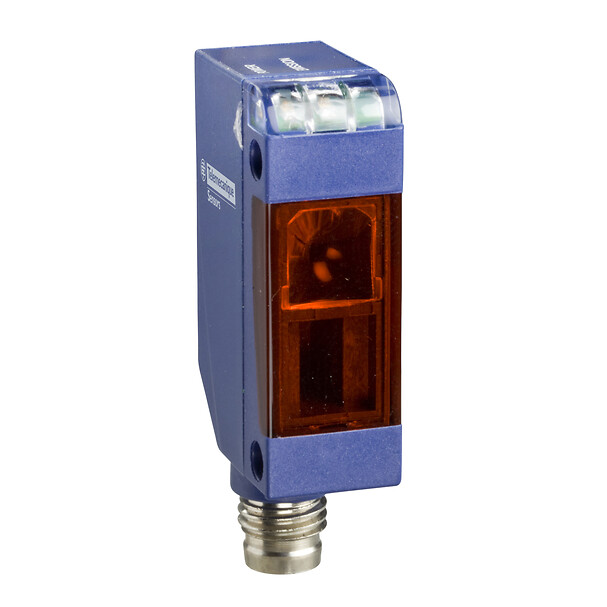
Telemecanique XUM0APSAM8 Photoelectric Sensor Industrial Guide
The Telemecanique XUM0APSAM8 photoelectric sensor is engineered for industrial automation systems that require compact, dependable, and accurate optical object detection. Modern manufacturing facilities rely heavily on photoelectric sensing technology because it enables non-contact detection with fast response times and stable operational performance.
As part of the well-known Telemecanique XUM miniature sensor family, the XUM0APSAM8 is suitable for installations where available mounting space is restricted. Industrial machine builders and automation engineers frequently choose miniature photoelectric sensors because they can be integrated into tight mechanical layouts without sacrificing sensing capability.
Main Technical Specifications
The Telemecanique XUM0APSAM8 operates with a 1224 VDC industrial power supply and supports reliable optical detection across a broad range of automation applications. The compact sensor housing is designed to withstand routine industrial operating conditions including vibration, dust exposure, and continuous production cycles.
The integrated connection system simplifies installation and allows efficient integration into control systems, production machinery, and conveyor applications. The sensor body is built for long operational life while maintaining consistent sensing accuracy.
Industrial environments often involve temperature changes, airborne contamination, and repetitive mechanical movement. For this reason, the XUM0APSAM8 includes environmental protection features that support dependable operation under challenging production conditions.
Benefits of Photoelectric Sensing
Photoelectric sensors provide several advantages compared with traditional mechanical detection devices. Since detection occurs without physical contact, there is less wear on both the sensor and the monitored object. This helps reduce maintenance requirements while supporting high-speed automation processes.
The XUM0APSAM8 is capable of detecting objects quickly and consistently, making it suitable for automated packaging systems, product counting applications, conveyor tracking, and material handling systems. Optical sensing also improves process efficiency by allowing accurate monitoring of moving components.
Industrial Applications
This sensor is commonly used in manufacturing facilities, logistics systems, packaging lines, food processing equipment, and automated assembly machines. The miniature design makes it especially useful for OEM equipment manufacturers who require compact automation components without compromising sensing reliability.
Conveyor monitoring is one of the most common applications for photoelectric sensors. The XUM0APSAM8 can support object presence detection, product spacing verification, and automated production flow monitoring. Its compact dimensions also allow installation near moving mechanical assemblies where larger sensors may not fit.
Telemecanique XUM0APSAM8 For additional Telemecanique automation references, visit Telemecanique industrial technology.
Installation Best Practices
Correct mounting alignment is essential for maintaining stable optical detection. The sensor should be fixed securely to minimize vibration-related movement. Electrical installation should follow industrial wiring practices, including separation from high-voltage cables and electromagnetic interference sources.
Regular inspection of the optical surface helps maintain sensing consistency. In facilities with dust accumulation or airborne particles, periodic cleaning may improve long-term reliability and operational stability.
Telemecanique XUM0APSAM8 FAQ
What is the Telemecanique XUM0APSAM8 used for?
It is used for non-contact object detection in industrial automation systems such as conveyors, packaging machinery, and production equipment.
What power supply does the sensor require?
The sensor operates using a 1224 VDC industrial supply voltage.
Why are photoelectric sensors commonly used in factories?
They provide fast, reliable, non-contact detection with reduced mechanical wear and high operational efficiency.
Can the sensor operate in industrial environments?
Yes. The sensor housing is designed for industrial conditions involving dust, vibration, and routine production operation.
Is the XUM0APSAM8 suitable for compact machinery?
Yes. Its miniature housing design makes it ideal for installations with limited mounting space.
Does the sensor require maintenance?
Basic maintenance such as optical lens cleaning and inspection of mounting stability is recommended for consistent long-term performance.