
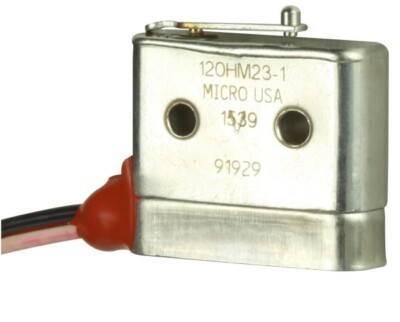
Honeywell 120HM8-1 Sealed Switches Technical Insight
The Honeywell 120HM8-1 sealed switch is typically evaluated as part of the broader Honeywell HM Series, a line known for hermetically sealed miniature snap-action switches used in environments where standard switch protection is not enough. Searches around the Honeywell 120HM8-1 sealed switch often overlap with terms such as aerospace sealed switch, hermetic snap-action switch, miniature SPDT switch, and harsh-environment electromechanical switch because the product type is associated with those engineering priorities.
How the HM Series Design Supports Reliability
Honeywell’s HM Series is built around a sealed architecture using stainless-steel housing and hermetic construction designed to resist the effects of dust, water, particulates, and corrosive gases. This matters in practice because switching components are often weak points in systems exposed to contamination. A sealed switch like the Honeywell 120HM8-1 type is investigated not only for switching performance, but for how well it protects that performance over time.
Verified Technical Framework
The HM Series specification set includes SPDT circuitry, dielectric strength of 1000 Vrms for one minute, minimum mechanical endurance of 25,000 operations, and minimum electrical endurance of 25,000 operations. Honeywell also notes contact material options including silver, silver alloy, gold, and gold bifurcated. Depending on the listing, electrical ratings can reach up to 4 A at 28 Vdc. For many technical buyers, those figures make the Honeywell 120HM8-1 sealed switch category relevant in systems where signal integrity and service-life consistency both matter.
Temperature Range and Harsh-Environment Suitability
One of the strongest reasons engineers research Honeywell HM Series sealed switches is temperature resilience. The family includes standard temperature coverage from -65°C to 121°C and optional configurations extending from -184°C to 260°C. This wide range makes the Honeywell 120HM8-1 sealed switch product type relevant for equipment that must keep working through extreme cold, elevated heat, or rapidly changing thermal conditions.
Typical Engineering Use Cases
Honeywell identifies applications such as military and commercial aircraft, helicopters, aviation support equipment, spacecraft, power generation, and oil and gas systems. In those environments, switches may be used to detect door, hatch, valve, or panel position. That application logic helps explain why the Honeywell 120HM8-1 sealed switch is usually discussed less as a simple component and more as a reliability-driven system element.
For more information about Honeywell, you can review the related product portfolio here.
FAQ
What type of product is the Honeywell 120HM8-1?
The Honeywell 120HM8-1 is associated with Honeywell sealed switches and is best understood within the HM Series hermetic sealed miniature snap-action switch family. That means its technical context is based on rugged switching performance rather than light-duty general use.
Why is the Honeywell 120HM8-1 relevant for harsh environments?
Because the HM family is designed with hermetic sealing and a stainless-steel housing. These characteristics help protect internal switch performance in conditions involving contamination, corrosive atmosphere exposure, or demanding mechanical service.
Does the HM Series support wide temperature operation?
Yes. Honeywell states that the family covers a standard range from -65°C to 121°C and includes optional configurations that extend from -184°C to 260°C. That broad range is one of the reasons the series is studied for extreme-duty applications.
Why do technical searches often include terms like miniature snap-action switch and aerospace switch?
Because the HM Series combines compact size with high-reliability sealed construction. That makes it a natural point of comparison in aerospace and industrial designs where small form factor and dependable actuation are both essential.
What should be checked beyond the part number?
It is important to confirm the exact catalog configuration, especially the actuator style, contact material, temperature class, and termination format. Within sealed switch families, these details often define whether the chosen part is suitable for the intended control architecture.