
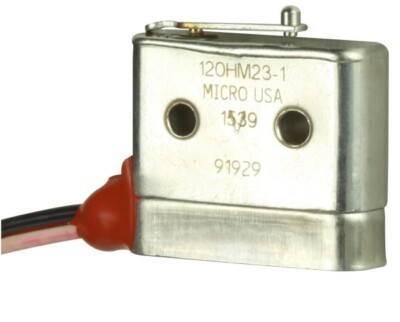
Honeywell 120HM9-1 Sealed Switches Overview
The Honeywell 120HM9-1 sealed switch is researched most often by professionals who need a compact switch built for environmental resilience and predictable actuation. Within Honeywell’s HM Series, the Honeywell 120HM9-1 sealed switch is associated with hermetic sealed switch design, miniature snap-action switching, and system-level reliability in aerospace and industrial control environments.
Why the Product Type Matters
Not every switch is designed to operate in conditions where contamination, altitude, vibration, and thermal extremes all influence performance. The value of the Honeywell 120HM9-1 sealed switch product type comes from its HM Series platform, which Honeywell positions for environments where dust, water, particulate contamination, and corrosive gases may be present. That makes it relevant in technical evaluations focused on lifecycle stability rather than short-term switching alone.
HM Series Technical Base
Honeywell identifies the HM family as a hermetic sealed miniature snap-action switch with SPDT circuitry and a 300 series stainless-steel housing. Published series-level specifications include a minimum of 25,000 mechanical operations, a minimum of 25,000 electrical operations, and initial dielectric voltage of 1000 Vrms for one minute. The family also supports multiple contact material options and electrical ratings up to 4 A at 28 Vdc, depending on exact configuration.
Mechanical and Environmental Performance
The HM Series is also described with symbol 2 vibration capability of 15 g over 10 Hz to 2000 Hz and shock type M at 100 G. For teams specifying a Honeywell 120HM9-1 sealed switch, these details are relevant because electromechanical integrity is often tested by motion and impact as much as by electrical load. Honeywell further emphasizes that selected HM versions are available with MIL-PRF-8805 qualification and some catalog listings carry UL 508 certification.
Where Honeywell 120HM9-1 Sealed Switches Fit
Practical application examples for HM Series switches include sensing door and hatch position, monitoring valve position, supporting aviation ground equipment, and acting as an internal switch element in pressure, temperature, or flow devices. That means the Honeywell 120HM9-1 sealed switch is usually considered where reliable state detection matters and where environmental intrusion could compromise a less protected switch design.
For more information about Honeywell, you can review the broader product family here.
FAQ
What is the Honeywell 120HM9-1 sealed switch known for?
It is generally associated with the HM Series approach to compact hermetic sealed switching. Engineers look at this product type when they need a miniature switch family built for harsh environments and dependable actuation.
Does the Honeywell 120HM9-1 belong to a high-reliability switch family?
Yes. Honeywell positions the HM Series for demanding applications including aerospace, spacecraft, and industrial systems. The family’s construction, sealing method, and environmental capability are all consistent with high-reliability use cases.
Why is SPDT circuitry important here?
SPDT switching provides flexible control logic in many electromechanical systems. In sealed switch design, combining SPDT architecture with hermetic protection helps support both electrical functionality and environmental durability.
Are certifications relevant when evaluating this kind of switch?
Absolutely. For many industrial and transportation projects, standards and qualification status are part of the purchasing decision. Honeywell notes that HM switches include MIL-PRF-8805 references and selected listings with UL 508 certification.
What should a buyer verify before using the part in a design?
The exact part listing should be checked for electrical rating, contact material, termination format, actuator configuration, and applicable temperature range. These details are essential for matching the switch to the intended operating environment and control load.