
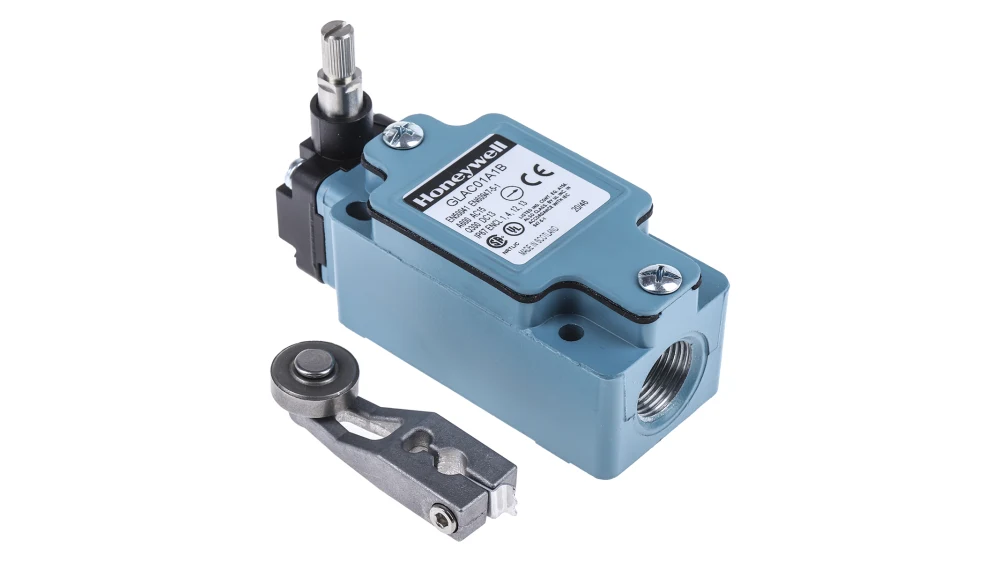
Honeywell ZLAC01A1B Limit Switch Technical Review
The Honeywell ZLAC01A1B limit switch is a compact industrial switching device used for mechanical position sensing in machinery and automated equipment. It is commonly described with a lever actuator, screw terminal connection, IP67 sealing, and a switch function suitable for industrial limit detection. In applications where consistent contact sensing is more important than complex electronics, the Honeywell ZLAC01A1B industrial limit switch fits a very practical need.
Why ZLAC01A1B Matters in Machine Design
Many machine builders still prefer mechanical limit switches for end-of-travel and position feedback because they are easy to understand, easy to wire, and easy to troubleshoot. The Honeywell ZLAC01A1B limit switch fits that philosophy well. A lever-based actuator can accommodate movement from cams, doors, slides, and other machine elements where a direct plunger might not be the best match.
That makes the product relevant for packaging systems, compact automation units, guarded access points, and machine modules that require repeatable switching in a small footprint.
Core Technical Features
One of the strongest characteristics associated with the Honeywell ZLAC01A1B industrial switch is its IP67 rating. In practical terms, that level of sealing helps in environments where dust, splashing liquid, and general contamination are part of normal operation. Industrial plants rarely offer clean, laboratory-like conditions. Components must tolerate moisture, residue, vibration, and unplanned exposure during cleaning or routine maintenance.
The use of screw terminals is also significant. In many control cabinets and machine wiring schemes, screw termination remains valued for serviceability. A technician can inspect and retighten connections without specialized tooling, which is still an advantage in field maintenance.
Actuator and Switching Behavior
The Honeywell ZLAC01A1B lever limit switch is associated with a lever actuator and a switch function often described as ON-(OFF). In real applications, this means it can serve as a responsive detection element where the machine only needs a signal during the actuated state. The exact motion profile of the machine should still be reviewed so that actuator travel, force, and release conditions are appropriate.
Lever switches are especially helpful when motion is not perfectly linear. They can provide a more forgiving mechanical interface in systems where contact geometry varies slightly over time.
Where Honeywell ZLAC01A1B Can Be Used
The Honeywell ZLAC01A1B limit switch may be relevant in transfer systems, small production machines, material handling assemblies, enclosure monitoring, and actuator confirmation points. In these contexts, the focus is not on advanced data acquisition but on dependable binary status confirmation.
Search interest remains strong for terms such as IP67 limit switch, lever limit switch, and Honeywell industrial switch because many buyers and engineers are looking for proven mechanical solutions, not unnecessary complexity.
For more information about Honeywell, reviewing the wider range of compact limit switches can help match actuator type and sealing level more accurately.
FAQ
What type of actuator does Honeywell ZLAC01A1B use?
This model is commonly listed with a lever actuator, making it suitable for contact with cams, moving panels, and non-linear mechanical motion.
Is Honeywell ZLAC01A1B sealed for industrial environments?
Yes. It is commonly associated with an IP67 rating, which supports use in environments with dust and splashing exposure.
Why are screw terminals important on a limit switch?
Screw terminals can simplify field wiring and maintenance. They allow technicians to inspect and secure wiring connections during service intervals.
What is the usual role of ZLAC01A1B in automation?
Its main role is position detection. It can indicate whether a moving element has reached a target point or whether a door, guard, or mechanism is in the expected state.
Is a lever actuator better than a plunger?
Not always. A lever is often better when the moving target does not approach in a perfectly straight line or when a little more mechanical tolerance is helpful.
What should be checked before selecting this switch?
Engineers should review actuator travel, switching function, mounting space, environmental exposure, and wiring preference before final selection.