
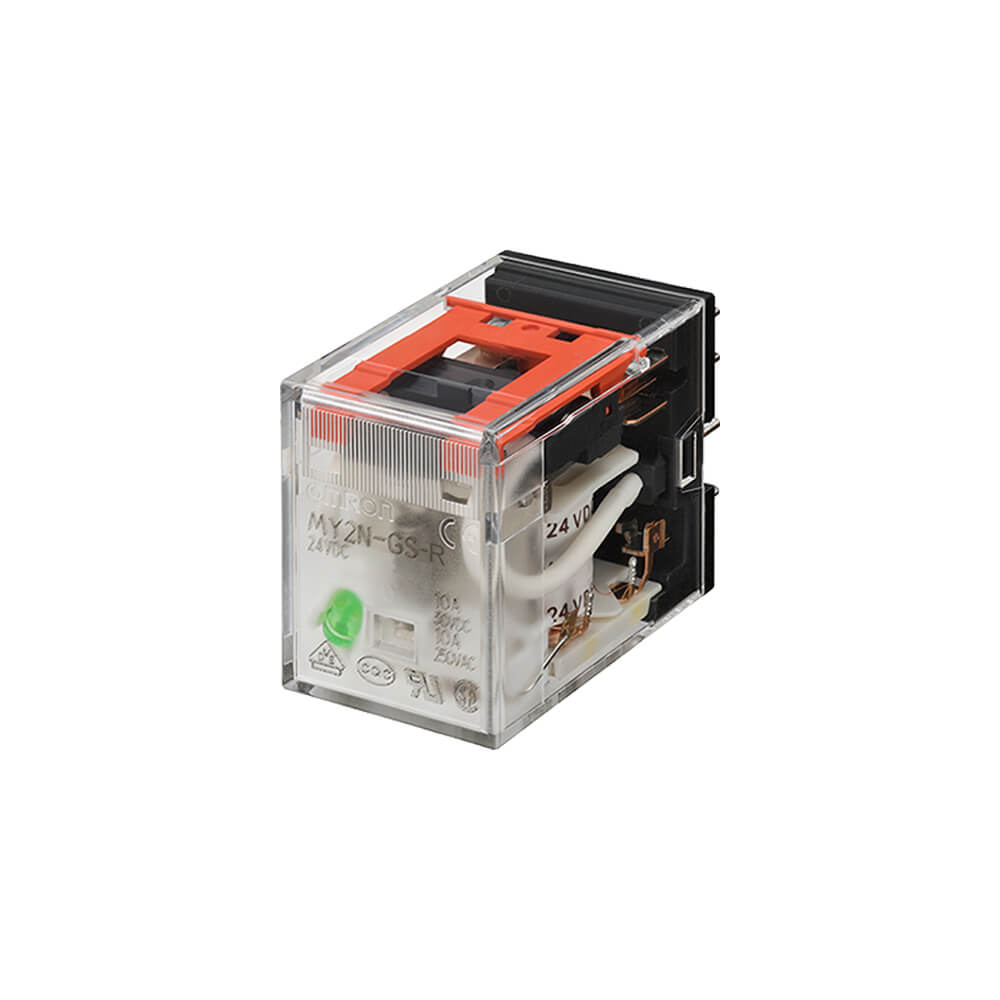
Omron MY4N-GS 24VDC Plug-in Relay Technical Overview
The Omron MY4N-GS 24VDC plug-in relay is a compact general-purpose relay for industrial automation, control panels, machine interfaces, and signal switching. It combines a 24 VDC coil with a four-pole changeover contact structure, giving engineers a practical way to switch multiple circuits from one DC control signal. In modern panels where PLCs, sensors, and control modules often operate on 24 VDC, this relay fits naturally into the electrical architecture.
Technical Characteristics
This relay is part of Omron’s MY-GS family and is commonly associated with plug-in socket installation, a transparent case, mechanical indication, and LED operation visibility. The 4PDT contact configuration allows four independent circuits to change state together when the coil is energized. This makes the relay useful in applications where several control paths must be switched at the same moment.
The 24 VDC coil makes the MY4N-GS 24VDC suitable for low-voltage control systems. Many PLC outputs, interface modules, power supplies, and automation devices use 24 VDC as a standard control voltage. When properly matched with the output capacity of the controller, the relay can serve as a buffer between electronic controls and field wiring.
Contact Function and Electrical Role
The Omron MY4N-GS 24VDC plug-in relay uses a 4PDT contact arrangement. Each pole provides changeover functionality, allowing normally open and normally closed circuit behavior. This is helpful in status logic, alarm circuits, enable chains, lamp circuits, auxiliary control lines, and multi-signal routing.
Electromechanical relays remain valuable because they provide galvanic separation between coil and contact circuits. The coil side can be driven by a control device, while the contact side can switch another circuit according to the relay’s rating. This separation helps protect sensitive control electronics and makes system design more modular.
Installation and Socket Compatibility
As a plug-in relay, this model is designed to work with compatible Omron sockets. Socket mounting helps improve serviceability because the relay can be replaced without disturbing the panel wiring. This is especially important in production environments where downtime must be minimized. For more information about Omron relay families, visit Omron components.
Where It Is Commonly Used
The MY4N-GS 24VDC relay is often used in machine control panels, packaging machines, conveyors, building automation systems, test equipment, auxiliary PLC output circuits, and general control cabinets. Its LED indicator is valuable during commissioning because technicians can immediately see whether the coil command is present.
Selection Notes
Before using this relay, confirm the coil voltage, contact current, load voltage, load type, socket model, ambient temperature, and panel wiring standard. For inductive loads such as solenoids or contactor coils, suitable surge suppression may be needed. Correct relay selection improves service life and reduces unexpected maintenance.
FAQ
What is the Omron MY4N-GS 24VDC plug-in relay?
It is a 24 VDC coil electromechanical relay with four changeover contacts, designed for general-purpose industrial control and interface switching.
Why is 24 VDC important?
24 VDC is widely used in automation panels because it is compatible with many PLCs, sensors, power supplies, and control modules.
What does the LED indicator do?
The LED indicates coil energization. It helps users confirm whether the relay is receiving the control signal.
Can this relay replace another MY4N relay?
Only if the coil voltage, contact rating, pin layout, socket compatibility, and application requirements match. Part numbers should not be substituted based on appearance alone.
Is it suitable for signal isolation?
Yes. It can isolate a control signal from the switched circuit, provided ratings and wiring rules are followed.
What should be checked before installation?
Check coil polarity requirements, coil voltage, socket type, contact load, wiring diagram, ambient conditions, and any required suppression for inductive loads.