
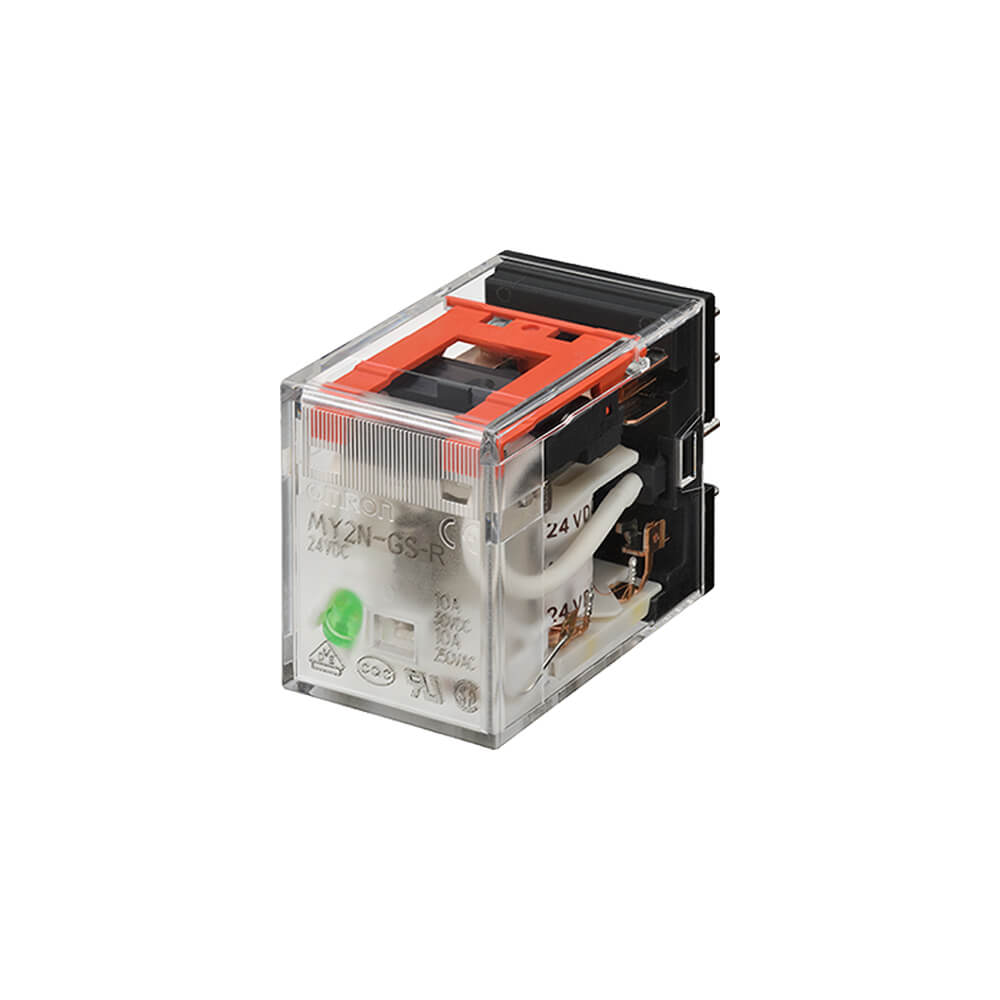
Omron MY4N-GS 24VAC Plug-in Relay Technical Guide
The Omron MY4N-GS 24VAC plug-in relay is a general-purpose electromechanical relay designed for control panels, machine automation, interface circuits, and auxiliary switching tasks. It belongs to Omron’s MY relay family, a widely used platform known for practical installation, clear status visibility, and compatibility with socket-based wiring systems. With a 24 VAC coil and a 4PDT contact arrangement, this relay is especially useful where one control signal must switch several independent circuits at the same time.
Core Technical Profile
The MY4N-GS 24VAC version uses an AC coil rated at 24 volts. In typical industrial control cabinets, this voltage level is common in transformer-fed control circuits. The relay has four poles, meaning it can manage four separate changeover circuits. Its 4PDT structure gives engineers flexibility when isolating signals, routing control paths, or switching multiple auxiliary loads from one coil command.
The relay is a plug-in type, which means it is normally installed with a compatible Omron relay socket. This design helps reduce wiring complexity and makes replacement easier during maintenance. Instead of rewiring the relay body directly, the technician can remove the relay from the socket and install a matching unit. For more Omron relay options, visit Omron components.
Contact Design and Switching Behavior
The MY4N-GS series is built for dependable control switching rather than high-power motor starting. Its contacts are suitable for auxiliary circuits, signal routing, interlocking, panel logic, and controlled resistive or moderate inductive loads within the stated ratings. The four-pole layout is valuable in applications where synchronized switching is needed, such as alarm circuits, safety indication chains, control permissives, and multi-path machine logic.
Because this is an electromechanical relay, it provides physical separation between the coil circuit and contact circuit. That separation is one of the main reasons relays remain important in automation systems: a low-energy control signal can safely operate separate load circuits without direct electrical continuity between both sides.
Indicator and Maintenance Advantages
The “N” in the MY4N family indicates an operation indicator. In practical use, the indicator helps maintenance teams quickly confirm whether the coil is energized. In a crowded panel, this simple visual cue can reduce troubleshooting time. The transparent case also supports visual inspection, allowing technicians to observe the mechanical state without removing the relay.
Typical Applications
The Omron MY4N-GS 24VAC plug-in relay is commonly selected for relay interface panels, HVAC control logic, packaging machinery, conveyor control panels, machine status circuits, and auxiliary PLC output expansion. It is also useful when AC control power is already available and the designer wants a relay that can switch several independent circuits from one command.
Omron MY4N-GS 24VAC FAQ
What is the Omron MY4N-GS 24VAC plug-in relay used for?
It is used for general-purpose control switching in automation panels. Typical roles include signal isolation, auxiliary switching, interlocking, indication circuits, and multiplying one control signal into several switched outputs.
Is MY4N-GS 24VAC suitable for PLC interface circuits?
Yes, it can be used as an interface relay when the coil voltage and contact ratings match the PLC output and field circuit requirements. Designers should always compare the load current, voltage, and load type with the relay ratings.
What does 4PDT mean?
4PDT means four-pole double-throw. The relay has four independent changeover contacts, each with common, normally open, and normally closed terminals.
Why choose a plug-in relay?
A plug-in relay simplifies replacement and maintenance. The wiring remains on the socket, while the relay body can be removed and replaced quickly.
Does this relay have a visual indicator?
Yes. The MY4N type includes an operation indicator, helping users confirm coil energization during testing and troubleshooting.
Can it switch inductive loads?
It can switch inductive loads within its specified ratings, but inductive circuits may require suppression components to reduce arcing and extend contact life.