
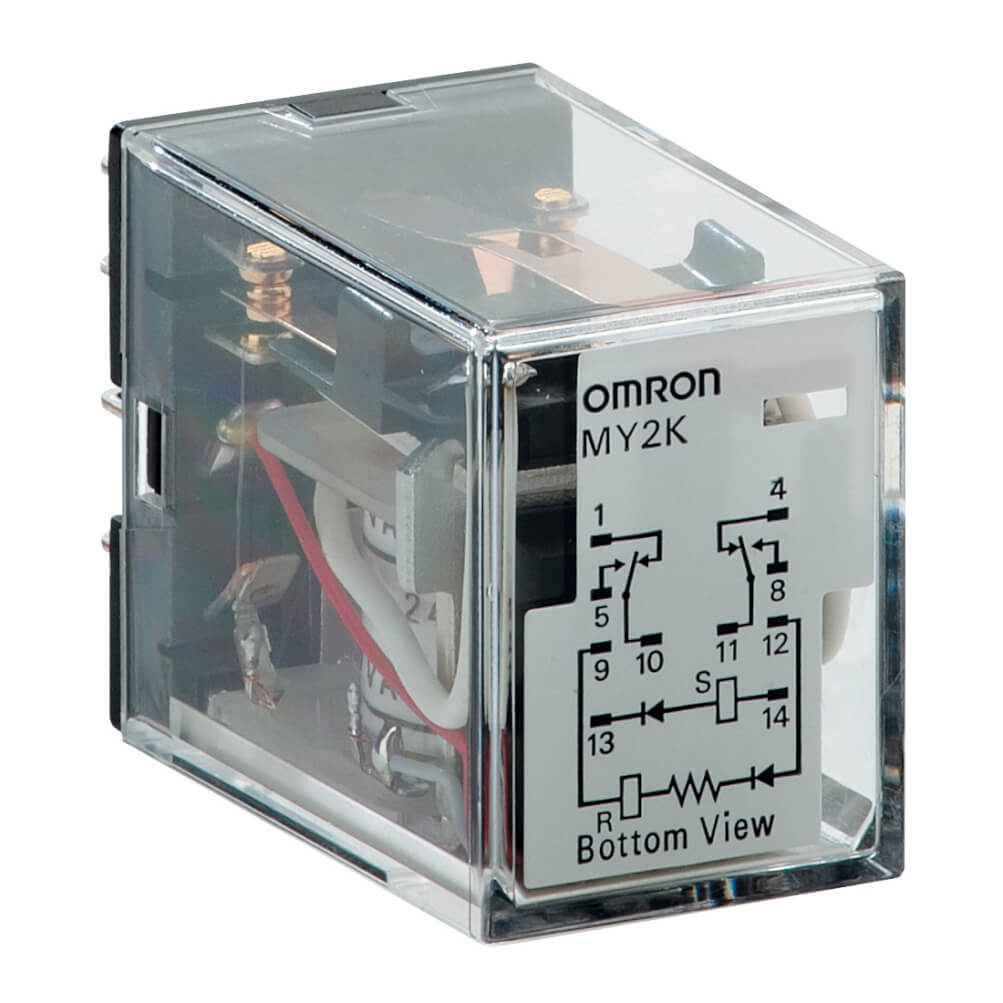
Omron MY2K-02 24VDC Latching Relay Guide
The Omron MY2K-02 24VDC latching relay is a two-pole relay designed for applications where the contact state must be retained without continuous coil power. Unlike a standard relay that returns to its default state when coil power is removed, a latching relay maintains its set or reset position until the opposite coil command is applied.
Technical Characteristics
Omron product information identifies the MY2K-02 24VDC as a latching relay with PCB terminals, DPDT contacts, a 24 VDC coil, silver alloy contacts with gold plating, and a rated carry current of 3 A. It also includes practical features such as a transparent case and mechanical indicator, helping technicians visually confirm relay state during inspection or troubleshooting.
The DPDT contact arrangement gives two changeover circuits. This is useful when designers need to switch two signal paths together or isolate two separate control circuits while using one relay command. The PCB terminal version supports direct board mounting, which is valuable in compact control modules and dedicated electronic assemblies.
Why Choose a Latching Relay?
A latching relay is useful when power efficiency, state memory, or fail-state behavior is important. Once the relay changes position, it does not need continuous coil energization to remain there. This can reduce heat, save energy, and support control strategies where the last relay state must remain stable during power interruptions.
Typical Applications
The Omron MY2K-02 24VDC latching relay can be used in automation boards, energy management equipment, signal routing circuits, control panels, access systems, instrumentation, and equipment that requires maintained contact status. Its 24 VDC control voltage aligns well with modern industrial control architecture.
Omron MY2K-02 24VDC For more information about Omron relay options, visit Omron relay options.
Omron MY2K-02 24VDC FAQ
What makes the Omron MY2K-02 24VDC different from a standard relay?
It is a latching relay. It retains its contact position after the coil signal is removed, while a standard relay normally returns when coil power is removed.
What is the contact arrangement?
The relay uses DPDT contacts, allowing two independent changeover circuits to operate together.
Why does it have gold-plated contact material?
Gold plating can improve contact reliability in low-level signal switching, especially where stable contact resistance is important.
Is this relay intended for PCB mounting?
Yes. The MY2K-02 version is associated with PCB terminals, making it suitable for direct circuit board installation.
Where is a latching relay most useful?
It is useful in systems that need low coil power consumption, retained switching state, or stable contact position after a short control pulse.