
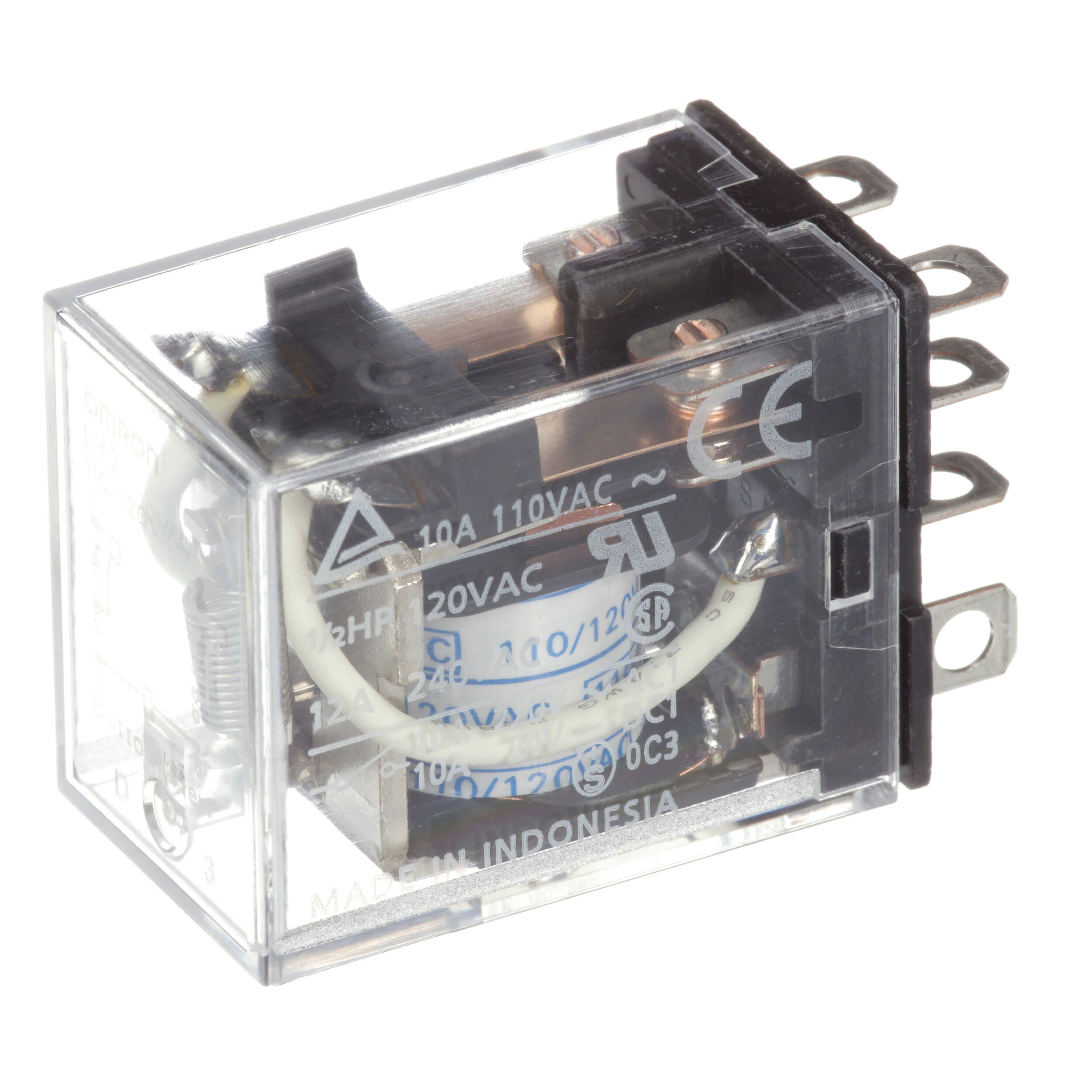
Omron LY2-0 110/120VAC General Purpose Relay
The Omron LY2-0 110/120VAC general purpose relay is part of Omron’s LY series, a well-known relay family used in control panels, automation cabinets, machine interfaces, and general switching applications. This model is designed around a 110/120 VAC coil and a DPDT contact arrangement, making it suitable when one control signal needs to switch two independent circuits at the same time.
Technical Overview
The Omron LY2-0 110/120VAC relay uses a two-pole contact configuration, commonly described as DPDT or 2 Form C. Its rated carry current is 10 A, and the contact material is silver alloy, selected for dependable electrical switching in industrial environments. The coil rating covers 110 VAC and 120 VAC operation, with coil current values varying by frequency. Omron lists 110 VAC at 50 Hz as 9.9 mA, 110 VAC at 60 Hz as 8.4 mA, 120 VAC at 50 Hz as 10.8 mA, and 120 VAC at 60 Hz as 9.2 mA.
Where This Relay Is Commonly Used
This relay is often used in electrical control circuits where alternating-current control voltage is already available. Typical use cases include motor control logic, heater control circuits, indicator switching, safety-related auxiliary circuits, and interface switching between low-power controls and higher-power loads. Its plug-in relay format also helps technicians replace or inspect the relay without rewiring the entire circuit.
Why Coil Voltage Matters
Choosing the correct coil voltage is essential. The 110/120 VAC coil version should be selected only when the control circuit provides the correct AC voltage range. Using the wrong coil voltage can cause failure to operate, overheating, noise, premature wear, or unsafe control behavior. In maintenance environments, matching the code printed on the relay body is one of the safest ways to avoid specification errors.
Contact Performance and Switching Context
The relay is rated for resistive and inductive loads, but engineers should always evaluate the actual load type. Resistive loads are simpler to switch, while inductive loads such as solenoids, contactor coils, and motors can generate voltage spikes when de-energized. For this reason, suppression components and correct wiring practices may be required depending on the circuit design.
Omron LY2-0 110/120VAC Installation Notes
The relay is normally used with a compatible socket, allowing DIN rail or panel-based installation depending on the selected base. Before installation, confirm socket compatibility, wiring diagram, load current, coil voltage, ambient temperature, and enclosure conditions. For additional Omron references, visit Omron information.
Omron LY2-0 110/120VAC FAQ
What type of relay is the Omron LY2-0 110/120VAC?
It is a general purpose electromechanical relay from the Omron LY series. It uses a 110/120 VAC coil and a DPDT contact arrangement, allowing two separate circuits to be switched from one coil signal.
What does DPDT mean on this relay?
DPDT means double pole, double throw. In practical terms, the relay has two changeover contact sets. Each pole can switch between normally closed and normally open paths when the coil is energized.
Can this relay be used for inductive loads?
Yes, it can be used with inductive loads within its rated limits, but the design should account for inrush current, coil kickback, and arc suppression. Inductive applications should be reviewed carefully before installation.
Is this the right relay for a 24 VDC control circuit?
No. This specific version is intended for 110/120 VAC coil operation. For a 24 VDC control circuit, a 24 VDC coil model from the same LY2 family should be selected instead.
Why is the plug-in format useful?
A plug-in relay can be removed from its socket for inspection or replacement without disturbing the fixed field wiring. This reduces downtime and simplifies maintenance in control panels.