
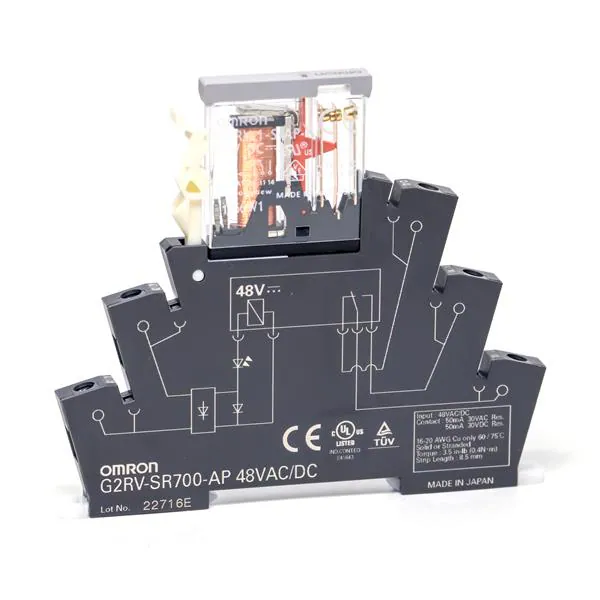
Omron G2RV-SR500-AP 100VAC Relay Socket Technical Guide
The Omron G2RV-SR500-AP 100VAC relay socket is a slim electromechanical I/O relay designed for control panels where compact wiring, clean signal transfer, and micro-load switching are required. It belongs to the Omron G2RV-SR series and uses a Push-In Plus terminal structure, making it suitable for dense automation panels, PLC interface circuits, machine control systems, and signal isolation applications.
Key Technical Characteristics
This model is rated for a 100VAC input voltage. Its rated current is approximately 5.9 mA at 50 Hz and 6.0 mA at 60 Hz, with power consumption around 0.8 VA. The AP version is intended for micro-load switching and uses Ag alloy contacts with Au plating. The contact configuration is SPDT, making it useful where one common signal must be switched between normally open and normally closed paths.
Where It Is Commonly Used
The Omron G2RV-SR500-AP 100VAC relay socket is often used in automation systems that operate with 100VAC control circuits. Typical environments include PLC output interfacing, compact machine panels, sensor signal transfer, low-current indication circuits, and relay isolation between field devices and controllers. Its 6.2 mm slim width helps engineers save rail space without sacrificing serviceability.
Design and Installation Notes
The Push-In Plus terminal system supports faster wiring compared with conventional screw terminals. The transparent relay case allows visual inspection of contact status, while the integrated LED indication helps maintenance teams confirm operation during troubleshooting. For related Omron automation components, visit Omron product information.
FAQ
What is the main function of the Omron G2RV-SR500-AP 100VAC relay socket?
It provides compact relay switching and signal isolation in industrial control panels using a 100VAC input circuit.
Is this model suitable for high-current loads?
No. The AP version is optimized for micro-load switching, typically 50 mA class applications, not high-current power switching.
Why does the AP version use gold-plated contacts?
Gold plating improves reliability when switching very small signals where standard relay contacts may not perform consistently.
Can it be used in PLC panels?
Yes. It is commonly selected for PLC interface circuits, especially where compact DIN rail mounting and signal separation are required.