
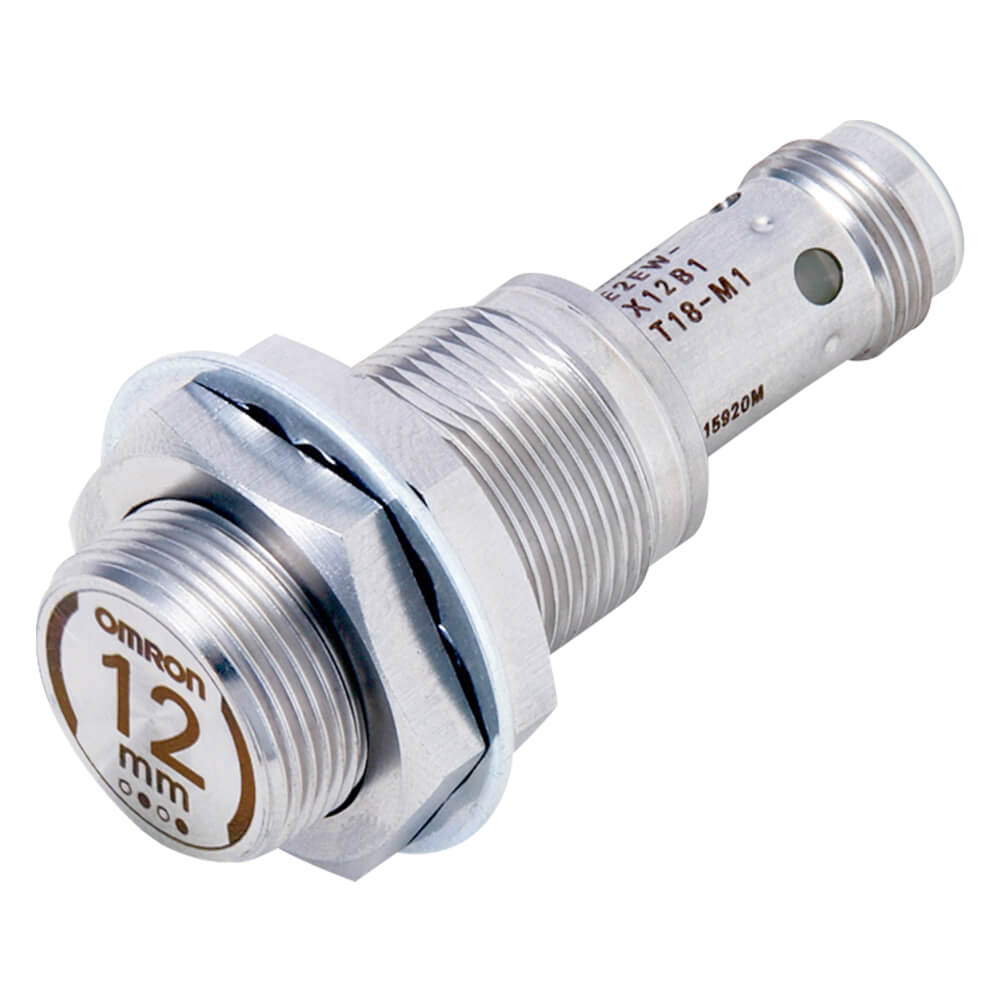
Omron E2EW-QX12B1T18-M1 Inductive Proximity Sensor
| Specification | Value |
|---|---|
| Manufacturer | Omron |
| Series | E2EW |
| Sensor Type | Inductive Proximity Sensor |
| Housing Size | M18 |
| Mounting Type | Quasi-flush |
| Sensing Distance | 12 mm |
| Output Type | PNP Normally Open with IO-Link |
| Communication | IO-Link COM3 (230.4 kbps) |
| Connection | M12 Connector |
| Housing Material | Stainless Steel with Fluororesin Coating |
| Protection Rating | IP67 |
| Overall Length | 54.4 mm |
| Thread Length | 28 mm |
The Omron E2EW-QX12B1T18-M1 Inductive Proximity Sensor is designed for reliable metal detection in industrial automation environments where durability and stable sensing performance are essential. Built with a stainless-steel body protected by a fluororesin coating, this model is intended for applications exposed to welding spatter, coolant, lubricants, and other demanding operating conditions. The combination of an M18 threaded housing, quasi-flush installation, and IO-Link communication makes the sensor suitable for modern manufacturing systems requiring diagnostic information in addition to switching signals. Product specifications are based on the manufacturer’s published documentation. :contentReference[oaicite:0]{index=0}
Technical Description
The Omron E2EW-QX12B1T18-M1 Inductive Proximity Sensor uses an electromagnetic field generated by its sensing face to detect metallic objects without physical contact. When conductive material enters the specified sensing zone, the internal oscillator changes state and the sensor activates its PNP normally open output. In addition to conventional switching, the integrated IO-Link COM3 interface enables parameterization, diagnostics, and process monitoring through compatible IO-Link masters.
The stainless-steel housing incorporates a fluororesin coating that improves resistance to welding spatter accumulation while maintaining long-term sensing stability. This construction also supports installation in machinery operating under exposure to oil mist, coolant, or frequent cleaning.
Operating Principle
An inductive proximity sensor creates a high-frequency electromagnetic field at its sensing face. Metallic objects entering this field generate eddy currents that reduce oscillator amplitude. The internal electronics continuously monitor these changes and switch the output once the detection threshold is reached.
For the Omron E2EW-QX12B1T18-M1 Inductive Proximity Sensor, IO-Link extends this operating principle by allowing communication of diagnostic information, operating status, parameter settings, and identification data to higher-level control systems.
Key Technical Characteristics
- 12 mm sensing distance
- M18 threaded cylindrical housing
- Quasi-flush mounting
- PNP Normally Open switching output
- Integrated IO-Link COM3 communication
- M12 connector interface
- Stainless-steel body with fluororesin coating
- IP67 environmental protection
- Designed for demanding industrial environments
Typical Applications
This sensor can be integrated into numerous industrial automation systems where accurate metallic object detection is required.
- Robotic welding cells
- Automated assembly stations
- Transfer and indexing mechanisms
- Machine tool positioning systems
- Metal processing equipment
- Automotive production lines
- Material handling systems
- Industrial conveyors
Industrial Use Cases
Automotive Manufacturing
The fluororesin-coated housing provides additional protection in welding environments where hot spatter may shorten the service life of conventional proximity sensors.
Machine Building
Equipment manufacturers can integrate IO-Link communication into predictive maintenance strategies by monitoring sensor diagnostics from the control system.
Metal Fabrication
The sensor is suitable for detecting steel fixtures, machine components, and positioning elements during automated manufacturing operations.
Production Automation
Its connector-based installation simplifies replacement during scheduled maintenance while reducing downtime.
Advantages
- Non-contact detection reduces mechanical wear.
- IO-Link enables parameter management and diagnostics.
- Fluororesin coating improves resistance to welding spatter.
- Metal sensing face supports operation in harsh industrial environments.
- Compact M18 housing fits standard mounting arrangements.
- IP67 protection supports operation in dusty and wet conditions.
- Connector connection simplifies installation and servicing.
Selection Considerations
Before selecting an inductive proximity sensor, engineers should verify the required sensing distance, mounting style, switching logic, communication requirements, connector compatibility, and environmental conditions. Applications involving welding operations, coolant exposure, or heavy contamination may benefit from fluororesin-coated sensor designs such as the Omron E2EW series. IO-Link compatibility should also be confirmed when process diagnostics or remote parameter configuration are required.
Additional information about compatible models can be found under Omron sensor series.
Frequently Asked Questions
1. What type of sensor is the Omron E2EW-QX12B1T18-M1?
It is an inductive proximity sensor designed for non-contact detection of metallic targets.
2. Does this model support IO-Link?
Yes. It supports IO-Link COM3 communication.
3. What is the sensing distance?
The rated sensing distance is 12 mm.
4. Which output configuration is provided?
The sensor provides a PNP Normally Open switching output together with IO-Link communication.
5. What connector is used?
The sensor uses a standard M12 connector.
6. Where is this sensor commonly installed?
Typical installations include welding cells, production machinery, automated conveyors, and assembly equipment.
7. Why is fluororesin coating used?
The coating helps improve resistance against welding spatter and contributes to longer operational reliability in demanding industrial environments.
8. Is the Omron E2EW-QX12B1T18-M1 Inductive Proximity Sensor suitable for modern automation systems?
Yes. The combination of a conventional switching output with IO-Link communication supports integration into Industry 4.0 and condition-monitoring architectures.