
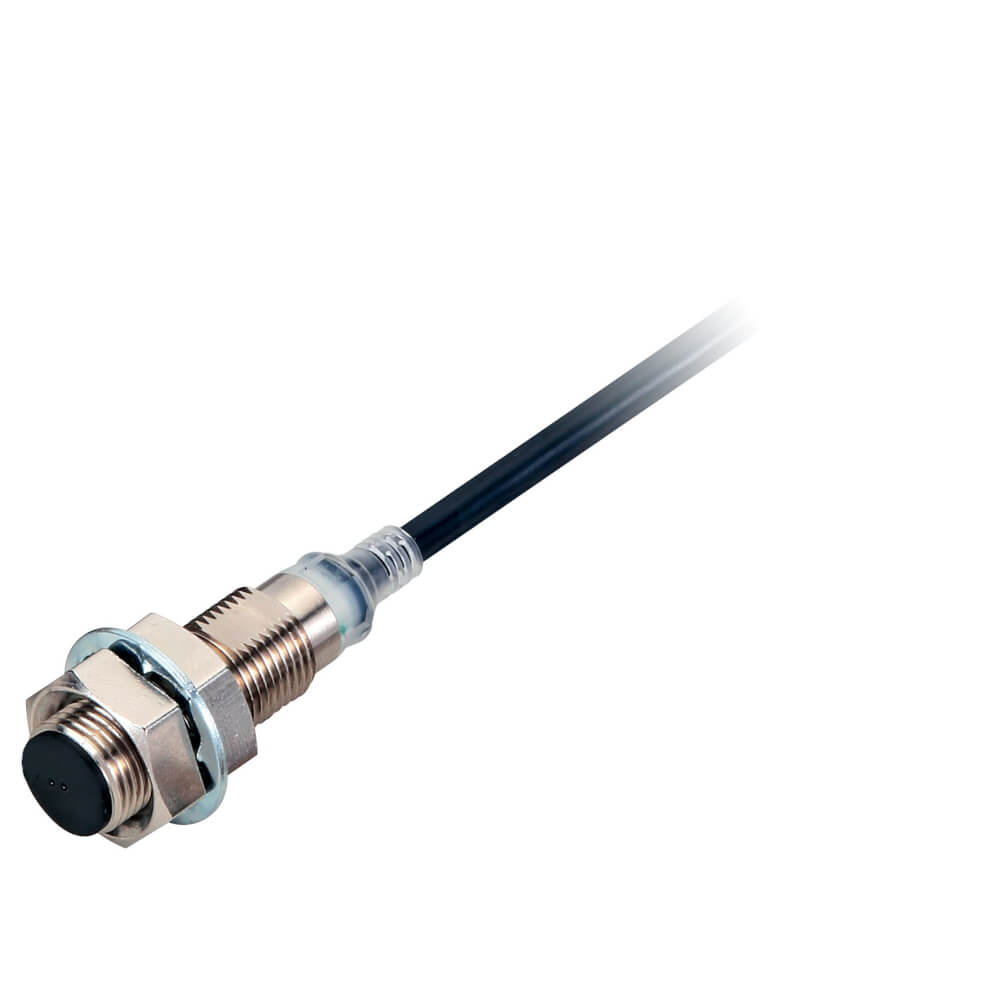
Omron E2E-X7D112-TR 2M Inductive Proximity Sensor
| Feature | Value |
|---|---|
| Sensor Type | Inductive Proximity Sensor |
| Housing Size | M12 |
| Mounting Type | Shielded (Quasi-flush) |
| Sensing Distance | 7 mm |
| Output Type | DC 2-wire |
| Operation Mode | NO (Normally Open) |
| Cable Length | 2 m Robotic Flexible Cable |
| Housing Material | Nickel-plated Brass |
| Protection Rating | IP67 / IP67G / IP69K |
| Overall Length | 47.1 mm |
| Thread Length | 28 mm |
| Response Frequency | 350 Hz |
The Omron E2E-X7D112-TR 2M Inductive Proximity Sensor is designed for reliable metal object detection in industrial automation environments. As part of the E2E NEXT series, this sensor combines long sensing distance capability with a compact M12 cylindrical housing, making it suitable for machinery, material handling systems, and automated production equipment. Its flexible robotic cable construction supports installations involving repeated movement and cable bending.
Technical Overview
The Omron E2E-X7D112-TR 2M Inductive Proximity Sensor features a shielded sensing design with a nominal sensing distance of 7 mm. The sensor uses a DC 2-wire output configuration and operates in Normally Open (NO) mode. Its nickel-plated brass housing provides mechanical durability while maintaining resistance to challenging industrial conditions.
The sensor is equipped with an oil-resistant PVC cable and supports operation in environments exposed to lubricants, coolants, and industrial cleaning processes. Protection ratings of IP67, IP67G, and IP69K help protect the sensing element and internal electronics from dust, water ingress, and high-pressure washdown procedures.
Working Principle
The Omron E2E-X7D112-TR 2M Inductive Proximity Sensor operates by generating a high-frequency electromagnetic field from its sensing surface. When a metallic target enters this field, eddy currents are induced in the target material.
These induced currents cause changes in the sensor’s oscillation characteristics. The internal detection circuitry monitors these changes and switches the output state when the target reaches the specified sensing range.
Because the detection process is contactless, there is no mechanical wear between the sensor and the target object. This operating principle contributes to stable long-term performance in automated systems.
Typical Applications
The Omron E2E-X7D112-TR 2M Inductive Proximity Sensor is commonly integrated into industrial systems requiring accurate detection of metallic machine components and moving parts.
- Position monitoring on automated machinery
- Conveyor system detection points
- Robotic end-of-travel sensing
- Packaging machine position verification
- Assembly line metal part detection
- Industrial material handling systems
- Automated storage and retrieval equipment
The flexible robotic cable makes the sensor particularly suitable for installations involving cable movement and dynamic machine operation.
Industrial Applications
In automotive manufacturing facilities, the sensor can be used to verify the position of metal fixtures, transfer components, and assembly tooling.
Within packaging plants, it can detect metal carriers, guide mechanisms, and machine actuators involved in high-speed production processes.
In metal processing operations, the sensor assists with machine sequencing, component positioning, and automated handling systems where reliable metal detection is required.
The sensor is also suitable for logistics automation systems that utilize metallic transport structures and conveyor mechanisms.
Advantages
- 7 mm sensing distance in a compact M12 housing
- Flexible robotic cable designed for repeated movement
- Shielded sensing construction for controlled installation
- IP67, IP67G, and IP69K environmental protection
- Nickel-plated brass housing for mechanical durability
- Oil-resistant cable construction
- Contactless detection technology
- Suitable for demanding industrial environments
Industry-Specific Usage Examples
Automotive Assembly Lines
The sensor can monitor the presence and position of metallic fixtures used during automated assembly operations. Consistent detection helps synchronize machine actions and transfer sequences.
Packaging Equipment
Machine builders often use the Omron E2E-X7D112-TR 2M Inductive Proximity Sensor to detect moving metal components such as cams, brackets, and indexing mechanisms.
Robotic Systems
The flexible cable design supports robotic applications where cables experience continuous bending. The sensor can detect metallic reference points and moving machine elements.
Selection Considerations
When selecting the Omron E2E-X7D112-TR 2M Inductive Proximity Sensor, engineers should evaluate target material properties, available mounting space, cable routing requirements, and environmental conditions.
The shielded sensing design allows installation near metal structures while maintaining specified sensing characteristics. Users should also verify that the required sensing distance aligns with application requirements.
For additional sensor families and related detection technologies, see Omron sensor products.
The Omron E2E-X7D112-TR 2M Inductive Proximity Sensor is frequently selected for applications requiring dependable metallic target detection, flexible cabling, and high environmental protection ratings.
In automated production systems, the Omron E2E-X7D112-TR 2M Inductive Proximity Sensor supports accurate machine monitoring without physical contact between the sensor and the detected object.
Frequently Asked Questions
What type of sensor is the E2E-X7D112-TR 2M?
It is a cylindrical inductive proximity sensor designed to detect metallic objects without physical contact.
What is the nominal sensing distance?
The sensor provides a nominal sensing distance of 7 mm.
What output configuration does it use?
The device uses a DC 2-wire output configuration.
What operating mode is implemented?
The sensor operates in Normally Open (NO) mode.
Is the sensor suitable for washdown environments?
Yes. It carries IP67, IP67G, and IP69K protection ratings.
Can it be used on moving robotic equipment?
Yes. The flexible robotic cable is designed for applications involving repeated cable movement.
What materials can it detect?
The sensor is primarily intended for detecting ferrous metal targets, although other metals may also be detected with varying sensing performance.
What industries commonly use this sensor?
Automotive manufacturing, packaging, material handling, machine building, robotics, and industrial automation sectors commonly use this model.