
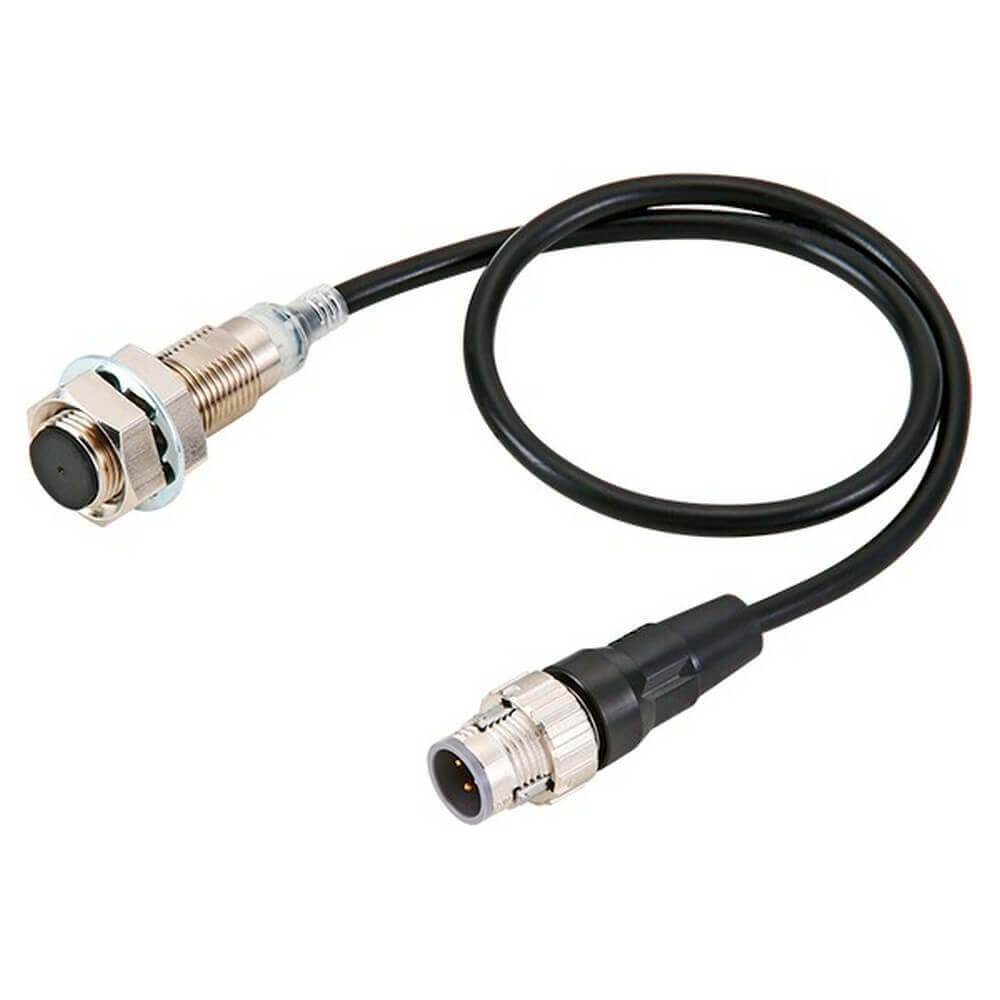
Omron E2E-X7D112-M1TGJ-T 0.3M Inductive Proximity Sensor
| Feature | Value |
|---|---|
| Sensor Type | Inductive Proximity Sensor |
| Series | E2E NEXT |
| Housing Size | M12 |
| Sensing Distance | 7 mm |
| Mounting Type | Shielded (Quasi-flush) |
| Output Configuration | NO (Normally Open) |
| Supply Type | DC 2-wire |
| Supply Voltage | 10 to 30 VDC |
| Connection Method | M12 Smartclick Pigtail Connector |
| Cable Length | 0.3 m |
| Housing Material | Nickel-plated Brass |
| Sensing Surface Material | PBT |
| Thread Length | 28 mm |
| Overall Length | 47.1 mm |
| Protection Rating | IP67, IP67G, IP69K |
The Omron E2E-X7D112-M1TGJ-T 0.3M Inductive Proximity Sensor is designed for reliable non-contact detection of metallic targets in industrial automation systems. As part of the E2E NEXT sensor family, this model combines a compact M12 cylindrical housing with a 7 mm sensing distance, making it suitable for machine builders, production equipment manufacturers, and process automation engineers.
The sensor incorporates a shielded sensing structure that helps maintain stable operation when installed close to metallic machine components. Its nickel-plated brass housing supports operation in demanding industrial environments where exposure to oils, washdown procedures, vibration, and mechanical stress may occur.
Technical Overview
Omron E2E-X7D112-M1TGJ-T 0.3M Inductive Proximity Sensor utilizes electromagnetic field generation to detect conductive metallic objects without requiring physical contact. The sensing element creates a high-frequency magnetic field at the sensor face. When a metal target enters the detection zone, eddy currents are induced within the target material, causing changes in the oscillation circuit.
These changes are processed by the sensor electronics and converted into a switching output signal. The NO output configuration remains inactive until a target is detected within the specified sensing range.
The DC 2-wire design simplifies wiring requirements while allowing integration into many industrial control circuits. In addition, the polarity-free configuration helps reduce installation errors during commissioning and maintenance activities.
Working Principle
The operating principle of the Omron E2E-X7D112-M1TGJ-T 0.3M Inductive Proximity Sensor is based on electromagnetic induction.
Detection Process
- Generation of a high-frequency electromagnetic field
- Interaction between the field and a metallic target
- Creation of eddy currents within the target
- Reduction of oscillator amplitude
- Output switching when the threshold is reached
This detection method allows contactless sensing while minimizing mechanical wear compared with traditional limit switches.
Typical Applications
The Omron E2E-X7D112-M1TGJ-T 0.3M Inductive Proximity Sensor is commonly installed in automated equipment where accurate metallic object detection is required.
- Conveyor position monitoring
- Automated assembly stations
- Machine tool position verification
- Packaging machinery
- Robotic handling systems
- Material transfer equipment
- Indexing mechanisms
- Production line automation
Its short pigtail connector configuration can be particularly useful in equipment designs where compact cable routing is required.
Industrial Applications
Manufacturing facilities frequently use this sensor for part presence verification and machine sequencing. In automotive production environments, it can assist with fixture positioning and component detection. Packaging systems may utilize the sensor to monitor metallic carriers or machine movement positions.
Metalworking machinery often benefits from non-contact sensing because it reduces mechanical wear associated with repeated switching operations. Food and beverage equipment designers may also consider this sensor where high ingress protection ratings are required for washdown environments.
Engineers looking for additional sensing technologies can explore Omron sensor products for broader automation system integration.
Advantages
- 7 mm sensing distance in a compact M12 housing
- Shielded sensing design for installation flexibility
- 2-wire DC operation
- Normally open output configuration
- Polarity-free wiring design
- Nickel-plated brass housing
- IP67, IP67G, and IP69K protection ratings
- Compact 0.3 m pigtail connector arrangement
Industry-Specific Usage Examples
Automotive Manufacturing
Production cells can use the sensor to verify fixture positioning before automated welding or assembly operations begin.
Packaging Industry
Packaging machinery may employ the sensor for metal guide detection and indexing position confirmation.
Machine Building
Equipment manufacturers can integrate the sensor into moving assemblies where compact installation dimensions are required.
Material Handling Systems
Conveyor transfer stations often use proximity sensors to detect carrier positions and synchronize automated movements.
Factors to Consider When Selecting This Sensor
- Required sensing distance
- Available installation space
- Target material characteristics
- Control system compatibility
- Environmental protection requirements
- Cable routing limitations
- Electrical supply specifications
- Machine safety requirements
Understanding these factors helps ensure proper integration of the Omron E2E-X7D112-M1TGJ-T 0.3M Inductive Proximity Sensor within industrial automation systems.
Frequently Asked Questions
What type of sensor is the Omron E2E-X7D112-M1TGJ-T 0.3M?
It is an inductive proximity sensor designed for non-contact detection of metallic objects.
What is the sensing distance?
The specified sensing distance is 7 mm.
Does the sensor require direct contact with the target?
No. Detection occurs through an electromagnetic field without physical contact.
What output configuration does the sensor use?
The sensor provides a normally open (NO) output.
What supply voltage is required?
The operating voltage range is 10 to 30 VDC.
What housing material is used?
The housing is manufactured from nickel-plated brass.
Is the sensor suitable for washdown environments?
The device provides IP67, IP67G, and IP69K protection ratings, supporting use in demanding industrial environments.
What connection method is provided?
The sensor uses an M12 Smartclick pigtail connector with a 0.3 m cable.
Where is this sensor commonly used?
Typical applications include conveyors, assembly equipment, machine tools, robotics, and packaging machinery.