
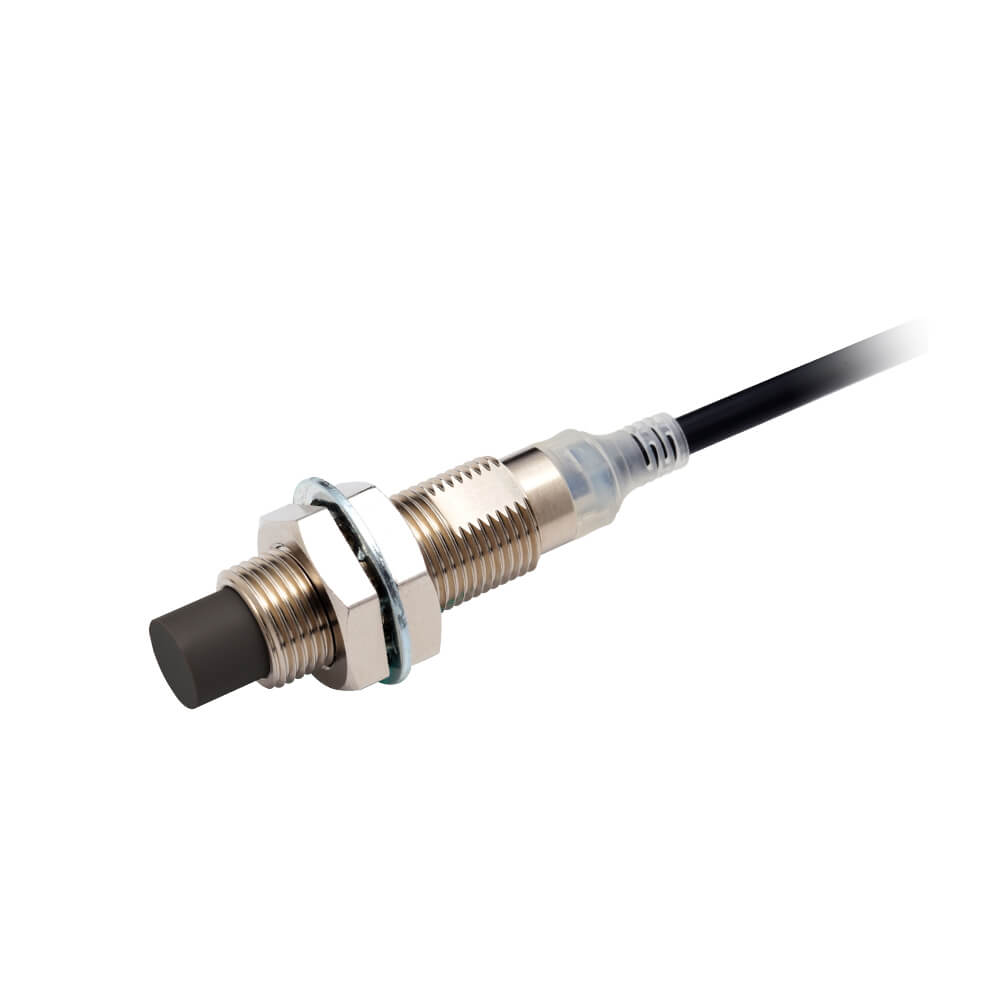
Omron E2E-X5MC212 2M Inductive Proximity Sensor
| Feature | Value |
|---|---|
| Manufacturer | Omron |
| Series | E2E NEXT |
| Sensor Type | Inductive Proximity Sensor |
| Sensing Distance | 5 mm |
| Housing Diameter | M12 |
| Output Type | PNP Normally Open (NO) |
| Supply Voltage | 10 to 30 VDC |
| Connection Method | 2 m Pre-wired Cable |
| Protection Rating | IP67 |
| Housing Material | Nickel-Plated Brass |
| Operating Temperature | -25°C to +70°C |
| Mounting Style | Shielded Flush Mount |
Reliable position monitoring and object detection are essential functions in automated production systems. The Omron E2E-X5MC212 Inductive Proximity Sensor is developed to detect metallic objects without physical contact, supporting accurate machine operation and process control across a broad range of industrial environments. Its compact M12 housing and shielded construction enable installation in machinery where space efficiency and installation flexibility are important requirements.
As a member of the Omron E2E NEXT family, this sensor incorporates advanced inductive sensing technology designed to maintain stable detection performance under demanding operating conditions. The integrated 2-meter cable provides a practical connection solution for equipment manufacturers and automation engineers.
Technical Description
The Omron E2E-X5MC212 Inductive Proximity Sensor features a nominal sensing distance of 5 mm and utilizes a shielded sensing structure that allows flush mounting within metallic equipment frames. This design helps optimize installation flexibility while preserving detection accuracy.
The sensor incorporates a nickel-plated brass housing that contributes to durability and resistance against common industrial environmental influences. It operates within a supply voltage range of 10 to 30 VDC and provides a PNP normally open output configuration suitable for many PLC and industrial control architectures.
The Omron E2E-X5MC212 Inductive Proximity Sensor is frequently used in automation systems requiring dependable metal object detection and position monitoring.
Working Principle
The sensor operates using electromagnetic induction. An internal oscillator generates a high-frequency magnetic field at the sensing face. When a conductive metallic target enters this field, eddy currents are generated within the target material.
These eddy currents absorb energy from the magnetic field and alter the oscillator characteristics. The sensor electronics continuously monitor these changes and activate the output when the detection threshold is reached.
Since no physical contact is required during operation, the sensor minimizes wear and supports long-term performance in applications involving frequent switching cycles and continuous operation.
Primary Usage Areas
- Automated production equipment
- Material handling systems
- Conveyor position monitoring
- Packaging machinery
- Machine tool automation
- Assembly line systems
- Industrial transfer mechanisms
- Automated storage solutions
The compact dimensions and robust construction make the sensor suitable for installation in diverse industrial environments where reliable metal detection is required.
Industrial Applications
Automotive Manufacturing
Automotive production facilities utilize inductive sensors to verify fixture positions, detect metallic components, and monitor automated transfer systems throughout assembly operations.
Material Handling Equipment
Conveyor and transfer systems frequently employ proximity sensors to confirm carrier locations and provide feedback signals for coordinated machine movement.
Packaging Machinery
Packaging equipment often requires accurate monitoring of indexing mechanisms and metallic machine components to maintain process synchronization.
Metal Processing Facilities
Metalworking operations use inductive sensors for part detection, machine positioning, and process verification throughout manufacturing workflows.
Advantages
- Non-contact metal detection
- PNP normally open output
- Compact M12 cylindrical housing
- Flush mounting capability
- IP67 environmental protection
- Reduced mechanical wear
- Suitable for continuous operation
- Integrated 2-meter cable connection
These characteristics support reliable operation in industrial environments where equipment uptime and sensing consistency are important operational objectives.
Sector-Specific Usage Examples
In warehouse automation systems, the Omron E2E-X5MC212 Inductive Proximity Sensor may be installed to monitor the position of metallic transport carriers moving through automated conveyor networks. Manufacturing facilities often use the sensor to supervise machine states and verify the position of mechanical assemblies.
Packaging machine builders can integrate the Omron E2E-X5MC212 Inductive Proximity Sensor into indexing systems where non-contact position detection contributes to repeatable machine operation. Metal fabrication plants may employ the sensor for workpiece detection and process monitoring applications.
Additional sensing technologies and compatible product families can be explored through Omron sensor products.
Important Considerations During Product Selection
- Required sensing distance
- Output type compatibility
- Target material properties
- Installation constraints
- Environmental protection requirements
- Power supply specifications
- Cable routing considerations
- Control system architecture
Evaluating these factors helps ensure proper integration and long-term operational performance within industrial automation systems.
Frequently Asked Questions
Omron E2E-X5MC212 What is the nominal sensing distance?
The sensor provides a sensing distance of 5 mm.
What output configuration does this model use?
The sensor features a PNP normally open output.
Omron E2E-X5MC212 Can the sensor be mounted flush in metal?
Yes. The shielded construction supports flush mounting applications.
What type of targets can it detect?
The sensor is designed for the detection of metallic objects.
What is the operating voltage range?
The sensor operates from a 10 to 30 VDC power supply.
Omron E2E-X5MC212 What protection rating is provided?
The housing is rated IP67.
How long is the connection cable?
The sensor is supplied with a permanently attached 2-meter cable.
Which industries commonly use this sensor?
Automotive, packaging, logistics, manufacturing, and machine-building industries frequently utilize inductive proximity sensors.
Why is non-contact sensing advantageous?
Non-contact operation reduces mechanical wear and supports long-term reliability.
Is the sensor suitable for automated machinery?
Yes. It is commonly integrated into conveyors, machine tools, assembly systems, and industrial automation equipment.