
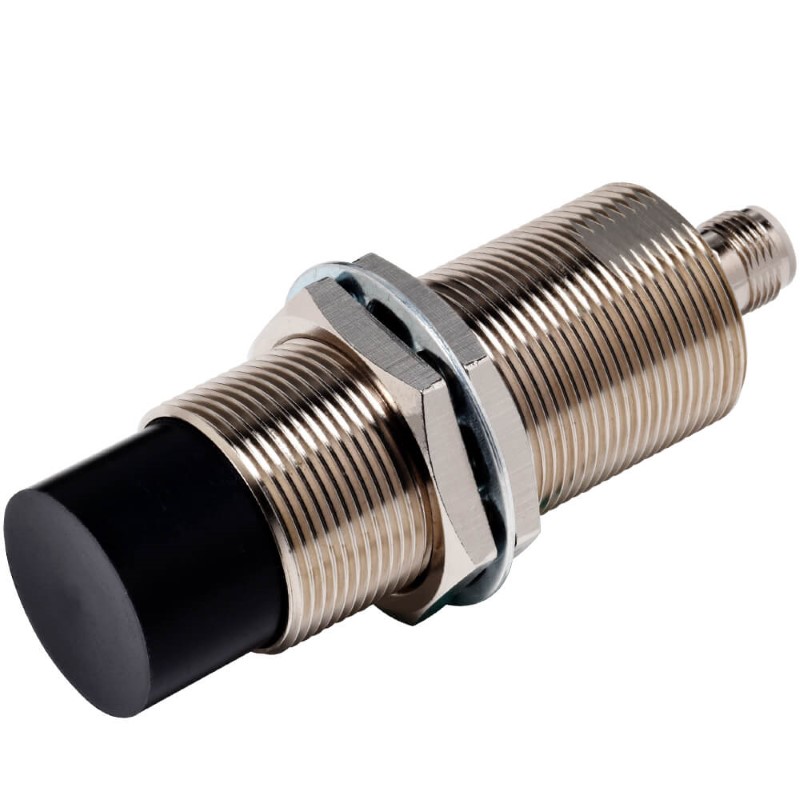
Omron E2E-X50MC2L30-M1 Inductive Proximity Sensor
| Feature | Value |
|---|---|
| Sensor Type | Inductive Proximity Sensor |
| Series | Omron E2E NEXT |
| Housing Size | M30 |
| Mounting Type | Non-flush (Unshielded) |
| Sensing Distance | 50 mm |
| Output Configuration | NPN, Normally Closed (NC) |
| Wiring Method | 3-Wire DC |
| Supply Voltage | 10 to 30 VDC |
| Connection Type | M12 Connector |
| Housing Material | Nickel-Plated Brass |
| Protection Rating | IP67 / IP69K |
| Operating Temperature | -25°C to +70°C |
| Response Frequency | 100 Hz |
| Overall Length | 95 mm |
The Omron E2E-X50MC2L30-M1 Inductive Proximity Sensor is designed for non-contact detection of metallic objects in industrial automation systems. As part of the E2E NEXT family, this sensor combines a large sensing range with a durable M30 cylindrical housing. Its 50 mm sensing distance allows machine designers to detect targets from greater distances compared to conventional inductive sensors, helping simplify installation and improve mechanical flexibility.
Technical Overview
The Omron E2E-X50MC2L30-M1 Inductive Proximity Sensor utilizes an electromagnetic field to identify the presence of conductive metal targets. The sensor features a non-flush design, enabling an extended sensing distance of 50 mm. The housing is manufactured from nickel-plated brass, providing resistance to mechanical stress and demanding industrial environments.
The sensor operates on a 10 to 30 VDC supply and provides an NPN normally closed output configuration. An M12 connector interface simplifies installation and maintenance activities while reducing wiring complexity.
Operating Principle
Like other inductive sensing devices, the Omron E2E-X50MC2L30-M1 Inductive Proximity Sensor generates a high-frequency electromagnetic field at its sensing face. When a metallic object enters this field, eddy currents are induced within the target material.
These eddy currents absorb energy from the oscillation circuit, causing a measurable change in the sensor’s internal circuitry. Once the threshold is reached, the output state changes and the connected control system receives a detection signal.
Because the detection method is contactless, there is no physical wear between the sensor and the target object. This characteristic contributes to reliable long-term operation in automated machinery.
Key Application Areas
- Conveyor positioning systems
- Metal component detection stations
- Automated transfer equipment
- Machine tool positioning systems
- Material handling installations
- Heavy-duty industrial machinery
- Automated storage and retrieval systems
- Production line monitoring equipment
The long sensing distance makes this model suitable for installations where mechanical clearance is required between the sensor and the moving target.
Industrial Applications
In automotive manufacturing facilities, the Omron E2E-X50MC2L30-M1 Inductive Proximity Sensor can be used to verify the position of metal carriers, fixtures, and transport assemblies.
In steel processing plants, the sensor can detect large metal workpieces moving through conveyor systems while maintaining a safe separation distance from hot or abrasive materials.
Packaging machinery manufacturers often integrate long-range inductive sensors into equipment where robust object detection is required despite vibration and environmental contamination.
Warehouse automation systems may utilize this sensor to monitor metal pallets, transfer mechanisms, and shuttle positioning systems.
Advantages of the Sensor Design
- Extended 50 mm sensing distance
- Robust nickel-plated brass housing
- High environmental protection rating
- M12 connector for simplified maintenance
- Suitable for demanding industrial environments
- Reliable detection of metallic targets
- Non-contact operation reduces wear
- Compatibility with standard PLC control systems
Sector-Specific Usage Examples
Automotive Assembly
Production engineers can use the Omron E2E-X50MC2L30-M1 Inductive Proximity Sensor to monitor the presence of metal body carriers moving between robotic assembly stations.
Mining Equipment
The sensor can be installed on material transport equipment to detect metallic machine components under harsh operating conditions.
Logistics Systems
Automated pallet transfer systems often require long-range detection of metallic carriers. The extended sensing capability supports reliable operation in these applications.
Industrial Manufacturing
Machine builders frequently incorporate the Omron E2E-X50MC2L30-M1 Inductive Proximity Sensor into automated handling systems where installation space and mechanical clearance must be optimized.
Engineers looking for additional sensing technologies can also review Omron sensor products for related automation applications.
Considerations When Selecting This Sensor
- Verify that the target material is metallic and compatible with inductive sensing.
- Confirm available installation space for the M30 housing.
- Evaluate required sensing distance and target dimensions.
- Consider environmental exposure including dust, water, and cleaning processes.
- Check PLC input compatibility with NPN output architecture.
- Review mounting clearances required for non-flush installation.
Frequently Asked Questions
What type of sensor is the Omron E2E-X50MC2L30-M1?
It is an inductive proximity sensor designed for non-contact detection of metallic objects.
What is the sensing distance?
The nominal sensing distance is 50 mm.
Does the sensor detect non-metallic materials?
No. Inductive sensing technology is intended for metallic targets.
What output configuration does it provide?
The sensor features an NPN normally closed (NC) output.
What supply voltage is required?
The device operates from 10 to 30 VDC.
What environmental protection rating does it have?
The sensor is rated IP67 and IP69K for protection against dust and water ingress.
What connection method is used?
An M12 connector is used for electrical connection.
Where is the Omron E2E-X50MC2L30-M1 Inductive Proximity Sensor commonly used?
It is commonly used in manufacturing equipment, conveyor systems, automated handling systems, automotive production lines, and industrial machinery.