
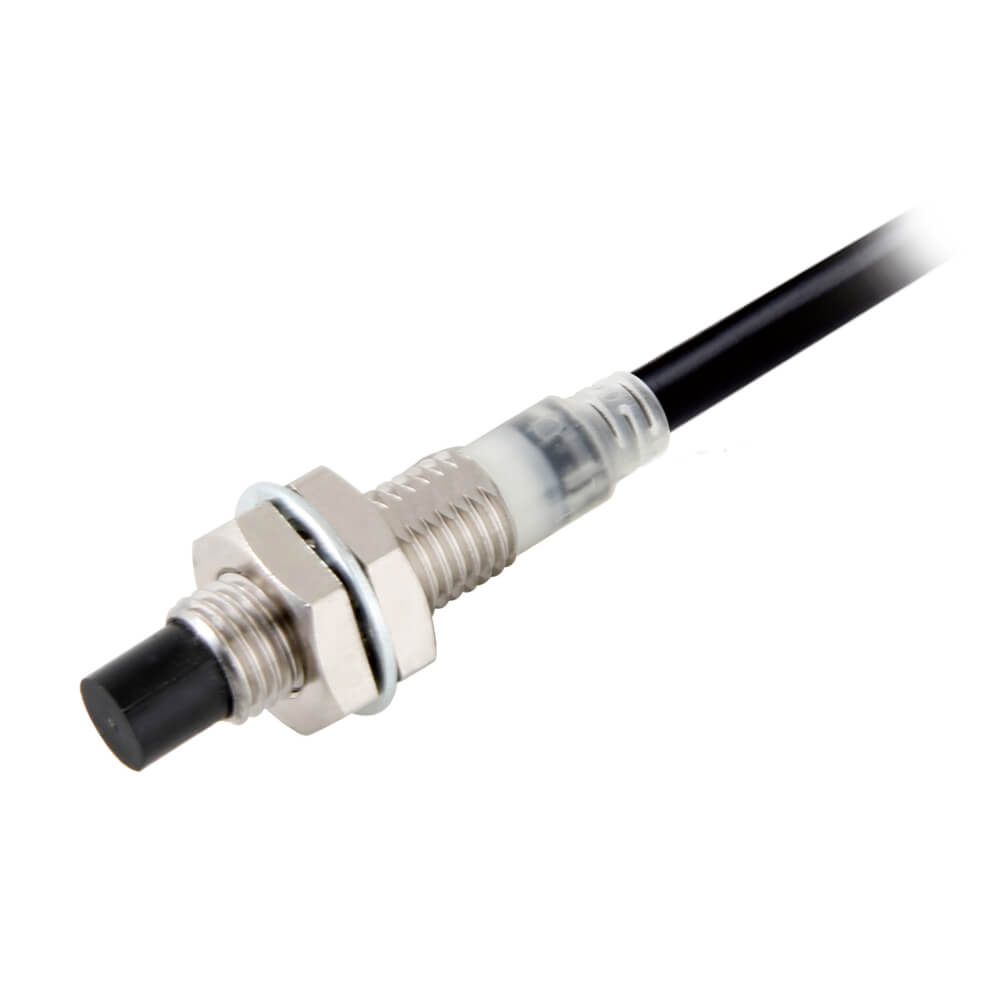
Omron E2E-X4MB1T8 5M Inductive Proximity Sensor
| Feature | Value |
|---|---|
| Sensor Type | Inductive Proximity Sensor |
| Series | E2E NEXT |
| Sensing Distance | 4 mm |
| Mounting Type | Non-flush |
| Housing Size | M8 Threaded Cylindrical Body |
| Housing Material | Stainless Steel |
| Output Type | PNP Normally Open (NO) |
| Connection Method | 5 m Cable |
| Supply Voltage | 10 to 30 VDC |
| Response Frequency | 1 kHz |
| Protection Rating | IP67 / IP67G / IP69K |
| Operating Temperature | -40°C to +85°C |
The Omron E2E-X4MB1T8 5M Inductive Proximity Sensor is designed for non-contact detection of metallic objects in industrial automation systems. As part of the E2E NEXT family, this sensor combines a compact M8 stainless-steel housing with a 4 mm sensing range, making it suitable for installations where space is limited while maintaining reliable detection performance.
The sensor is engineered for environments where vibration, contamination, moisture, and temperature fluctuations are common. Its rugged construction and high ingress protection ratings allow integration into machinery, assembly stations, material handling systems, and automated production lines.
Technical Description
The Omron E2E-X4MB1T8 5M Inductive Proximity Sensor utilizes electromagnetic field generation to detect conductive metal targets without physical contact. The non-flush sensing design provides an extended sensing distance of 4 mm compared to shielded alternatives of similar dimensions.
The sensor features a stainless-steel body that enhances mechanical durability and resistance to industrial contaminants. Its PNP normally open output configuration allows direct integration with PLC inputs, industrial controllers, and distributed I/O systems.
The extended cable version provides installation flexibility when sensors must be positioned at a significant distance from control cabinets or connection points.
Working Principle
An inductive proximity sensor operates by generating a high-frequency electromagnetic field from its sensing face. When a metallic object enters this field, eddy currents are induced within the target material.
These eddy currents alter the oscillation characteristics of the sensor circuit. Once the change reaches the switching threshold, the output state changes and sends a signal to the connected control system.
Because detection occurs without mechanical contact, the Omron E2E-X4MB1T8 5M Inductive Proximity Sensor minimizes wear and contributes to stable long-term operation in repetitive industrial processes.
Typical Applications
- Machine tool position monitoring
- Conveyor system object detection
- Automated assembly equipment
- Packaging machinery
- Industrial robotics
- Metal part counting systems
- Production line presence detection
- Transfer mechanism positioning
In automated manufacturing cells, the sensor can verify the presence of metal fixtures before machining operations begin. In conveyor applications, it can detect metallic carriers or pallets moving between production stages.
Industrial Applications
Automotive Manufacturing
The sensor can be used to confirm fixture positioning, detect metal components during assembly, and monitor machine movement within automated workstations.
Packaging and Material Handling
Industrial packaging systems frequently use inductive sensors to detect machine components, monitor actuator positions, and verify equipment status.
Metal Processing Facilities
In metal fabrication environments, the sensor assists with positioning control, machine sequencing, and component presence verification.
Electronics Production
Compact dimensions make installation possible in precision assembly equipment where available mounting space is restricted.
For additional product families and industrial sensing technologies, explore Omron sensor products.
Advantages
- Compact M8 stainless-steel construction
- 4 mm sensing distance for reliable detection
- PNP normally open output compatibility
- High environmental protection ratings
- Resistance to dust, water, and oil exposure
- Wide operating temperature range
- Non-contact detection reduces mechanical wear
- Extended 5 m cable simplifies installation
Industry-Specific Usage Examples
In automotive welding stations, the sensor may confirm fixture locking positions before robotic operations begin. In warehouse automation systems, it can monitor the movement of metal transport carriers between conveyor sections.
Food packaging equipment often uses protected inductive sensors to monitor machine positions in washdown environments. Metalworking facilities may install the Omron E2E-X4MB1T8 5M Inductive Proximity Sensor near clamping mechanisms to verify operational readiness before machining cycles start.
Considerations When Selecting the Sensor
- Verify that the target material is metallic.
- Ensure the required sensing distance is within the 4 mm range.
- Confirm compatibility with PNP input circuitry.
- Evaluate available mounting space for the M8 housing.
- Review environmental conditions including moisture and temperature.
- Consider cable routing requirements during installation.
- Check PLC or controller input specifications.
When properly selected and installed, the Omron E2E-X4MB1T8 5M Inductive Proximity Sensor can provide stable detection performance across a wide range of industrial automation applications.
Frequently Asked Questions
What type of objects can this sensor detect?
The sensor is designed to detect metallic objects using inductive sensing technology.
What is the sensing distance?
The nominal sensing distance is 4 mm.
Does the sensor require physical contact with the target?
No. Detection occurs through an electromagnetic field without physical contact.
What output configuration does it use?
The sensor provides a PNP normally open output.
Can it be used in wet environments?
Yes. Its IP67, IP67G, and IP69K ratings support operation in demanding industrial environments.
What is the operating temperature range?
The sensor operates from -40°C to +85°C.
Where is the Omron E2E-X4MB1T8 5M Inductive Proximity Sensor commonly installed?
It is frequently installed on conveyors, machine tools, assembly equipment, and automated production systems.
Why choose an inductive proximity sensor instead of a mechanical switch?
Inductive sensors provide non-contact operation, reducing wear and increasing service life in repetitive applications.