
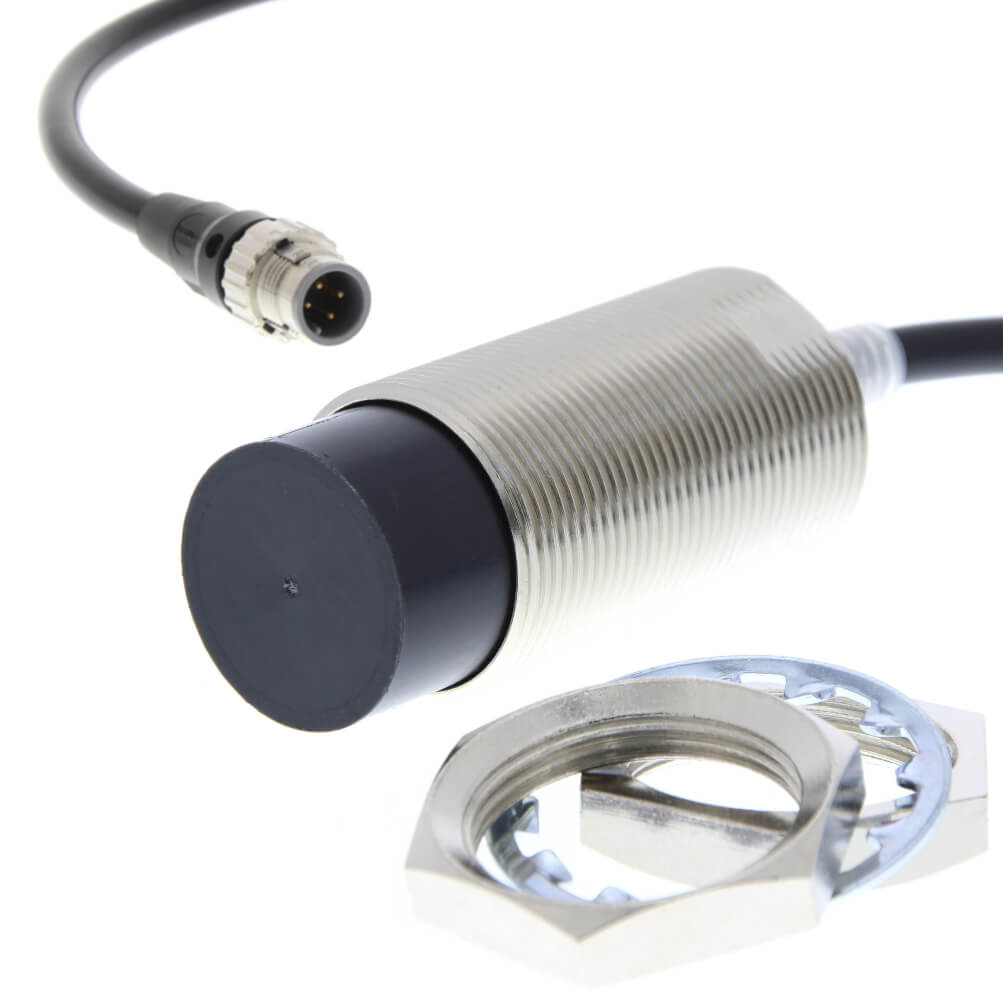
Omron E2E-X40MD2L30-M1TGJ-T 0.3M Inductive Proximity Sensor
| Feature | Value |
|---|---|
| Sensor Type | Inductive Proximity Sensor |
| Series | E2E NEXT |
| Housing Diameter | M30 |
| Mounting Style | Non-flush |
| Sensing Distance | 40 mm |
| Output Type | DC 2-wire |
| Operation Mode | NC |
| Connection Type | M12 Smartclick Connector with 0.3 m Pigtail |
| Housing Material | Nickel-plated Brass |
| Thread Length | 50 mm |
| Overall Length | 82.3 mm |
| Protection Rating | IP67, IP67G, IP69K |
Reliable object detection is essential in automated manufacturing systems where production continuity depends on accurate machine feedback. The Omron E2E-X40MD2L30-M1TGJ-T 0.3M Inductive Proximity Sensor is designed to detect metallic targets without physical contact while supporting efficient installation through its connector-based wiring configuration.
This model belongs to the E2E NEXT series and combines long sensing distance performance with a robust industrial housing. The integrated M12 Smartclick connector arrangement allows simplified replacement procedures and supports machine designs that require modular sensor connectivity.
Technical Description
The Omron E2E-X40MD2L30-M1TGJ-T 0.3M Inductive Proximity Sensor features an M30 threaded cylindrical body manufactured from nickel-plated brass. Its non-flush mounting design enables a sensing distance of 40 mm, making it suitable for applications where increased installation clearance is required.
The sensor operates using a DC 2-wire normally closed output configuration. A short 0.3-meter pigtail cable is combined with an M12 Smartclick connection system, reducing installation complexity while supporting rapid maintenance procedures.
Protection ratings of IP67, IP67G, and IP69K enable deployment in environments exposed to moisture, cleaning agents, dust, and industrial contaminants.
Working Principle
The sensor continuously generates an electromagnetic field from its sensing face. When a metallic target enters the sensing zone, eddy currents are induced within the object. These currents affect the internal oscillation circuit and create a measurable change within the sensor electronics.
The circuitry processes this change and switches the output state accordingly. Since no mechanical contact occurs during detection, component wear is minimized and long-term sensing stability can be maintained.
This principle is widely utilized throughout industrial automation systems where consistent object detection is required under demanding operating conditions.
Application Areas
- Automated assembly machinery
- Industrial conveyor systems
- Robotic production cells
- Metal processing equipment
- Packaging automation lines
- Machine position monitoring
- Automated transfer stations
- Warehouse automation systems
The connectorized design is especially beneficial for equipment manufacturers seeking to reduce machine downtime during maintenance activities.
Industrial Applications
Automotive Production Facilities
The sensor can monitor metal fixture positions, workpiece movement, and machine indexing systems used throughout vehicle manufacturing processes.
Food and Beverage Packaging Equipment
Its high protection ratings allow installation on machinery exposed to routine cleaning procedures while maintaining reliable sensing performance.
Automated Material Handling Systems
The sensor assists in monitoring steel carriers, transfer mechanisms, and positioning devices within logistics operations.
Machine Building Projects
Machine manufacturers frequently implement connectorized sensors to simplify wiring architecture and support easier replacement procedures during servicing.
Advantages
- Extended 40 mm sensing distance
- M12 Smartclick connector system
- Compact 0.3-meter pigtail connection
- Durable metal housing construction
- Non-contact detection technology
- High environmental protection ratings
- Reduced maintenance effort
- Suitable for demanding industrial environments
The Omron E2E-X40MD2L30-M1TGJ-T 0.3M Inductive Proximity Sensor is commonly selected for automation systems that require both long-range metal detection and connector-based installation flexibility.
Engineers often integrate the Omron E2E-X40MD2L30-M1TGJ-T 0.3M Inductive Proximity Sensor into modular machine platforms where maintenance efficiency and standardized wiring practices are important design objectives.
Sector-Specific Usage Examples
- Detecting pallet positions in distribution facilities
- Monitoring machine carriage movement in manufacturing lines
- Position verification of metal tooling systems
- Detecting transfer arm locations in robotic cells
- Monitoring indexing mechanisms in packaging equipment
- Confirming movement of metallic transport carriers
Factors to Consider During Selection
- Required sensing range
- Target material characteristics
- Mounting space availability
- Environmental conditions
- Connector compatibility requirements
- Machine maintenance strategy
- Control system interface requirements
Omron E2E-X40MD2L30-M1TGJ-T 0.3M Additional sensing technologies and related industrial products can be reviewed through Omron sensor solutions when developing comprehensive automation systems.
Omron E2E-X40MD2L30-M1TGJ-T 0.3M Frequently Asked Questions
What is the sensing distance of this sensor?
The rated sensing distance is 40 mm.
What type of connection does the sensor use?
The sensor uses an M12 Smartclick connector with a 0.3-meter pigtail cable.
What output configuration is available?
The device provides a DC 2-wire normally closed output.
Can the sensor operate in washdown environments?
Yes. IP67, IP67G, and IP69K ratings support operation in demanding industrial environments.
Which materials can be detected?
The sensor is designed for the detection of metallic objects.
What mounting style is required?
The sensor is intended for non-flush mounting installations.
Why use a connectorized sensor?
Connectorized designs simplify installation, maintenance, and replacement procedures compared with permanently wired alternatives.
Where is the Omron E2E-X40MD2L30-M1TGJ-T 0.3M Inductive Proximity Sensor commonly used?
It is commonly used in automation machinery, robotic systems, material handling equipment, and industrial production lines.