
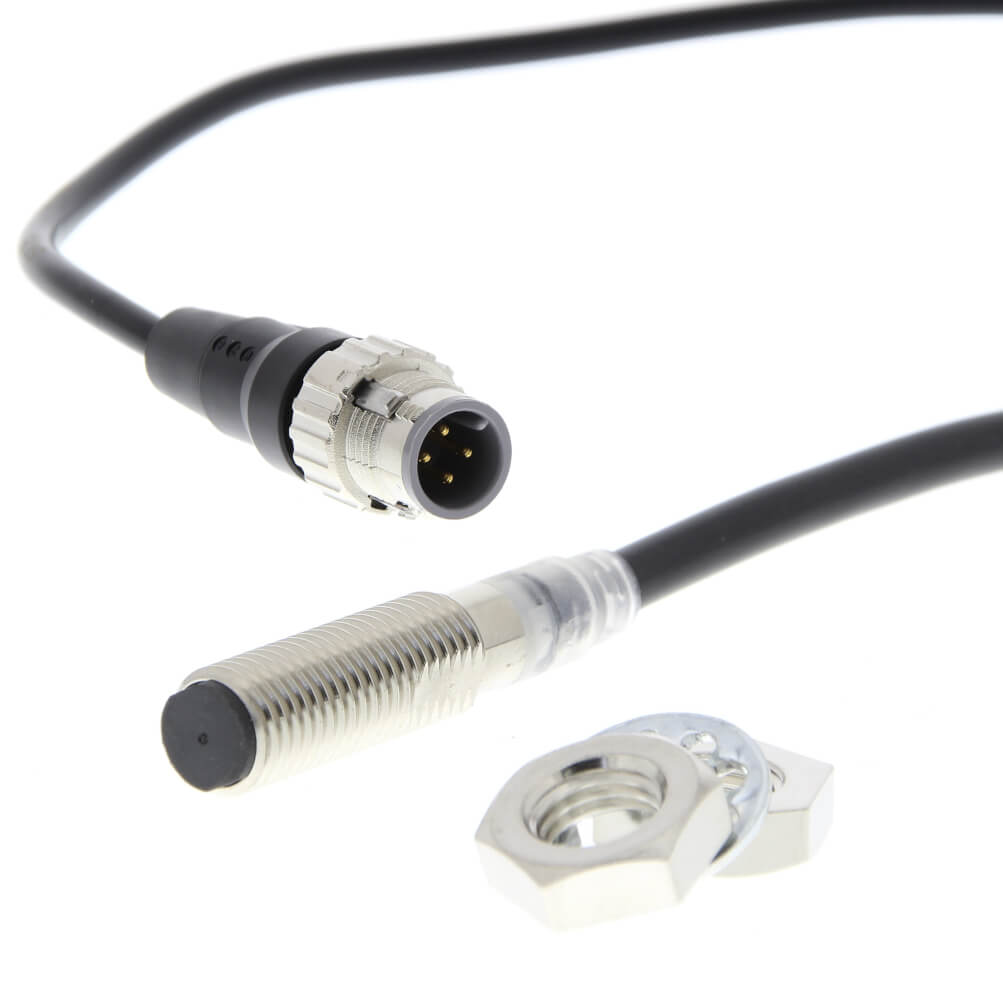
Omron E2E-X3D28-M1TGJ-T 0.3M Inductive Proximity Sensor
| Feature | Value |
|---|---|
| Manufacturer | Omron |
| Series | E2E NEXT |
| Sensor Type | Inductive Proximity Sensor |
| Housing Size | M8 |
| Sensing Distance | 3 mm |
| Mounting Type | Shielded |
| Output Type | 2-wire DC |
| Operation Mode | NO (Normally Open) |
| Connection Type | M12 Smartclick Pigtail Connector |
| Cable Length | 0.3 m |
| Housing Material | Nickel-Plated Brass |
| Protection Rating | IP67 / IP67G / IP69K |
| Thread Length | 21 mm |
| Overall Length | 37.8 mm |
Modern automation systems often require compact sensing devices capable of operating reliably in demanding industrial conditions. The Omron E2E-X3D28-M1TGJ-T Inductive Proximity Sensor is designed for metal object detection where space constraints, environmental exposure, and repeatable switching performance are critical factors. Its compact M8 housing and extended sensing distance make it suitable for equipment designers seeking dependable position and presence detection.
As part of the E2E NEXT sensor family, the Omron E2E-X3D28-M1TGJ-T Inductive Proximity Sensor combines inductive sensing technology with robust mechanical construction. The sensor is engineered to maintain stable operation in environments that include vibration, oil exposure, coolant contact, and frequent cleaning procedures.
Technical Description
This sensor utilizes a shielded inductive sensing structure to detect metallic targets without physical contact. The design helps maintain predictable detection characteristics while allowing installation near surrounding metal structures.
- M8 threaded cylindrical housing
- 3 mm sensing distance
- Normally Open switching function
- 2-wire DC output configuration
- M12 Smartclick connector with 0.3 m cable
- Nickel-plated brass housing construction
- High environmental protection ratings
Working Principle
The sensor operates by generating an electromagnetic field from its sensing face. When a conductive metal object enters this field, eddy currents develop within the target material. These currents influence the oscillator circuit inside the sensor.
The internal electronics continuously monitor this change. Once the target reaches the defined sensing range, the output state changes and provides a switching signal to the connected control system. Because there is no mechanical contact during operation, the sensing process minimizes wear and supports long service life.
Application Areas
The compact dimensions and durable construction allow the sensor to be used in a wide variety of industrial automation tasks.
- Automated production machinery
- Transfer and handling equipment
- Assembly stations
- Packaging lines
- Industrial robotics
- Conveyor monitoring systems
- Material positioning applications
- Machine guarding systems
Engineers evaluating additional sensing technologies may review Omron sensor series for related automation applications.
Industrial Applications
Robotic Manufacturing Cells
Industrial robots frequently require compact position verification sensors. This device can be used to monitor fixture locations, end-effector positions, and transfer mechanisms.
Packaging and Filling Systems
The sensor can confirm machine component positions before filling, sealing, labeling, or palletizing operations begin.
Assembly Automation
Manufacturing systems often use proximity sensors to verify the presence of metallic workpieces prior to automated assembly sequences.
Transport Systems
Conveyor-based installations may use the sensor to identify pallet carriers, metal fixtures, or transfer stops throughout the production process.
Omron E2E-X3D28-M1TGJ-T Advantages
- Compact installation dimensions
- Reliable non-contact sensing technology
- Extended sensing range for an M8 sensor
- High resistance to industrial contaminants
- Suitable for washdown environments
- Shielded design for controlled sensing zones
- Mechanical durability through metal housing construction
- Simplified installation with Smartclick connection technology
Sector-Specific Usage Examples
Food manufacturing facilities may install the sensor to monitor stainless-steel machine components exposed to regular cleaning cycles.
Automotive production plants can use it to detect metallic carriers moving between workstations and assembly cells.
Warehousing automation systems may integrate the sensor into conveyor modules to confirm transfer positions and stop locations.
Metal fabrication facilities often apply proximity sensing for actuator verification and machine status monitoring.
Factors to Consider During Product Selection
Choosing an inductive proximity sensor requires evaluation of application-specific requirements and environmental conditions.
- Confirm the target material is metallic.
- Verify the required sensing distance.
- Evaluate installation space limitations.
- Check compatibility with 2-wire DC circuits.
- Review connector accessibility.
- Assess environmental exposure levels.
- Consider mounting configuration requirements.
Omron E2E-X3D28-M1TGJ-T Frequently Asked Questions
1. What is the sensing distance of this sensor?
The rated sensing distance is 3 mm.
2. What output type does the sensor provide?
It uses a 2-wire DC output configuration.
3. Is the output Normally Open or Normally Closed?
This model operates with a Normally Open (NO) output.
4. What type of objects can it detect?
The sensor is designed for metallic target detection.
5. Is it suitable for washdown environments?
Yes. IP67, IP67G, and IP69K protection ratings support operation in demanding industrial environments.
6. What connection method is used?
The sensor features an M12 Smartclick pigtail connector with a 0.3-meter cable.
7. Where is the Omron E2E-X3D28-M1TGJ-T Inductive Proximity Sensor commonly used?
It is frequently installed in assembly systems, robotics, packaging machinery, and conveyor automation equipment.
8. What housing material is used?
The housing is manufactured from nickel-plated brass.
9. Can the sensor be mounted near metal structures?
Yes. Its shielded sensing design supports installation close to surrounding metallic components.
10. Why is the Omron E2E-X3D28-M1TGJ-T Inductive Proximity Sensor suitable for industrial automation?
Its combination of compact dimensions, non-contact sensing, robust environmental protection, and stable detection performance supports reliable operation in automated systems.