
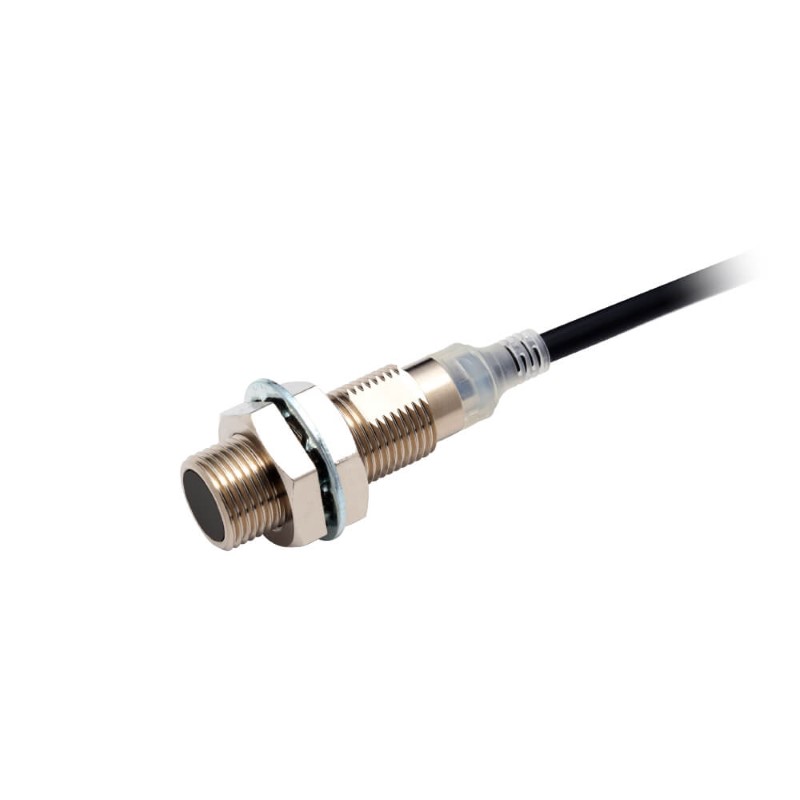
Omron E2E-X2R5D2-N 5M Inductive Proximity Sensor
| Feature | Value |
|---|---|
| Sensor Type | Inductive Proximity Sensor |
| Series | E2E NEXT |
| Housing Size | M12 |
| Mounting Type | Flush |
| Sensing Distance | 2.5 mm |
| Output Type | DC 2-Wire |
| Operation Mode | NC (Normally Closed) |
| Supply Voltage | 10 to 30 VDC |
| Connection Method | Cable |
| Cable Length | 5 m |
| Cable Specification | Oil-Resistant PVC |
| Housing Material | Nickel-Plated Brass |
| Thread Length | 32.9 mm |
| Overall Length | 47 mm |
| Protection Rating | IP67 / IP67G / IP69K |
Technical Overview
Production facilities often require sensing devices that can operate reliably across extended installation distances without sacrificing detection performance. The Omron E2E-X2R5D2-N 5M Inductive Proximity Sensor addresses these requirements through a robust inductive sensing design combined with a factory-installed 5-meter cable for flexible integration into industrial machinery.
As part of the E2E NEXT sensor family, the Omron E2E-X2R5D2-N 5M Inductive Proximity Sensor is designed for non-contact detection of metallic objects. Its flush-mounted M12 cylindrical housing enables installation within compact machine assemblies, while the 2.5 mm sensing distance provides dependable target detection for automation processes.
Working Principle
The sensor uses an internally generated electromagnetic field to identify the presence of conductive metallic targets. When a metal object enters the sensing zone, eddy currents are created within the target. These currents influence the oscillation circuit inside the sensor, resulting in an output state change.
Since the sensing process does not require physical contact, mechanical wear is minimized. This characteristic makes inductive sensors suitable for applications involving repetitive movement, high cycle rates, and continuous machine operation.
Design and Construction Features
The sensor body is manufactured from nickel-plated brass, providing resistance against mechanical impacts and industrial contaminants. The flush configuration allows installation directly into metal machine structures without creating interference with nearby components.
The integrated 5-meter oil-resistant PVC cable simplifies installation when the control cabinet or I/O equipment is located further away from the sensing point. This can reduce the need for additional extension cables and connection accessories.
Typical Application Areas
- Machine automation systems
- Industrial conveyor lines
- Packaging machinery
- Automated transfer equipment
- Production cell monitoring
- Metal component verification
- Position sensing applications
- Industrial assembly stations
Industrial Applications
Logistics and Conveying Systems
Large conveyor installations frequently require sensors positioned far from electrical control panels. The extended cable length of this model can simplify installation in these environments.
Packaging Equipment
Packaging systems use inductive sensors to monitor moving machine elements, detect metal carriers, and verify mechanical positioning during production cycles.
Automotive Manufacturing
Automotive production lines rely on proximity sensors for fixture monitoring, metal component presence detection, and automated assembly verification.
Machine Tool Equipment
Metalworking machinery often incorporates inductive sensors for position feedback and monitoring moving mechanical assemblies.
Advantages
- Non-contact metal detection technology
- Extended 5-meter cable connection
- Compact M12 cylindrical housing
- Flush mounting capability
- Stable sensing performance
- Durable nickel-plated brass construction
- Oil-resistant cable material
- High environmental protection ratings
Sector-Specific Usage Examples
- Monitoring pallet positions on conveyor systems
- Detecting metallic machine carriers in packaging lines
- Verifying fixture engagement in automotive production cells
- Position monitoring of transfer mechanisms
- Detecting moving machine parts in assembly equipment
- Feedback sensing within automated handling systems
Considerations Before Selection
When selecting the Omron E2E-X2R5D2-N 5M Inductive Proximity Sensor, engineers should review environmental conditions, installation geometry, sensing distance requirements, and electrical compatibility.
- Verify that a 2.5 mm sensing distance is suitable for the application.
- Confirm compatibility with NC control logic.
- Review mounting arrangements for flush installation.
- Assess cable routing paths for the 5-meter connection.
- Check exposure to oil, coolant, and cleaning procedures.
- Evaluate control system voltage requirements.
Additional information about Omron sensor products can support sensor selection and system design activities.
Omron E2E-X2R5D2-N 5M Frequently Asked Questions
What is the primary function of the Omron E2E-X2R5D2-N 5M Inductive Proximity Sensor?
It detects metallic objects without physical contact using electromagnetic induction technology.
What is the sensing distance?
The specified sensing distance is 2.5 mm.
How long is the connection cable?
The sensor is equipped with a factory-installed 5-meter cable.
Does the sensor support flush mounting?
Yes. It is designed for flush installation within metallic mounting surfaces.
What output type is used?
The sensor uses a DC 2-wire Normally Closed output configuration.
Which protection ratings are available?
The device is rated IP67, IP67G, and IP69K.
Can it operate in oil-exposed industrial environments?
The oil-resistant PVC cable construction supports use in industrial applications where lubricants and fluids may be present.
What industries commonly use this sensor?
Packaging, automotive manufacturing, logistics automation, machine building, and material handling industries commonly use this sensor.
What material is used for the sensor housing?
The housing is manufactured from nickel-plated brass.
Why is the Omron E2E-X2R5D2-N 5M Inductive Proximity Sensor suitable for industrial automation?
The combination of non-contact operation, durable construction, compact dimensions, and extended cable length supports reliable integration into automated systems.