
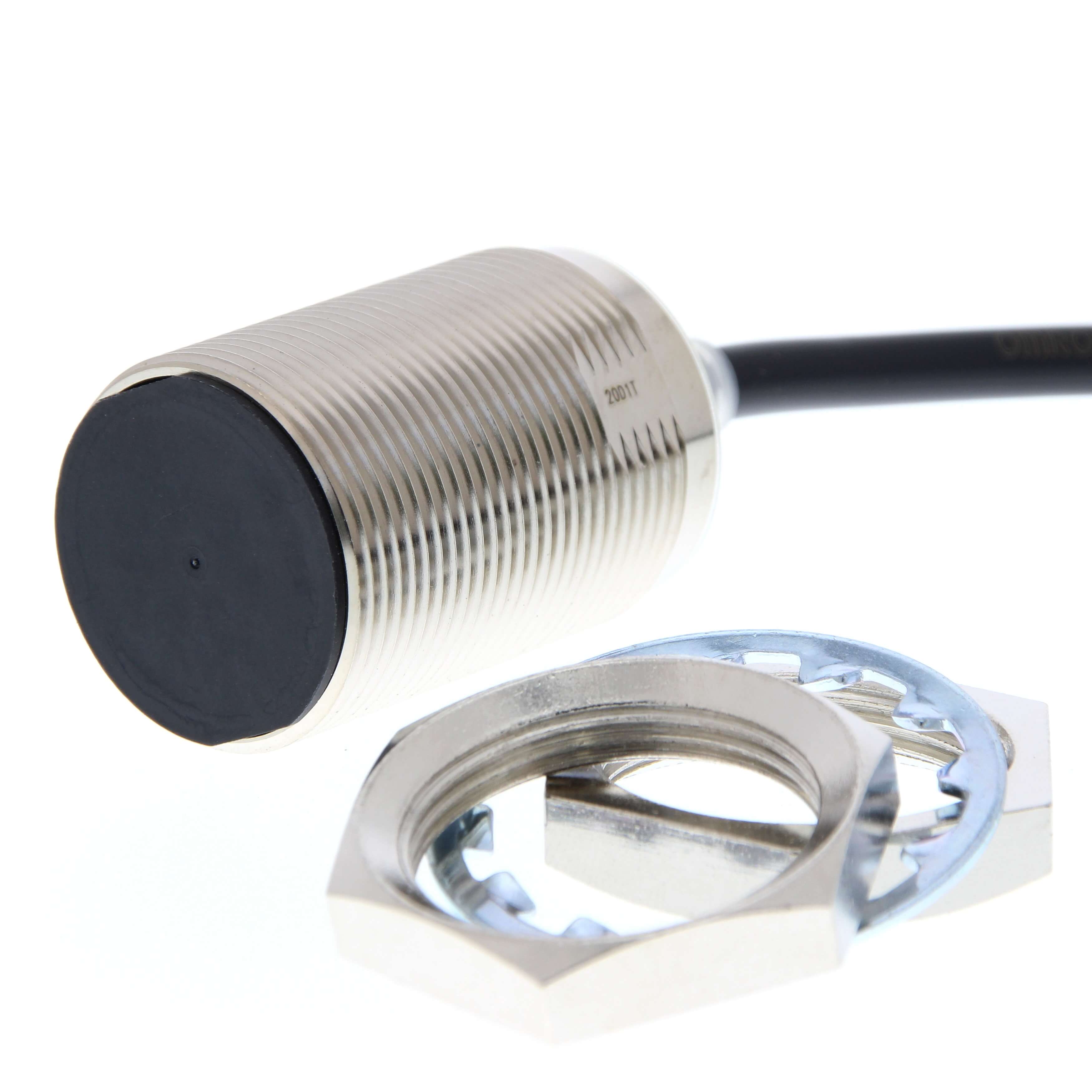
Omron E2E-X20D130-R 5M Inductive Proximity Sensor
| Feature | Value |
|---|---|
| Product Type | Inductive Proximity Sensor |
| Series | E2E NEXT |
| Housing Diameter | M30 |
| Sensing Distance | 20 mm |
| Output Type | DC 2-Wire |
| Output Configuration | Normally Open |
| Connection Method | Pre-Wired Cable |
| Cable Length | 5 m |
| Housing Material | Nickel-Plated Brass |
| Protection Rating | IP67 / IP67G / IP69K |
| Thread Size | M30 |
| Detection Principle | Inductive Metal Detection |
The Omron E2E-X20D130-R 5M Inductive Proximity Sensor is designed for non-contact detection of metallic objects in industrial automation systems. With its M30 cylindrical housing, 20 mm sensing distance, and 5 m pre-wired cable, it is suitable for applications where the sensor must be mounted away from terminal boxes or control panels.
The Omron E2E-X20D130-R 5M Inductive Proximity Sensor belongs to the E2E NEXT series, which is commonly used in machine automation, conveyor systems, and production equipment requiring stable metal target detection.
Omron E2E-X20D130-R 5M Technical Description
This inductive proximity sensor uses a DC 2-wire normally open output configuration. The M30 threaded housing allows secure installation on machine frames, brackets, and metal structures. Its nickel-plated brass body supports mechanical durability in industrial environments.
The 5 m cable version is useful in larger machines, long conveyor lines, and distributed automation systems where additional cable length simplifies routing and reduces the need for intermediate connectors.
Working Principle
The sensor generates an electromagnetic field at its sensing face. When a metallic target enters this field, eddy currents are produced in the object. These currents change the oscillator behavior inside the sensor, causing the output to switch.
Because the detection process does not require physical contact, the sensor reduces mechanical wear compared with limit switches and mechanical position devices.
Omron E2E-X20D130-R 5M Usage Areas
- Long conveyor lines
- Automated storage systems
- Metal part detection stations
- Industrial transport mechanisms
- Machine position monitoring
- Assembly automation
- Packaging machinery
Industrial Applications
Logistics Automation
In automated warehouse systems, the sensor can confirm the position of carriers, metal stops, transfer units, and actuator mechanisms.
Heavy Equipment Manufacturing
Large production machines often require sensors with longer cable lengths for installation across extended frames or moving mechanical sections.
Conveyor Control
The sensor can be used to monitor metallic targets on conveyor structures, helping control movement, stopping points, and sequence confirmation.
Omron E2E-X20D130-R 5M Advantages
- 20 mm sensing distance for metallic targets
- 5 m integrated cable for extended installation layouts
- Non-contact operation
- M30 threaded housing for robust mounting
- Nickel-plated brass body
- High ingress protection ratings
- Suitable for demanding automation environments
Selection Considerations
Before selecting this sensor, engineers should review target material, target size, mounting distance, cable route, environmental exposure, and control system input compatibility.
The 5 m cable version is especially useful when the sensor is installed at a distance from junction boxes or electrical cabinets. For broader comparison, related Omron sensor products can be reviewed during automation system planning.
Frequently Asked Questions
What does this sensor detect?
It detects metallic objects using inductive sensing technology.
What is the sensing distance?
The nominal sensing distance is 20 mm.
What cable length does this model have?
This version includes a 5 m pre-wired cable.
Is physical contact required?
No. The sensor detects metal targets without physical contact.
What output type is used?
It uses a DC 2-wire normally open output configuration.
What is the housing size?
The sensor has an M30 threaded cylindrical housing.
Can it be used in conveyor systems?
Yes. It is suitable for position detection and metal target monitoring in conveyor automation.
What should be checked before installation?
Engineers should check sensing distance, target material, mounting position, wiring route, and environmental conditions.