
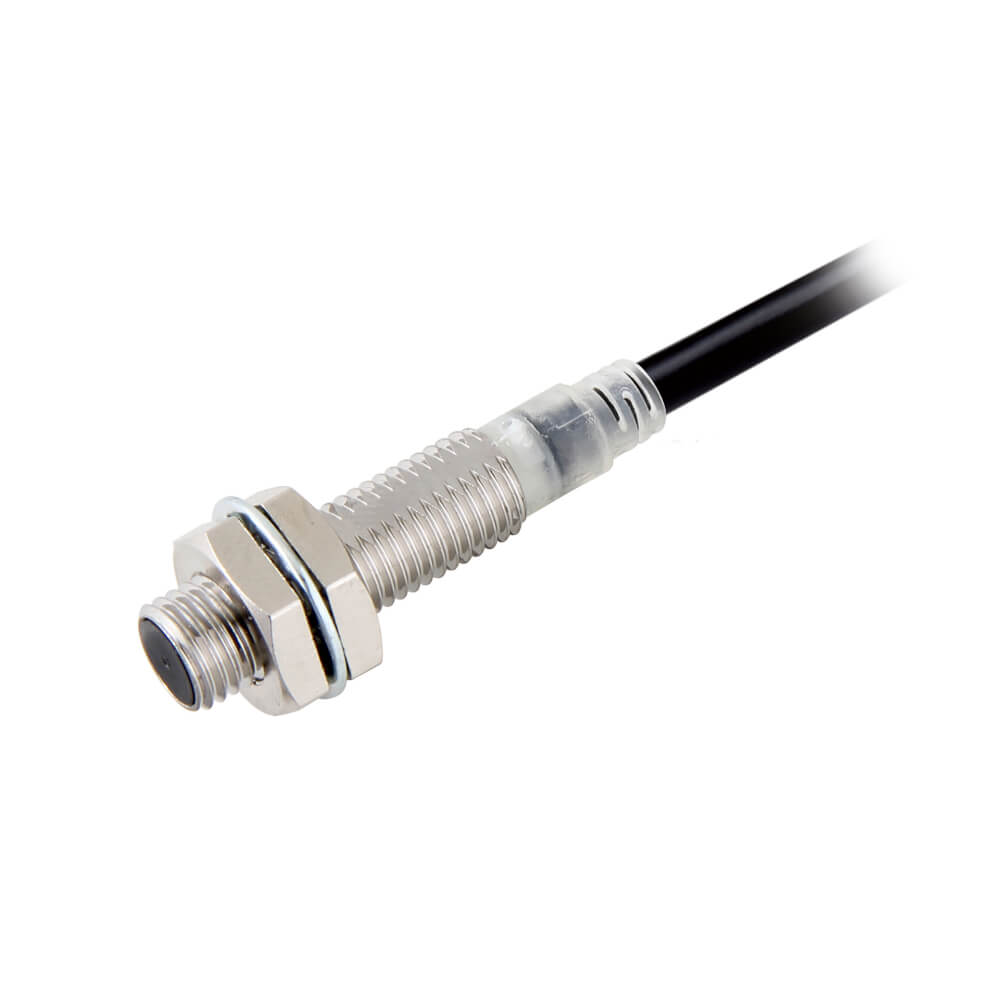
Omron E2E-X1R5C18-R 2M Inductive Proximity Sensor
| Feature | Value |
|---|---|
| Sensor Type | Inductive Proximity Sensor |
| Series | E2E NEXT |
| Size | M8 |
| Mounting Type | Flush |
| Sensing Distance | 1.5 mm |
| Overall Length of Sensor | 37.8 mm |
| Thread Length | 22 mm |
| Material Housing | Stainless Steel |
| Output Type | NPN |
| Operation Mode | NO |
| Connection Method | Cable |
| Cable Specifications | PVC Oil-Resistant |
| Cable Length | 2 m |
| IO-Link Baud Rate | Not Applicable |
| Degree of Protection | IP67 / IP67G / IP69K |
Technical Description
The Omron E2E-X1R5C18-R 2M Inductive Proximity Sensor is a short-body M8 inductive sensor designed for close-range detection of metallic targets. It combines a stainless-steel housing, flush installation format, 1.5 mm sensing distance, and a 2 m oil-resistant PVC cable.
The Omron E2E-X1R5C18-R 2M Inductive Proximity Sensor is suitable for applications where direct cable wiring is preferred over detachable connectors. Its NPN normally open output allows integration with many PLC input cards, distributed I/O systems, and industrial control panels using sinking input logic.
Omron E2E-X1R5C18-R 2M Working Principle
The sensor creates an electromagnetic field at the active face. When a metal object enters the detection area, induced eddy currents modify the sensor’s internal oscillation. The electronics evaluate this change and switch the output when the target is within the rated sensing range.
Since there is no physical contact between the sensor and the target, the sensing process reduces mechanical wear. This is particularly useful in machinery with high cycle rates, repetitive indexing, and frequent position confirmation tasks.
Omron E2E-X1R5C18-R 2M Usage Areas
- Metal object detection on conveyors
- Position feedback in machine modules
- Workpiece presence checks
- Fixture verification in assembly stations
- End-position sensing on actuators
- Automated transfer mechanism monitoring
- Machine tool sequence confirmation
- Detection of metallic guides, stops, or carriers
Industrial Applications
In metal processing environments, the oil-resistant cable is useful near lubricated equipment, cutting fluids, and machine zones where cable exposure must be considered. In conveyor-based systems, the sensor may detect a metal reference part to synchronize transport movement.
In packaging and material handling machinery, the sensor can monitor mechanical movement without requiring contact with the moving element. For related products, Omron sensor series can be reviewed according to connection style and industrial requirements.
Advantages
- Short M8 stainless-steel body
- Flush mounting capability
- 2 m fixed cable connection
- Oil-resistant PVC cable
- IP67, IP67G, and IP69K protection ratings
- NPN normally open output
- Contactless metal detection
- Suitable for repetitive machine cycles
Sector-Based Usage Examples
In machining cells, this sensor may verify the location of a metallic clamp before cutting starts. In logistics automation, it can confirm the position of a metal stopper at a transfer point. In packaging lines, it may detect metallic machine parts used for timing and sequence control.
Selection Considerations
When choosing this sensor, the installation environment should be reviewed carefully. The cable type, target distance, metal target size, available mounting space, and controller input compatibility are important selection criteria.
Because the rated sensing distance is 1.5 mm, alignment between the target and the sensing face must be controlled during installation. Cable routing should also avoid excessive mechanical stress, sharp bends, or direct abrasion.
Omron E2E-X1R5C18-R 2M Frequently Asked Questions
What is the sensing distance?
The rated sensing distance is 1.5 mm.
What type of connection does it use?
It uses a fixed 2 m cable connection.
Is the cable oil-resistant?
Yes, the cable specification is PVC oil-resistant.
What is the output configuration?
The sensor uses an NPN normally open output.
What targets can it detect?
It detects metallic targets.
Can it be mounted flush?
Yes, it is a flush mounting sensor.
Where is it commonly used?
It is commonly used in conveyors, machining equipment, assembly systems, and automated handling machinery.
What protection ratings are specified?
The specified protection ratings are IP67, IP67G, and IP69K.