
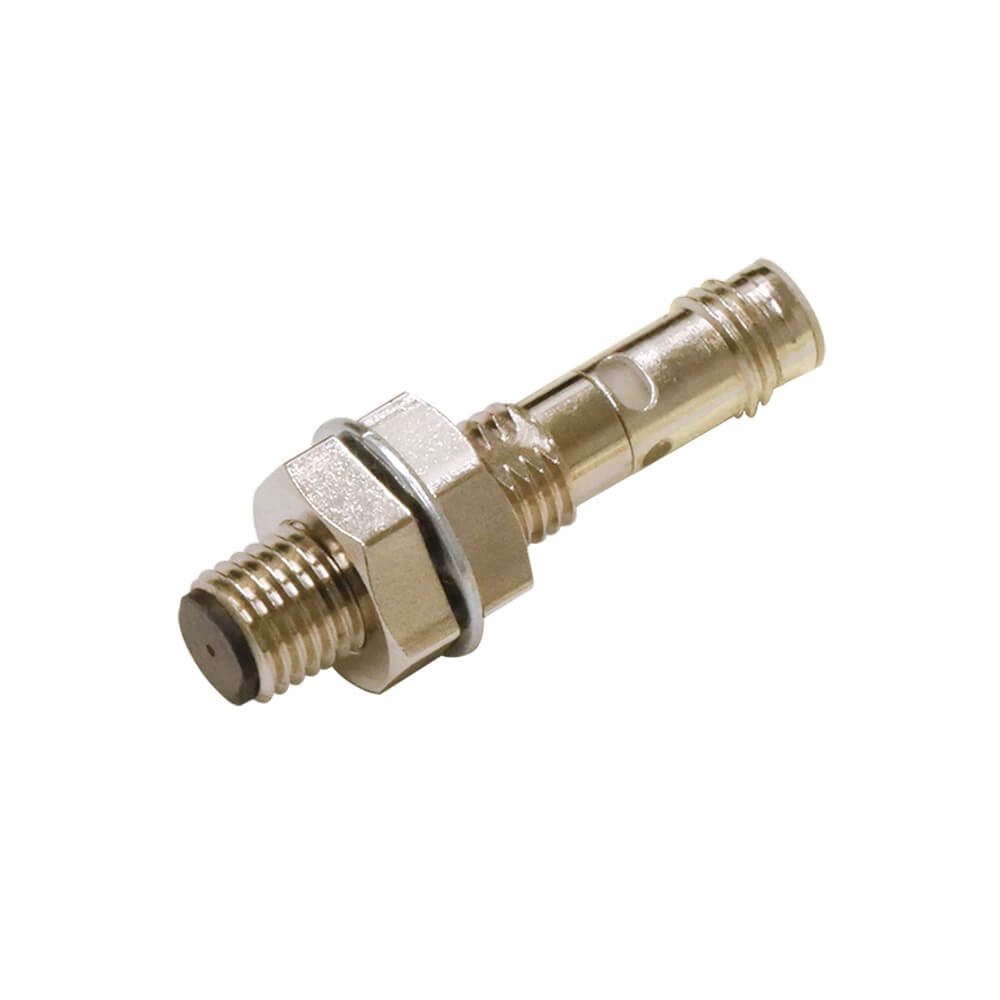
Omron E2E-X1R5C18-M5 Inductive Proximity Sensor
| Feature | Value |
|---|---|
| Sensor Type | Inductive Proximity Sensor |
| Series | E2E NEXT |
| Size | M8 |
| Mounting Type | Flush |
| Sensing Distance | 1.5 mm |
| Overall Length of Sensor | 39 mm |
| Thread Length | 22 mm |
| Material Housing | Stainless Steel |
| Output Type | NPN |
| Operation Mode | NO |
| Connection Method | Connector M8 – 3 pin |
| IO-Link Baud Rate | Not Applicable |
| Degree of Protection | IP67 / IP69K |
Technical Description
The Omron E2E-X1R5C18-M5 Inductive Proximity Sensor is an M8 cylindrical sensor used for detecting metal objects at close range in industrial automation equipment. It has a stainless-steel housing, flush mounting design, 1.5 mm sensing distance, and NPN normally open output configuration.
The Omron E2E-X1R5C18-M5 Inductive Proximity Sensor differs from connector variants with higher pin counts by using an M8 3-pin connection method. This structure is suitable for simple three-wire proximity sensor circuits where supply voltage, ground, and switching output are connected directly to a controller or I/O module.
Working Principle
The sensor generates an electromagnetic field from the sensing surface. When a metal target enters the effective sensing area, the field is affected by induced currents in the target. The sensor circuit detects this change and switches the output state.
This operating principle allows object detection without mechanical contact. It is useful in applications where frequent switching, vibration, dust, lubricant, or limited access would make mechanical limit switches less practical.
Usage Areas
- Short-distance metal presence detection
- Machine position monitoring
- Transfer station confirmation
- Metal workpiece detection
- Automated fixture monitoring
- Conveyor component sensing
- Pneumatic cylinder end-position detection
- Compact production cell feedback
Omron E2E-X1R5C18-M5 Industrial Applications
In machine-building projects, this sensor may be installed near slides, stops, and guide elements to confirm movement completion. In packaging equipment, it can monitor metallic parts of the mechanism to support sequence timing. In metalworking systems, it may confirm that a workpiece or tool carrier is correctly positioned before machining begins.
In automated inspection cells, the compact body supports installation near test fixtures where the sensor must detect a metal reference point without interfering with the product flow.
Advantages
- Compact M8 size
- Flush mounting structure
- 1.5 mm close-range detection
- Stainless-steel housing
- M8 3-pin connector
- NPN normally open output
- IP67 and IP69K protection
- Contactless sensing method
Sector-Based Usage Examples
In automotive assembly, the sensor may confirm the presence of metal tooling pins. In logistics machinery, it can detect metal stops in diverter systems. In pharmaceutical packaging machines, it may monitor mechanical positions inside protected automation modules.
For related industrial sensing components, Omron sensor products can be evaluated according to mounting size, connection method, and output type.
Selection Considerations
Before selecting this model, the control system input type should be checked to confirm compatibility with an NPN normally open sensor. The target must be metallic, and its distance from the sensing face should remain within the rated 1.5 mm range.
The M8 3-pin connector is suitable for standardized wiring, but the available connector cable, panel layout, and replacement strategy should be reviewed during machine design.
Omron E2E-X1R5C18-M5 Frequently Asked Questions
What type of sensor is this?
It is an inductive proximity sensor for metal detection.
What is the rated sensing distance?
The rated sensing distance is 1.5 mm.
What is the output type?
The output type is NPN.
What is the operation mode?
The operation mode is normally open.
What connector does it use?
It uses an M8 3-pin connector.
Can this sensor be installed in metal surroundings?
Yes, it is a flush mounting model designed for this type of installation.
Is it used for non-metal targets?
No, it is intended for detecting metallic objects.
What industries commonly use this sensor?
Machine building, packaging, automotive production, logistics, and assembly automation commonly use this sensor type.