
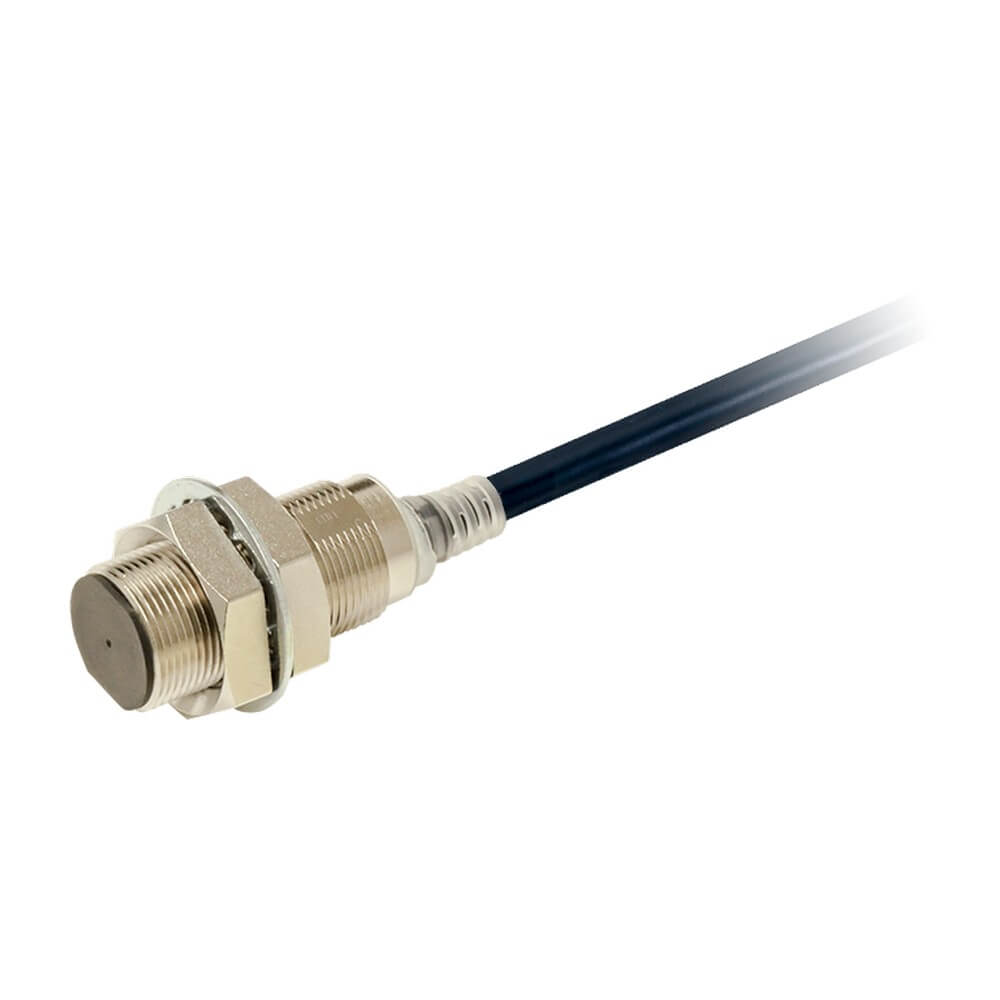
Omron E2E-X14B1T18-R 2M Inductive Proximity Sensor
| Feature | Value |
|---|---|
| Sensor Type | Inductive Proximity Sensor |
| Series | E2E NEXT |
| Housing Size | M18 |
| Sensing Distance | 14 mm |
| Mounting Style | Quasi-Flush |
| Output Configuration | 2-Wire DC |
| Cable Length | 2 m |
| Housing Material | Nickel-Plated Brass |
| Protection Rating | IP67 / IP69K |
| Operating Temperature | -25°C to +70°C |
| Power Supply | DC Type |
| Connection Method | Pre-Wired Cable |
Technical Description
The Omron E2E-X14B1T18-R 2M Inductive Proximity Sensor is designed for non-contact detection of metallic objects in industrial automation systems. As a member of the E2E NEXT sensor family, this model provides stable sensing performance in applications where reliability, durability, and resistance to harsh environmental conditions are required.
Its M18 cylindrical housing allows installation in a wide range of machinery and production equipment. The sensor incorporates a 14 mm sensing distance, enabling reliable detection of metallic targets without physical contact. The integrated 2-meter cable facilitates installation in larger equipment layouts where additional connection flexibility is needed.
The Omron E2E-X14B1T18-R 2M Inductive Proximity Sensor is commonly implemented in manufacturing facilities, automated handling systems, machine-building projects, and production lines where consistent metal detection contributes to process reliability and equipment monitoring.
Working Principle
The sensor operates using electromagnetic induction technology. An oscillating electromagnetic field is generated at the sensing face of the sensor. When a conductive metallic object enters the sensing area, eddy currents are induced within the target material.
These eddy currents affect the internal oscillation circuit of the sensor. The electronics continuously monitor these changes and determine when a target is present. Once the detection threshold is reached, the output changes state and communicates the presence of the object to the control system.
Because the sensing method does not rely on physical contact, wear is minimized and long-term operational stability can be maintained even in demanding industrial environments.
Key Features
- 14 mm sensing distance for metallic targets
- M18 threaded industrial housing
- 2-meter integrated cable connection
- Non-contact sensing technology
- Nickel-plated brass housing construction
- Suitable for continuous industrial operation
- IP67 and IP69K environmental protection
- Resistance to dust, moisture, and washdown conditions
Typical Areas of Use
The Omron E2E-X14B1T18-R 2M Inductive Proximity Sensor can be integrated into numerous industrial systems where accurate detection of metallic components is required.
- Automated production lines
- Machine tool monitoring
- Assembly stations
- Material transfer systems
- Packaging equipment
- Industrial conveyors
- Automated storage systems
- Robotic manufacturing cells
Industrial Applications
Automotive Manufacturing
In automotive production facilities, the sensor may be used to verify the presence of metal fixtures, carriers, and workpieces before automated assembly operations begin.
Machine Building
Equipment manufacturers often integrate inductive sensors to monitor actuator positions, moving mechanical components, and machine cycle status.
Logistics Automation
Distribution centers and warehouse automation systems use inductive sensors to detect metallic carriers, pallet transport mechanisms, and automated shuttle equipment.
Packaging Machinery
Packaging systems may utilize the sensor to verify machine positions, monitor transport elements, and ensure proper sequencing of mechanical operations.
Advantages
- Reliable sensing independent of ambient lighting conditions
- Reduced mechanical wear due to contactless operation
- Stable performance in demanding industrial environments
- Flexible installation enabled by the 2-meter cable
- High resistance to contamination and moisture
- Long operational service life
Industry-Specific Examples
In metal fabrication facilities, the Omron E2E-X14B1T18-R 2M Inductive Proximity Sensor can monitor workpiece positioning before machining processes begin. In conveyor-based logistics systems, it may verify carrier movement between transfer stations. Within automated assembly cells, the sensor can confirm fixture positioning before robotic operations start.
Food and beverage equipment manufacturers may also utilize the sensor in machinery exposed to washdown procedures due to its robust environmental protection characteristics.
Considerations When Selecting an Inductive Sensor
Selecting an appropriate inductive proximity sensor requires evaluation of sensing distance, target dimensions, mounting configuration, environmental conditions, and connection requirements. Engineers should also consider available installation space and cable routing requirements.
The Omron E2E-X14B1T18-R 2M Inductive Proximity Sensor is particularly suitable for installations where reliable metallic target detection and extended cable reach are important design considerations.
For additional sensing technologies and related product families, explore Omron sensor products.
Frequently Asked Questions
1. What type of sensor is the Omron E2E-X14B1T18-R 2M Inductive Proximity Sensor?
It is an inductive proximity sensor designed for non-contact detection of metallic objects.
2. What is the rated sensing distance?
The sensor provides a sensing distance of 14 mm.
3. What cable length is supplied?
The sensor includes an integrated 2-meter cable.
4. Which materials can be detected?
The device is designed to detect conductive metallic targets.
5. Is physical contact required for detection?
No. The sensor operates using electromagnetic induction and does not require contact with the target.
6. What protection ratings are available?
The sensor supports IP67 and IP69K protection levels.
7. Which industries commonly use this model?
Automotive, logistics, packaging, manufacturing, and machine-building industries commonly utilize this sensor.
8. Can the sensor operate in dusty environments?
Yes. Its housing and protection ratings support operation in environments with dust and moisture exposure.
9. What housing size does the sensor use?
The device is built in an M18 threaded cylindrical housing.
10. Why is a non-contact sensing method beneficial?
Non-contact sensing reduces wear, minimizes maintenance requirements, and improves long-term reliability in industrial applications.