
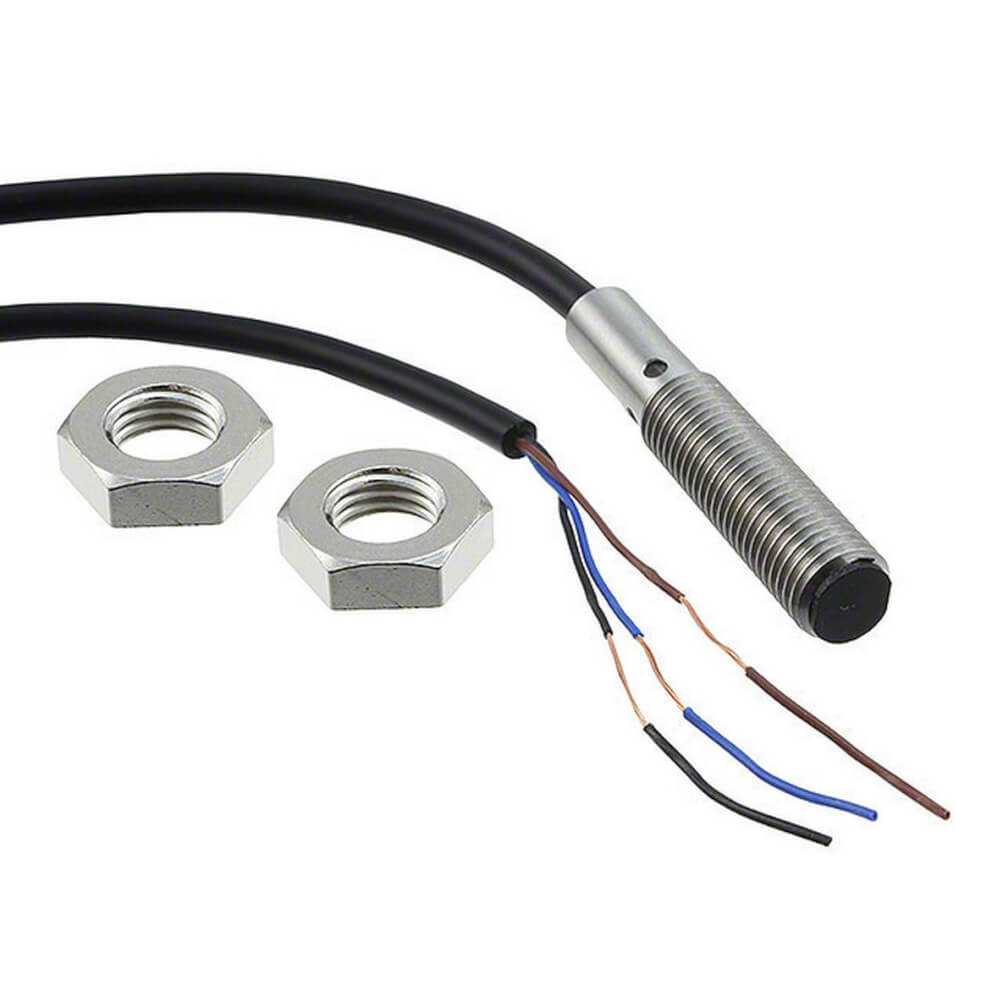
Omron E2B-S08KS02-WP-C1 5M Inductive Proximity Sensor
| Feature | Value |
|---|---|
| Product Type | Inductive Proximity Sensor |
| Series | E2B |
| Housing Size | M8 |
| Mounting Type | Flush |
| Sensing Distance | 2 mm |
| Output Type | NPN |
| Operation Mode | Normally Open |
| Connection Method | Cable |
| Cable Length | 5 m |
| Cable Specification | PVC |
| Housing Material | Stainless Steel |
| Overall Length | 42 mm |
| Thread Length | 27 mm |
| Protection Rating | IP67 |
The Omron E2B-S08KS02-WP-C1 5M Inductive Proximity Sensor is an M8 cylindrical sensor configured with an NPN normally open output. It is intended for control systems that use sinking output logic and require compact non-contact detection of metallic objects.
The Omron E2B-S08KS02-WP-C1 5M Inductive Proximity Sensor combines a 2 mm sensing distance, flush mounting structure, stainless steel housing, and 5 m PVC cable. This configuration is practical for machines where sensors must be positioned close to actuators, tooling, or moving metal parts.
Technical Description
The sensor detects conductive targets without physical contact. Its NPN normally open output changes state when a metallic object enters the sensing range. This behavior is used by machine controllers to confirm part presence, stroke completion, mechanical alignment, or carrier position.
The flush M8 body allows the sensor to be mounted into threaded metal brackets or machine plates. This can reduce exposure to mechanical impact while keeping the sensing face aligned with the target path.
Working Principle
Inside the sensor, an oscillator generates an electromagnetic field at the sensing face. When a metal target approaches, eddy currents are induced in the target. These currents draw energy from the field and modify the oscillator condition.
The internal circuit evaluates this change and switches the NPN output. The result is a repeatable electrical signal that can be processed by PLC inputs, controller terminals, or industrial I/O systems.
Usage Areas
- Metal target detection in compact machine sections
- Position monitoring in pneumatic actuator assemblies
- Workpiece confirmation in small fixtures
- Mechanical stop detection in indexing equipment
- Presence sensing in automated inspection stations
Industrial Applications
Fixture-Based Manufacturing
The sensor can confirm whether a metal workpiece is seated in a fixture before the next operation starts.
Robotic Loading Cells
It can provide target confirmation when a robot places a metal part into a nest or transfer location.
Compact Handling Modules
The M8 housing supports installation in dense assemblies where larger sensors would be difficult to mount.
Advantages
- NPN normally open output for compatible control circuits
- 5 m cable for flexible field wiring
- Compact M8 threaded housing
- Flush mounting for protected installation
- Stainless steel body for machine environments
- IP67 rating for dust and moisture protection
- Contactless sensing for reduced mechanical wear
Selection Considerations
The most important selection factors are output logic, sensing distance, target material, cable route, and mounting geometry. This model should be selected only where an NPN normally open output matches the control system design.
Omron E2B-S08KS02-WP-C1 5M For related alternatives, visit Omron sensor series.
Omron E2B-S08KS02-WP-C1 5M Frequently Asked Questions
What is the output type of this sensor?
It has an NPN output.
Is the output normally open or normally closed?
The output operation is normally open.
What is the sensing distance?
The rated sensing distance is 2 mm.
What cable length is supplied?
This model is supplied with a 5 m cable.
Can it detect non-metallic objects?
No. Inductive proximity sensors are designed for metallic targets.
Is it suitable for flush mounting?
Yes. It has a shielded flush mounting design.
What type of machinery can use this sensor?
It can be used in assembly machines, handling equipment, robotic cells, and fixture-based production systems.
What should be checked during commissioning?
Target alignment, wiring polarity, output logic, sensing distance, and mechanical mounting stability should be checked.