
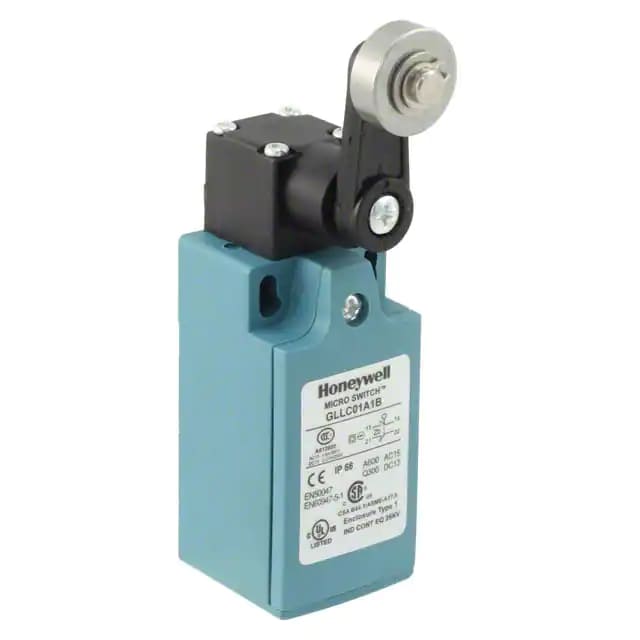
Honeywell ZLEC01B Industrial Limit Switch Explained
The Honeywell ZLEC01B industrial limit switch is a plunger-style mechanical switch used for position detection in industrial equipment. It is commonly referenced with a 1NO/1NC contact arrangement, plunger actuator, metal housing, and IP67 environmental protection. For engineers and maintenance teams who need a robust mechanical switch for repeated end-position detection, the Honeywell ZLEC01B limit switch remains a practical and highly understandable solution.
What Makes ZLEC01B Relevant?
Not every industrial sensing point requires a complex electronic sensor. In fact, many machine builders still prefer a mechanical limit switch where direct physical confirmation is useful. The Honeywell ZLEC01B plunger limit switch is relevant in exactly those situations. It can confirm whether a machine component has reached its target travel or whether a moving section is physically present at the required point.
This kind of sensing logic is common in indexing equipment, transfer lines, guarded access mechanisms, and machine tool support systems.
Technical Characteristics in Practical Terms
The Honeywell ZLEC01B industrial switch is frequently described as having 1NO/1NC contacts, which gives flexibility in control wiring. It is also associated with a plunger actuator, a popular choice where machine movement is direct and repeatable. Compared with a lever or roller style, a plunger can be the better option when the contact path is linear and tightly controlled.
Its IP67 rating is equally important. In industrial settings, sealing protects against dust and exposure to liquids that may occur during operation or washdown-adjacent maintenance. A switch may be mechanically sound but still fail early if environmental protection is overlooked.
Housing, Environment, and Reliability
The Honeywell ZLEC01B metal housing limit switch is designed for more demanding machine environments than lightweight commercial switches. A metal body can support rigidity, installation confidence, and resistance to routine physical handling. The switch is also commonly listed with industrial voltage and environmental attributes that reflect its machine-duty purpose.
From a maintenance standpoint, reliability is not only about the switching mechanism. It also depends on correct actuator alignment, proper cable or conduit protection, and prevention of excessive overtravel.
Where ZLEC01B Is Commonly Applied
The Honeywell ZLEC01B limit switch can be considered for machine travel limits, access door detection, slide or ram positioning, and repeated end-stop confirmation in controlled mechanical motion. It is especially useful where direct contact is acceptable and highly visible troubleshooting is valued.
Search demand remains solid for phrases such as plunger limit switch, IP67 industrial switch, and Honeywell limit switch because these products solve a real operational problem with minimal complexity.
For more information about Honeywell, reviewing additional industrial switch families can help when comparing plunger, lever, and roller-based actuation styles.
FAQ
What actuator type does Honeywell ZLEC01B use?
It is commonly identified as a plunger-style limit switch, suited to direct mechanical actuation.
Does ZLEC01B provide both NO and NC contacts?
Yes. It is commonly listed with a 1NO/1NC contact arrangement, which is useful in industrial control logic.
Is Honeywell ZLEC01B designed for harsh environments?
Its IP67 rating and metal housing indicate suitability for industrial environments where dust and moisture protection are important.
When is a plunger switch better than a lever switch?
A plunger switch is often better when the approach is straight and controlled, and where compact, direct actuation is desired.
What should installers pay attention to?
They should verify alignment, prevent excessive overtravel, protect wiring or conduit, and confirm switching repeatability under actual machine speed and load.
Why do many factories still use mechanical limit switches?
Because they are simple, dependable, easy to diagnose, and well suited to many position-detection tasks without adding unnecessary electronic complexity.