
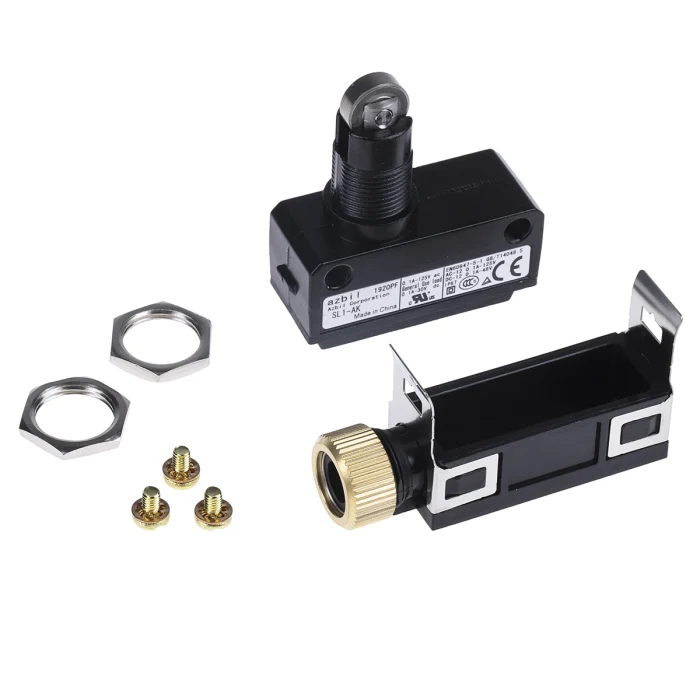
Honeywell SL1-EK Limit Switch Overview for Compact Roller Plunger Applications
The Honeywell SL1-EK limit switch is part of the SL1 compact limit switch family and is designed for installations where sealed construction, compact size, and reliable snap-action switching are required. As a Honeywell SL1-EK limit switch, this model is commonly associated with a top roller plunger actuator and SPDT contact arrangement, making it useful in machine designs where repeatable motion must be detected in a controlled and space-conscious way.
The SL1 family is often chosen for compact equipment because it offers a balance between small footprint and industrial durability. That is especially important in machinery where full-size enclosed limit switches may be physically too large. The Honeywell SL1-EK limit switch fits into that design logic by giving engineers a more compact electromechanical solution without abandoning serviceable switching architecture.
Technical Value of the Honeywell SL1-EK Limit Switch
One of the most useful aspects of the Honeywell SL1-EK limit switch is its roller plunger actuator. In real machine environments, roller plunger designs can help reduce friction and improve mechanical interaction with moving surfaces, cams, or guided travel mechanisms. This can support smoother actuation and more consistent switching behavior over repeated cycles.
The broader SL1 series is described by Honeywell as sealed, sensitive, and long-life, with compact dimensions suited to machinery miniaturization. That family-level positioning helps explain why product codes such as the Honeywell SL1-EK limit switch are commonly searched by design engineers and maintenance teams. When a machine is built around a compact actuator geometry, exact code matching becomes important.
Where the Honeywell SL1-EK Limit Switch Works Best
A Honeywell SL1-EK limit switch is well suited to packaging equipment, automation assemblies, compact transfer mechanisms, door or flap detection systems, and imported machinery requiring exact-format replacement parts. Because the actuator is designed around rolling contact, it can be a practical choice in repetitive motion systems where direct sliding impact would be less desirable.
It also supports the kind of engineering decision-making that values proven components. Many users still prefer compact electromechanical limit switches because they are easy to integrate, easy to diagnose, and familiar across a wide range of industrial platforms. That makes the Honeywell SL1-EK limit switch particularly relevant in mixed fleets where standardization and maintainability matter.
For additional background and related product-family information, visit more information about Honeywell.
Why Searchers Look for the Honeywell SL1-EK Limit Switch
Searches for the Honeywell SL1-EK limit switch are usually exact-intent technical searches rather than general browsing. Users want to confirm actuator style, contact format, environmental sealing, and installation fit. In industrial procurement, a product code like this often represents a real machine requirement, especially when imported or compact equipment depends on a very specific switch profile.
That is why exact-code documentation matters. A generic article about compact limit switches is not enough when the installer needs to know whether the roller plunger format and sealed body will align with an existing assembly. The Honeywell SL1-EK limit switch remains valuable because it solves that type of precise requirement.
FAQ: Honeywell SL1-EK Limit Switch
What kind of actuator does the SL1-EK use?
The Honeywell SL1-EK limit switch is commonly identified with a top roller plunger actuator, which supports smoother actuation against moving machine surfaces.
What type of applications suit the SL1-EK limit switch?
It is well suited to compact industrial machinery, travel detection, positioning tasks, and replacement projects where a small sealed switch body is required.
Why is the SL1 series popular in compact machine designs?
Because the SL1 family is designed to be sealed, durable, and space-efficient, making it attractive for miniaturized machinery and tighter installation zones.
Is the SL1-EK limit switch mainly for new builds or replacements?
It can be relevant for both, but exact-code searches often come from replacement needs where actuator shape and physical fit are critical.
Why would an engineer choose a roller plunger switch?
A roller plunger can reduce friction during mechanical engagement and offer more controlled movement in repetitive industrial actuation points.