
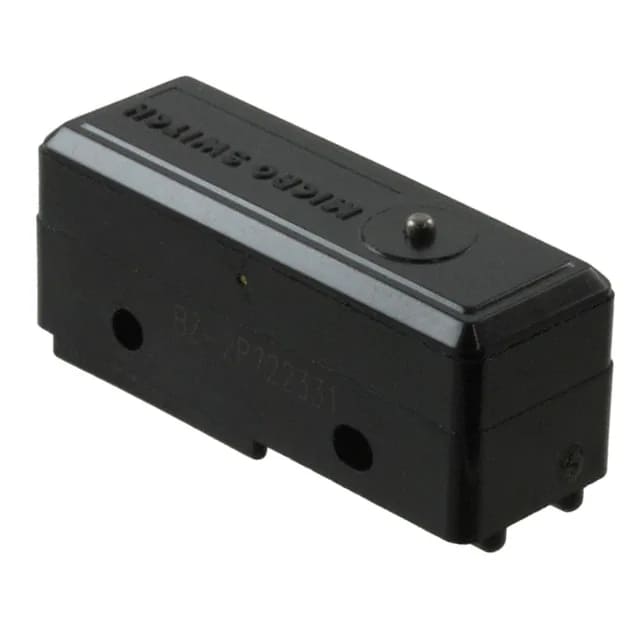
Honeywell BZ-2R722331 Basic Switch: Technical Details, Design Benefits, and Industrial Relevance
The Honeywell BZ-2R722331 basic switch belongs to Honeywell’s MICRO SWITCH BZ Series, a long-established platform known for precision snap-action performance, dependable repeatability, and broad industrial use. When engineers search for a Honeywell BZ-2R722331 basic switch, they are usually looking for a premium large basic switch that offers a pin plunger actuator, SPDT circuitry, and stable switching behavior in applications where mechanical accuracy matters.
What Is the Honeywell BZ-2R722331 Basic Switch?
The Honeywell BZ-2R722331 basic switch is commonly identified as a premium large snap-action switch with a pin plunger actuator. Technical listings describe it as an SPDT switch with gold contacts and a rating around 1 A at 125 Vac in the referenced configuration. This combination makes it useful in low-current precision signaling applications where clean switching and repeatable actuation are important.
The BZ Series is well regarded because it was built for accuracy, reliability, and long service life. Honeywell’s official BZ Series documentation notes that the internal flat-spring design supports precise switch characteristics and can be suitable for applications requiring sensitive differential travel and dependable actuation across repeated cycles.
Core Technical Features
For the Honeywell BZ-2R722331 basic switch, distributor and datasheet references point to these defining characteristics: SPDT circuitry, pin plunger actuator, premium large basic switch construction, and gold contact configuration. The switch is also listed with solder or similar compact termination formats depending on catalog reference. In many control systems, this style of switch is chosen when the mechanical input is direct and linear, making the pin plunger a straightforward solution for motion or position confirmation.
Gold contacts are especially relevant in low-level switching environments. In practical terms, that matters when signal integrity is more important than high current handling. Engineers in instrumentation, control subassemblies, and specialized machine interfaces often look for this type of contact arrangement because it supports reliable switching of lighter electrical loads.
Where the Honeywell BZ-2R722331 Basic Switch Fits Best
The Honeywell BZ-2R722331 basic switch is well suited to equipment that requires precise position sensing, end-of-stroke confirmation, manual operator interface detection, or compact electromechanical feedback. It can be found in industrial assemblies, control cabinets, specialty automation devices, and OEM equipment where a premium basic switch is preferred over a lower-grade alternative.
One reason the Honeywell BZ-2R722331 basic switch continues to attract attention is that premium basic switches often solve small but important design problems. A switch of this type can help confirm that a door is closed, a cam has reached a position, a mechanism has reset, or a linkage has completed its travel. In modern systems, those signals may feed PLC inputs, safety logic, or monitoring functions.
Why the BZ Series Still Matters
The Honeywell BZ Series remains relevant because switch performance is about more than simply opening and closing a circuit. Designers care about operating consistency, repeatability, lifecycle confidence, actuator feel, and tolerance control. Honeywell’s BZ family has a strong reputation in these areas. That matters in industrial engineering because even small deviations in switch behavior can lead to nuisance faults, inconsistent machine timing, or difficult maintenance diagnostics.
The Honeywell BZ-2R722331 basic switch is particularly interesting for projects that need a pin plunger switch with dependable motion transfer and controlled snap-action response. In a market where generic replacements are easy to find, many engineering teams still prefer original Honeywell switch platforms when performance consistency is part of the specification.
Selection and Maintenance Notes
When selecting the Honeywell BZ-2R722331 basic switch, users should verify actuator interface geometry, operating force, allowable current, contact material suitability, and terminal style. As with any snap-action switch, installation quality affects performance. Poor alignment, excessive side loading, or unsuitable electrical loading can reduce the expected service quality of the switch in the field.
For more information about Honeywell, reviewing the wider BZ Series family can help identify whether this exact configuration is the right fit or whether another actuator and terminal arrangement from the same series is better suited to the application.
FAQ
What type of switch is the Honeywell BZ-2R722331 basic switch?
It is a premium large snap-action basic switch from Honeywell’s MICRO SWITCH BZ Series. It is commonly listed with SPDT circuitry and a pin plunger actuator.
Why are gold contacts important in the Honeywell BZ-2R722331 basic switch?
Gold contacts are valuable in low-level switching applications because they can help support more reliable electrical contact in signal-oriented circuits. This makes the switch suitable for precision sensing and control tasks rather than only high-current power switching.
Is the Honeywell BZ-2R722331 basic switch used in industrial equipment?
Yes. It is well suited to OEM machinery, control systems, precision mechanisms, and industrial subassemblies where compact but dependable electromechanical feedback is required.
What does SPDT mean for the Honeywell BZ-2R722331 basic switch?
SPDT means single pole double throw. In practical use, it allows one common connection to switch between two output states, which is useful for monitoring, control logic, and machine status feedback.
How should the Honeywell BZ-2R722331 basic switch be selected?
Selection should be based on actuator style, electrical load, contact material, termination format, mounting compatibility, and the mechanical motion it will detect. Matching those details to the application is the key to reliable long-term performance.