
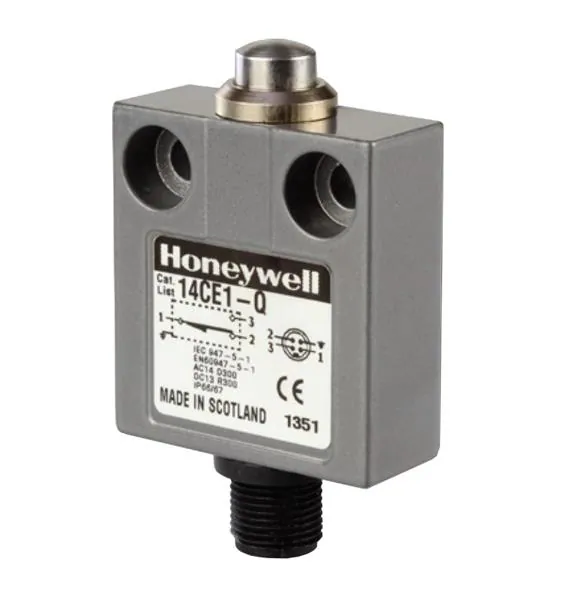
Honeywell 14CE18-6 Limit Switch: A Practical Technical Overview
The Honeywell 14CE18-6 limit switch is an enclosed industrial switch designed for machine position detection, end-of-travel confirmation, and repeatable mechanical actuation in compact control systems. As a Honeywell 14CE18-6 limit switch, it is typically selected where engineers need a sealed form factor, dependable switching, and a compact device that can still tolerate real factory conditions.
What Type of Product Is the Honeywell 14CE18-6?
The Honeywell 14CE18-6 enclosed basic switch belongs to Honeywell’s compact limit switch portfolio. Published part data shows an enclosed design with SPDT switching, cable termination, and an IP67 environmental rating. Core electrical and mechanical references also list 5 A current capability, 240 VAC voltage rating, operating temperatures from 0°C to 70°C, and a defined operating force and travel profile, which is important for repeatable actuation in machine assemblies.
Where the Honeywell 14CE18-6 Limit Switch Is Commonly Used
In real installations, the Honeywell 14CE18-6 limit switch is well suited to packaging equipment, conveyor sections, access mechanisms, guarded panels, and compact OEM machinery. It is especially useful when the designer wants a clear mechanical switching point rather than relying on a non-contact sensor. That matters in applications where tactile confirmation and physical movement are part of the safety or process logic.
Why Engineers Choose This Honeywell Enclosed Basic Switch
A strong advantage of the Honeywell 14CE18-6 enclosed basic switch is its balance between footprint and durability. IP67 protection helps the switch resist dust and temporary moisture exposure, while the enclosed construction supports cleaner integration in industrial cabinets and machine frames. The SPDT contact arrangement also gives controls engineers flexibility for normally open and normally closed logic paths in one device.
Another reason this model remains relevant is service predictability. A switch with a clearly defined operating force and travel range is easier to specify, easier to replace, and easier to validate during maintenance planning. That can reduce commissioning delays in retrofit or rebuild projects.
Installation and Application Considerations
When specifying the Honeywell 14CE18-6 limit switch, the most important checks are actuator alignment, cable routing, switching load, and environmental sealing at the connection points. Even a robust switch performs best when the actuation path is straight, repeatable, and free from side loading. Engineers should also confirm the electrical load profile, especially if the switch is interfacing with inductive control circuits or relay-heavy panels.
For more information about Honeywell, it is worth reviewing the broader Honeywell switch portfolio to compare enclosed compact models with heavier-duty LS or HDLS alternatives.
FAQ
What is the Honeywell 14CE18-6 used for?
It is primarily used for end-of-travel detection, mechanical position monitoring, and control input confirmation in compact industrial machinery.
Is the Honeywell 14CE18-6 a limit switch?
Yes. It is an enclosed basic switch used as a compact industrial limit switch for machine motion and position feedback applications.
Does the Honeywell 14CE18-6 support harsh environments?
It is designed with an enclosed body and published IP67 sealing, which makes it suitable for many industrial environments where dust and moisture resistance are important.
Why does SPDT matter on the Honeywell 14CE18-6 limit switch?
SPDT gives one changeover contact arrangement, allowing greater control logic flexibility than a simple single-state output. That is useful in alarm, interlock, and status monitoring circuits.
What should be checked before replacing a Honeywell 14CE18-6 enclosed basic switch?
Verify the actuator geometry, wiring method, environmental rating, contact arrangement, and electrical load. A switch can look similar physically but still differ in travel, force, or circuit behavior.