
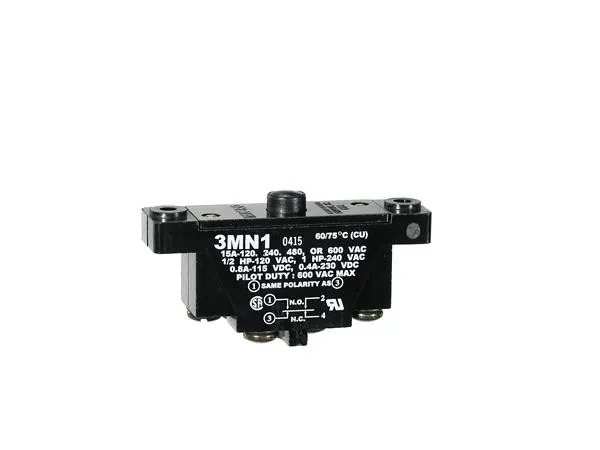
Honeywell 3MN1 Basic Switch Specifications and Industrial Use Guide
The Honeywell 3MN1 basic switch is a long-established industrial switching component used in applications where dependable mechanical actuation matters more than unnecessary complexity. As a Honeywell 3MN1 basic switch, this model is associated with the MN series and is configured as a chassis-mount snap-action switch with a round pin plunger actuator and screw terminal connection. It is listed with SPDT (DB/DM) circuitry, a current rating of 15 A AC and 800 mA DC, and voltage ratings of 120 V AC and 115 V DC.
That combination makes the Honeywell 3MN1 basic switch relevant for machine builders, panel integrators, and maintenance teams looking for a robust mechanical switching solution in industrial environments. The pin plunger format is especially useful where direct linear actuation is preferred. In those applications, a moving part can push against the plunger with clear, repeatable travel, helping to create a predictable electrical response.
Core Technical Features of the Honeywell 3MN1 Basic Switch
The Honeywell 3MN1 basic switch uses a round pin plunger actuator rather than a lever or roller design. This matters because plunger-based switches are often chosen where the available actuation path is compact and direct. Technical listings also show an operating force range of 340 gf to 567 gf and a release force of 170 gf. Those figures suggest a deliberate actuation profile suited to machinery where a firmer mechanical input is acceptable or even desirable.
The Honeywell 3MN1 basic switch also shows mechanical life up to 10,000,000 cycles, which is one of the reasons users continue to search for this exact code. In industrial decision-making, long cycle life is not just a marketing point. It can influence maintenance intervals, spare-parts planning, and total service cost over time.
Why the Honeywell 3MN1 Basic Switch Still Matters
There are many environments where a classic electromechanical switch remains the most sensible solution. The Honeywell 3MN1 basic switch fits those scenarios well. It can support position sensing, end-of-travel confirmation, sequence control, or status monitoring in industrial machines where straightforward contact-based switching is still preferred. Unlike more complex sensing technologies, a basic switch like this can often be inspected, tested, and replaced with less downtime and less specialist support.
Its chassis-mount construction and screw terminal connection also support serviceability. That is valuable in legacy systems and retrofit projects, where keeping the same mounting and wiring style can reduce labor time. If you want to review more product-family context, see Honeywell resources here.
Industrial Relevance of the Honeywell 3MN1 Basic Switch
Search demand for Honeywell 3MN1 basic switch content usually comes from exact-match replacement searches, engineering documentation reviews, or OEM maintenance schedules. In those cases, users are typically validating whether the part’s actuator, force range, electrical rating, and mounting style fit an existing machine design. Because the Honeywell 3MN1 basic switch is tied to a specific mechanical behavior, exact code accuracy becomes very important.
Another reason for continued interest is temperature capability. This switch is listed for operation from -55°C to 85°C, which broadens its relevance in industrial and equipment environments where ambient conditions are more demanding than normal room-temperature control panels. That gives designers and technicians additional confidence when using it in harsher settings.
FAQ: Honeywell 3MN1 Basic Switch
What type of switch is the Honeywell 3MN1?
The Honeywell 3MN1 is a basic snap-action switch in the MN series. It uses a round pin plunger actuator, chassis mounting, and screw terminal connection.
What electrical ratings are associated with the Honeywell 3MN1 basic switch?
Technical listings show 15 A AC and 800 mA DC current ratings, together with 120 V AC and 115 V DC voltage ratings. These details are critical when checking application compatibility.
Why do engineers use a pin plunger switch like the Honeywell 3MN1?
A pin plunger actuator is ideal when the motion path is direct and linear. It allows a moving component to press straight into the switch for a clear, repeatable actuation event.
Is the Honeywell 3MN1 suitable for heavy-use industrial equipment?
It can be a strong option for repetitive mechanical switching because distributor data lists mechanical life up to 10,000,000 cycles. That makes it attractive in systems where long service intervals matter.
What makes the 3MN1 basic switch relevant for replacement searches?
Its actuator type, force range, wiring style, and mounting format all affect installation. In industrial maintenance, those exact details often matter more than the broader product family name.