
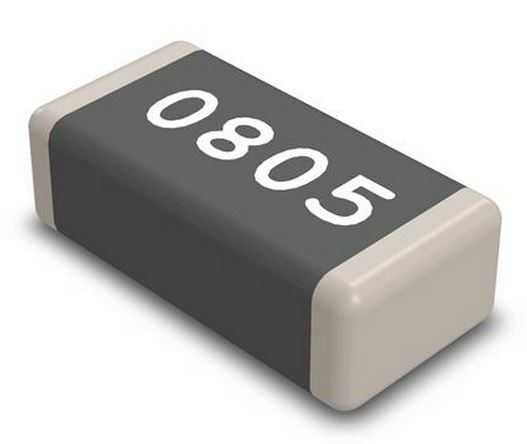
Honeywell 173-501APC-301 500 Ohm NTC Thermistor Guide
The Honeywell 173-501APC-301 thermistor is a compact NTC temperature sensor designed for PCB-level thermal sensing in applications where size, response consistency, and assembly compatibility matter. Public product data identifies this part as a 500 Ohm NTC thermistor in an 0805 surface-mount package, making it a specialized option for circuits that are designed around lower nominal resistance values.
What Is the Honeywell 173-501APC-301?
The Honeywell 173-501APC-301 NTC thermistor belongs to Honeywell’s 173 Series of end-banded surface-mount thermistors. It is specified as a 500 Ohm thermistor at 25°C with ±1% tolerance, which gives it a tighter resistance window than many standard thermistor options. Distributor listings also identify a B25/100 value of 3250K, which is useful when engineers are comparing thermal curves across sensor families.
In plain terms, this means the Honeywell 173-501APC-301 temperature sensor is a compact board-mount component whose resistance changes with temperature. That predictable resistance shift allows designers to track heat, stabilize circuits, or build compensation behavior directly into the electronics.
Important Technical Features
- Product type: Honeywell NTC thermistor
- Part number: 173-501APC-301
- Nominal resistance: 500 Ohm at 25°C
- Resistance tolerance: ±1%
- B25/100: 3250K
- Package: 0805 (2012 Metric)
- Mounting: Surface mount
- Operating temperature range: -60°C to 125°C
The 173 Series documentation also indicates that this family is intended for automated assembly on rigid or flexible PCBs, includes solder-plated nickel barrier terminations, and is built to suit high-density board layouts. That makes the Honeywell 173-501APC-301 thermistor practical for volume manufacturing as well as compact product design.
Why a 500 Ohm NTC Thermistor Matters
While 10k thermistors are common, lower-resistance devices like the Honeywell 173-501APC-301 500 Ohm thermistor are useful in circuits designed around a specific impedance range, response profile, or calibration method. In some designs, a lower nominal resistance can be advantageous for interface matching, analog measurement strategy, or thermal compensation behavior.
This is why product selection should never be based on package size alone. The Honeywell 173-501APC-301 temperature sensor is best evaluated through its resistance value, tolerance, curve behavior, and compatibility with the rest of the sensing network.
Typical Applications
Applications for a Honeywell 173-501APC-301 NTC thermistor can include compact industrial electronics, control boards, instrumentation, thermal compensation networks, and embedded circuits that need board-level temperature tracking. Because it is an 0805 Honeywell thermistor, it supports compact layouts and automated placement processes.
For teams reviewing component options, this part stands out most where tight tolerance and a 500 Ohm NTC thermistor profile are more useful than a generic high-resistance device. For more information about Honeywell, it is worth comparing resistance curves and target temperature windows before final component selection.
FAQ
What is the Honeywell 173-501APC-301 used for?
The Honeywell 173-501APC-301 is used for temperature sensing and thermal compensation on printed circuit boards. It is especially relevant in compact electronics where a small SMD footprint and predictable NTC behavior are required.
How is the Honeywell 173-501APC-301 different from standard 10k thermistors?
The main difference is its nominal resistance. This model is a 500 Ohm thermistor at 25°C, not a 10k part. That changes how it behaves in a circuit and affects divider design, calibration, and signal interpretation.
Why does the ±1% tolerance matter?
A tighter tolerance can improve consistency from unit to unit, which is helpful in circuits that depend on repeatable measurement behavior. The Honeywell 173-501APC-301 thermistor is therefore relevant where precision matters more than broad general-purpose use.
Is the Honeywell 173-501APC-301 suitable for automated assembly?
Yes. As part of the 173 Series, it is designed for surface mounting and is aligned with automated PCB assembly workflows. That makes it easier to use in repeatable manufacturing environments.
What should engineers verify before choosing this thermistor?
Engineers should confirm the resistance value, curve fit, temperature range, tolerance needs, ADC or analog interface design, and sourcing status. A thermistor that is correct electrically but mismatched to the system curve can still create design problems later.