
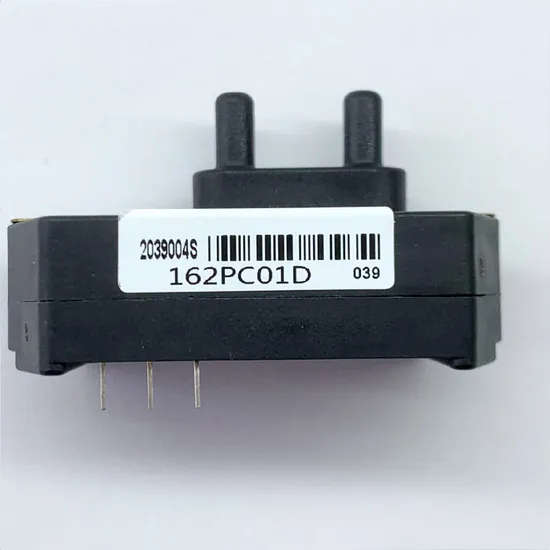
Honeywell 162PC01D Differential Pressure Sensor: Technical Guide and Applications
The Honeywell 162PC01D differential pressure sensor is a low-pressure sensing component designed for applications that need stable analog output and accurate response in compact electronic systems. When engineers search for a Honeywell 162PC01D pressure sensor, they are usually looking for a board-mount solution that can measure low differential pressure with good repeatability and straightforward electrical integration. In that context, the 162PC01D remains a recognizable part in instrumentation, medical, and environmental monitoring discussions.
What Makes the Honeywell 162PC01D Distinct?
The Honeywell 162PC01D differential pressure sensor is commonly associated with the 160PC series and is broadly described as an amplified, temperature-compensated low-pressure transducer. Available technical references commonly identify it as a differential pressure sensor with an operating pressure of 1 psi, a dual-port configuration, and an analog voltage output. It is also often listed with a 6 V to 16 V supply range and an output in the neighborhood of 1 V to 7 V, which supports direct integration into analog measurement systems.
Why Differential Pressure Sensing Matters
Low-pressure differential measurement is important in systems where even small pressure changes affect process quality or device performance. That includes airflow monitoring, filter condition checks, respiratory and medical equipment support functions, and laboratory instrumentation. In these use cases, the Honeywell 162PC01D pressure sensor is valuable because it is designed for precise low-range pressure detection rather than high-pressure industrial switching.
Practical Integration Benefits
Because the Honeywell 162PC01D differential pressure sensor is widely referenced as a board-mount device with a compact package, it fits projects where space efficiency matters. Its analog output makes it suitable for systems that use signal conditioning, microcontroller-based monitoring, or threshold analysis through external electronics. Engineers also appreciate that product-specific references reduce ambiguity during sourcing, validation, and replacement planning.
Where the Honeywell 162PC01D Is Used
Typical application discussions around the Honeywell 162PC01D pressure sensor include medical devices, environmental monitoring, airflow measurement, pressure verification, and compact embedded systems. It is especially relevant in designs where a clean analog representation of differential pressure is needed rather than a simple on/off signal.
For more information about Honeywell sensing technologies and related pressure solutions, reviewing the wider sensor portfolio can help identify compatible alternatives or adjacent product families.
FAQ
What type of sensor is the Honeywell 162PC01D?
The Honeywell 162PC01D is generally identified as a differential pressure sensor intended for low-pressure measurement with an amplified analog output.
What pressure range is associated with the Honeywell 162PC01D differential pressure sensor?
Technical listings commonly describe it as a 1 psi differential pressure sensor, which places it in the low-pressure measurement category rather than high-pressure industrial control.
What kind of output does the 162PC01D provide?
The Honeywell 162PC01D pressure sensor is typically associated with an analog voltage output, often referenced around 1 V to 7 V depending on supply and application conditions.
What supply voltage is used with 162PC01D?
It is commonly listed with a 6 V to 16 V supply range, making it suitable for a variety of embedded and instrument-level designs.
What are common applications for the 162PC01D?
Typical use cases include airflow monitoring, medical and laboratory equipment, environmental sensing, and systems that need accurate low differential pressure feedback.
Why is the exact phrase 162PC01D differential pressure sensor helpful in sourcing?
Using the full product phrase helps separate this part from other Honeywell pressure devices, especially pressure switches and higher-range transducers that serve very different design purposes.